Back
BackCalculus I Practice Test Study Guidance
Study Guide - Smart Notes
 Tailored notes based on your materials, expanded with key definitions, examples, and context.
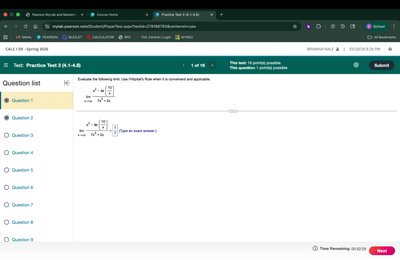
Q1. Evaluate the following limit using L'Hôpital's Rule when it is convenient and applicable:
Background
Topic: Limits and L'Hôpital's Rule
This question tests your ability to evaluate limits that result in indeterminate forms (like ) and to apply L'Hôpital's Rule, which involves differentiating the numerator and denominator.
Key Terms and Formulas:
L'Hôpital's Rule: If results in or , then (if the limit on the right exists).
Indeterminate Form: A limit that initially gives or .
Step-by-Step Guidance
First, substitute into the numerator and denominator to check if you get an indeterminate form.
If you get , confirm that L'Hôpital's Rule applies.
Differentiate the numerator and the denominator with respect to .
Set up the new limit using the derivatives: .
Try solving on your own before revealing the answer!
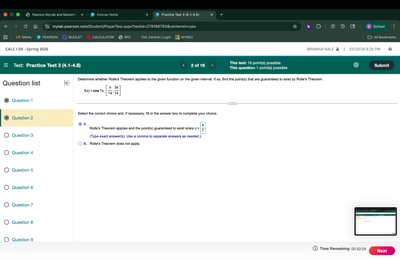
Q2. Determine whether Rolle's Theorem applies to the given function on the given interval. If so, find the point(s) that are guaranteed to exist by Rolle's Theorem:
on
Background
Topic: Rolle's Theorem
This question tests your understanding of the conditions for Rolle's Theorem and your ability to check if a function meets those conditions on a closed interval.
Key Terms and Formulas:
Rolle's Theorem: If is continuous on , differentiable on , and , then there exists at least one in such that .
Step-by-Step Guidance
Check if is continuous on and differentiable on .
Evaluate and to see if .
If all conditions are met, find such that .
Try solving on your own before revealing the answer!
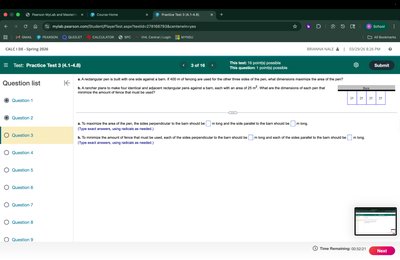
Q3. A rectangular pen is built with one side against a barn. If 48 ft of fencing are used for the other three sides of the pen, what dimensions maximize the area?
Background
Topic: Optimization (Applications of Derivatives)
This question tests your ability to set up and solve an optimization problem using calculus, specifically maximizing area with a constraint on perimeter.
Key Terms and Formulas:
Area of a rectangle:
Perimeter constraint: (since one side is against the barn)
Step-by-Step Guidance
Let be the length parallel to the barn and be the width (perpendicular to the barn).
Write the constraint equation: .
Solve for one variable in terms of the other using the constraint.
Substitute into the area formula to get as a function of one variable.
Find the critical points by taking the derivative and setting it to zero.
Try solving on your own before revealing the answer!
Q4. Determine the intervals on which the following function is concave up or concave down. Select the correct choice and, if necessary, fill in the answer boxes to complete your choice:
Background
Topic: Concavity and Inflection Points
This question tests your ability to use the second derivative to determine where a function is concave up or down and to find inflection points.
Key Terms and Formulas:
Second Derivative Test: means concave up; means concave down.
Inflection Point: Where changes sign.
Step-by-Step Guidance
Find the first derivative and then the second derivative .
Solve to find possible inflection points.
Test intervals between these points to determine where is positive or negative.
Try solving on your own before revealing the answer!
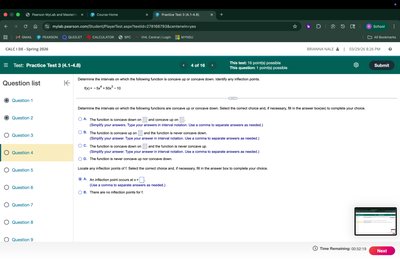
Q5. Determine the absolute maximum/minimum of the given interval for on
Background
Topic: Absolute Extrema on a Closed Interval
This question tests your ability to find the absolute maximum and minimum values of a function on a closed interval using critical points and endpoints.
Key Terms and Formulas:
Critical Points: Where or is undefined.
Absolute Extrema: Evaluate at critical points and endpoints, then compare values.
Step-by-Step Guidance
Find and solve to get critical points in .
Evaluate at each critical point and at the endpoints and .
Compare all values to determine the absolute maximum and minimum.
Try solving on your own before revealing the answer!
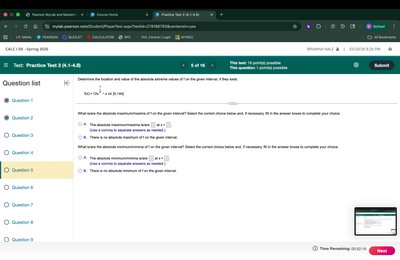
Q6. Use the graph to identify the points of the interval at which local and absolute extrema values exist.
Background
Topic: Extrema from Graphs
This question tests your ability to read a graph and identify where local and absolute maximum and minimum values occur.
Key Terms and Formulas:
Local Maximum/Minimum: Highest/lowest point in a small neighborhood.
Absolute Maximum/Minimum: Highest/lowest point on the entire interval.
Step-by-Step Guidance
Examine the graph for peaks (local maxima) and valleys (local minima).
Compare all values on the interval to determine the absolute maximum and minimum.
List the -values where these extrema occur.
Try solving on your own before revealing the answer!
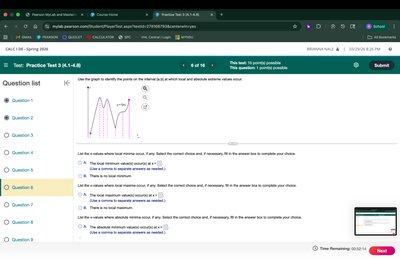
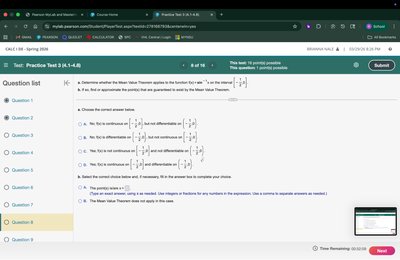
Q7. Determine whether the Mean Value Theorem applies to the function on the interval . If so, find the value(s) of that are guaranteed to exist by the Mean Value Theorem.
Background
Topic: Mean Value Theorem (MVT)
This question tests your understanding of the Mean Value Theorem and your ability to check if a function meets the necessary conditions on a closed interval.
Key Terms and Formulas:
Mean Value Theorem: If is continuous on and differentiable on , then there exists in such that .
Step-by-Step Guidance
Check if is continuous on and differentiable on .
If so, set up the equation .
Solve for in .
Try solving on your own before revealing the answer!
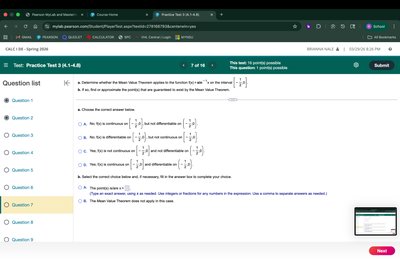
Q8. Determine whether the Mean Value Theorem applies to the function on the interval . If so, find the value(s) of that are guaranteed to exist by the Mean Value Theorem.
Background
Topic: Mean Value Theorem (MVT)
This question tests your ability to check the domain of a function and the conditions for the Mean Value Theorem.
Key Terms and Formulas:
Domain of :
Mean Value Theorem: Same as above.
Step-by-Step Guidance
Check if is defined and continuous on .
If not, explain why the Mean Value Theorem does not apply.
Try solving on your own before revealing the answer!
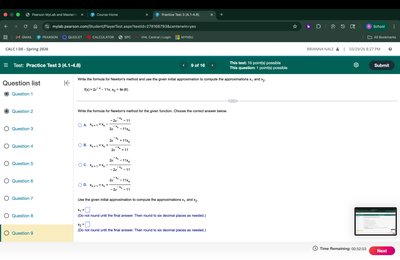
Q9. Write the formula for Newton's method and use the given initial approximation to compute the approximation, if any, for with .
Background
Topic: Newton's Method for Approximating Roots
This question tests your ability to use Newton's Method to approximate solutions to equations numerically.
Key Terms and Formulas:
Newton's Method:
Step-by-Step Guidance
Write and find .
Plug into the Newton's Method formula to find .
Set up the calculation for but do not compute the final value yet.
Try solving on your own before revealing the answer!
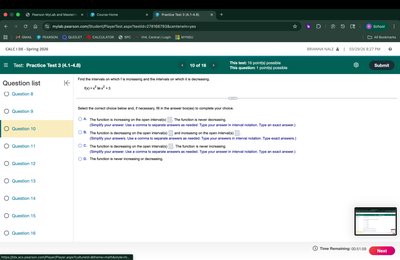
Q10. Find the intervals on which is increasing and the intervals on which it is decreasing.
Background
Topic: Increasing/Decreasing Functions
This question tests your ability to use the first derivative to determine where a function is increasing or decreasing.
Key Terms and Formulas:
First Derivative Test: means increasing; means decreasing.
Step-by-Step Guidance
Rewrite in simplest form and find .
Solve to find critical points.
Test intervals between critical points to determine where is positive or negative.
Try solving on your own before revealing the answer!
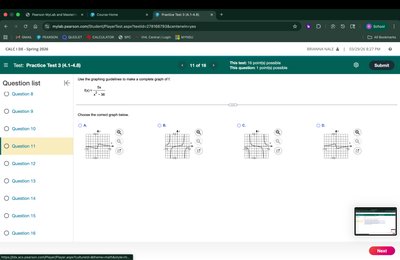
Q11. Use the graphing guidelines to make a complete graph of .
Background
Topic: Curve Sketching
This question tests your ability to analyze a function using calculus (critical points, inflection points, intercepts, end behavior) to sketch its graph.
Key Terms and Formulas:
Critical Points: Where
Inflection Points: Where
Intercepts: Where
Step-by-Step Guidance
Find and to locate critical and inflection points.
Find - and -intercepts.
Analyze end behavior as .
Combine all information to sketch the graph.
Try solving on your own before revealing the answer!
Q12. Write the equation of the line that represents the linear approximation to the following function at the given point. Use the linear approximation to estimate the given quantity:
at ; estimate
Background
Topic: Linear Approximation (Tangent Line Approximation)
This question tests your ability to use the tangent line at a point to approximate function values near that point.
Key Terms and Formulas:
Linear Approximation:
Step-by-Step Guidance
Find and at .
Write the linear approximation .
Plug into to estimate .
Try solving on your own before revealing the answer!
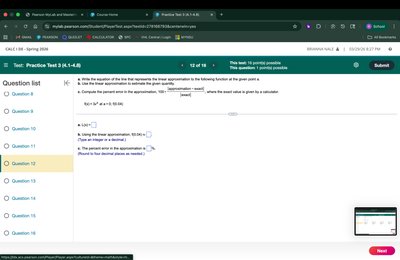
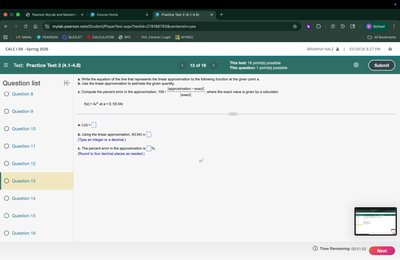
Q13. Write the equation of the line that represents the linear approximation to the following function at the given point. Use the linear approximation to estimate the given quantity:
at ; estimate
Background
Topic: Linear Approximation (Tangent Line Approximation)
This question tests your ability to use the tangent line at a point to approximate function values near that point.
Key Terms and Formulas:
Linear Approximation:
Step-by-Step Guidance
Find and at .
Write the linear approximation .
Plug into to estimate .
Try solving on your own before revealing the answer!
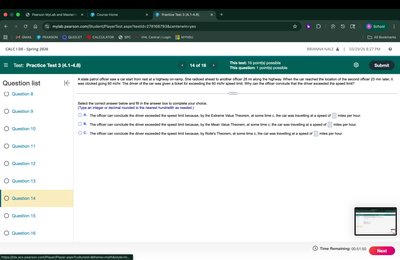
Q14. A state patrol officer uses a radar gun near a highway on-ramp. The officer could estimate a driver's speed by using the Mean Value Theorem. What can the officer conclude about the speed of the driver?
Background
Topic: Applications of the Mean Value Theorem
This question tests your understanding of how the Mean Value Theorem can be used in real-world scenarios to estimate average and instantaneous rates of change.
Key Terms and Formulas:
Mean Value Theorem: for some in
Step-by-Step Guidance
Understand that the Mean Value Theorem guarantees the existence of a point where the instantaneous rate equals the average rate over the interval.
Relate this to the context of measuring speed over a distance and time interval.
Conclude what the officer can infer about the driver's speed at some point.
Try solving on your own before revealing the answer!
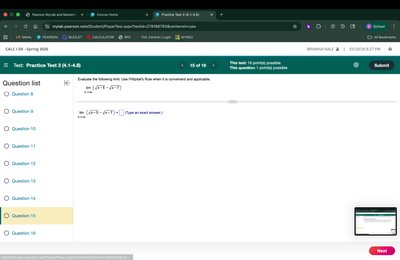
Q15. Evaluate the following limit using L'Hôpital's Rule when it is convenient and applicable:
Background
Topic: Limits and L'Hôpital's Rule
This question tests your ability to evaluate limits that result in indeterminate forms and to apply L'Hôpital's Rule.
Key Terms and Formulas:
L'Hôpital's Rule: If results in or , then (if the limit on the right exists).
Step-by-Step Guidance
Substitute into the numerator and denominator to check for an indeterminate form.
If you get , differentiate the numerator and denominator with respect to .
Set up the new limit using the derivatives: .
Try solving on your own before revealing the answer!
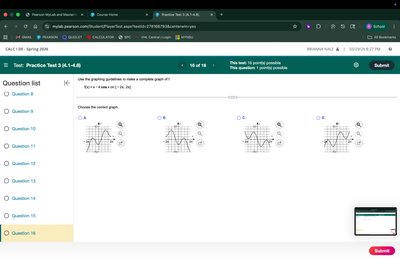
Q16. Use the graphing guidelines to make a complete graph of .
Background
Topic: Curve Sketching
This question tests your ability to analyze a function using calculus (critical points, inflection points, intercepts, end behavior) to sketch its graph.
Key Terms and Formulas:
Critical Points: Where
Inflection Points: Where
Intercepts: Where
Step-by-Step Guidance
Find and to locate critical and inflection points.
Find - and -intercepts.
Analyze end behavior as .
Combine all information to sketch the graph.
Try solving on your own before revealing the answer!