 Back
BackCalculus I Quiz Study Guide: Average Velocity and Limits
Study Guide - Smart Notes
 Tailored notes based on your materials, expanded with key definitions, examples, and context.
Q1. Find the average velocity of over the intervals:
(a)
(b)
(c)
(d)
Background
Topic: Average Velocity (Sec 2.1)
This question tests your understanding of how to compute the average velocity of a function over a given interval, which is foundational for the concept of derivatives.
Key Terms and Formulas
Average velocity:
: Position function
: Interval over which average velocity is calculated
Step-by-Step Guidance
Evaluate the function at the endpoints of each interval. For example, for , find and .
Use the formula for average velocity: for each interval.
For part (d), substitute and into , then use the formula .
Set up the expressions for each interval, but do not compute the final values yet.
Try solving on your own before revealing the answer!
Final Answer:
(a)
(b)
(c)
(d)
Each answer uses the average velocity formula and the values from the position function.
Q2. Find the average velocity of over the interval .
Background
Topic: Average Velocity (Sec 2.1)
This question tests your ability to apply the average velocity formula to a cubic function.
Key Terms and Formulas
Average velocity:
: Position function
Step-by-Step Guidance
Calculate and by substituting into the function.
Set up the average velocity formula: .
Write out the expressions for and , but do not compute the final value yet.
Try solving on your own before revealing the answer!
Final Answer:
The average velocity is calculated by plugging the values into the formula.
Q3. Find the average velocity of over the interval .
Background
Topic: Average Velocity (Sec 2.1)
This question tests your ability to apply the average velocity formula to a quadratic function.
Key Terms and Formulas
Average velocity:
Step-by-Step Guidance
Calculate and by substituting into the function.
Set up the average velocity formula: .
Write out the expressions for and , but do not compute the final value yet.
Try solving on your own before revealing the answer!
Final Answer:
The average velocity is calculated by plugging the values into the formula.
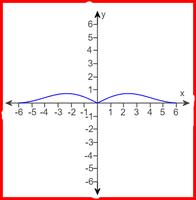
Q4. Use the graph of the given function to find .
Background
Topic: Limits of Functions (Sec 2.2)
This question tests your understanding of how to find the limit of a function as approaches a specific value using a graph.
Key Terms and Formulas
Limit:
Right-hand limit:
Left-hand limit:
Step-by-Step Guidance
Examine the graph as approaches $0$ from both sides.
Determine the value that approaches from the left () and from the right ().
If both sides approach the same value, the limit exists and equals that value.
Try solving on your own before revealing the answer!
Final Answer:
Both the left and right limits approach 0, so the limit exists and equals 0.
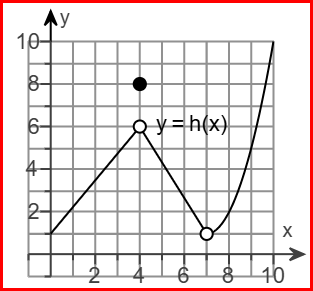
Q5. Use the graph of the given function to find:
(a)
(b)
(c)
(d)
(e)
Background
Topic: Limits and Function Values from Graphs (Sec 2.2)
This question tests your ability to read function values and limits from a graph, including cases where the function is undefined at a point.
Key Terms and Formulas
Function value:
Limit:
Step-by-Step Guidance
For each part, locate the relevant -value on the graph and determine the function value or limit.
For limits, check the value approached from both sides ( and ).
For function values, check if the point is filled (defined) or open (undefined).
Set up the answers based on the graph, but do not state the final values yet.
Try solving on your own before revealing the answer!
Final Answer:
(a)
(b)
(c) is undefined
(d)
(e)
Answers are based on the graph's points and the values approached from both sides.
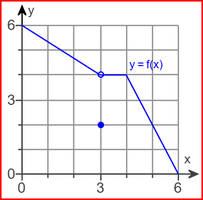
Q6. Use the graph of the given function to find:
(a)
(b)
(c)
(d)
Background
Topic: Limits and Function Values from Graphs (Sec 2.2)
This question tests your ability to read function values and limits from a graph.
Key Terms and Formulas
Function value:
Limit:
Step-by-Step Guidance
For each part, locate the relevant -value on the graph and determine the function value or limit.
For limits, check the value approached from both sides ( and ).
For function values, check if the point is filled (defined) or open (undefined).
Set up the answers based on the graph, but do not state the final values yet.
Try solving on your own before revealing the answer!
Final Answer:
(a)
(b)
(c)
(d)
Answers are based on the graph's points and the values approached from both sides.
Q7. Find the following limit or state that it does not exist:
Background
Topic: Evaluating Limits Algebraically (Sec 2.3)
This question tests your ability to evaluate limits by direct substitution for polynomial functions.
Key Terms and Formulas
Limit:
Direct substitution: Substitute into the function
Step-by-Step Guidance
Substitute directly into the function .
Write out the expression for the limit, but do not compute the final value yet.
Try solving on your own before revealing the answer!
Final Answer:
Direct substitution gives the limit value.
Q8. Find the following limit or state that it does not exist:
Background
Topic: Evaluating Limits Algebraically (Sec 2.3)
This question tests your ability to evaluate limits by direct substitution for polynomial functions.
Key Terms and Formulas
Limit:
Direct substitution: Substitute into the function
Step-by-Step Guidance
Substitute directly into the function .
Write out the expression for the limit, but do not compute the final value yet.
Try solving on your own before revealing the answer!
Final Answer:
Direct substitution gives the limit value.
Q9. Find the following limit or state that it does not exist:
Background
Topic: Limits Involving Radicals (Sec 2.3)
This question tests your ability to evaluate limits involving radicals, often requiring algebraic manipulation such as multiplying by the conjugate.
Key Terms and Formulas
Limit:
Conjugate:
Step-by-Step Guidance
Notice that direct substitution gives an indeterminate form .
Multiply numerator and denominator by the conjugate of the denominator: .
Simplify the resulting expression and set up the new limit, but do not compute the final value yet.
Try solving on your own before revealing the answer!
Final Answer:
Multiplying by the conjugate and simplifying allows you to evaluate the limit.
Q10. Find the following limit or state that it does not exist:
Background
Topic: Limits Involving Radicals (Sec 2.3)
This question tests your ability to evaluate limits involving radicals, often requiring algebraic manipulation such as multiplying by the conjugate.
Key Terms and Formulas
Limit:
Conjugate:
Step-by-Step Guidance
Notice that direct substitution gives an indeterminate form .
Multiply numerator and denominator by the conjugate of the numerator: .
Simplify the resulting expression and set up the new limit, but do not compute the final value yet.
Try solving on your own before revealing the answer!
Final Answer:
Multiplying by the conjugate and simplifying allows you to evaluate the limit.
