 Back
BackCalculus II Review: Arc Length, Surface Area, Physical Applications, and Exponential Models
Study Guide - Smart Notes
 Tailored notes based on your materials, expanded with key definitions, examples, and context.
Q1. Find the arc length of the curve y = -8x - 3 on [−2, 6].
Background
Topic: Arc Length of a Curve
This question tests your ability to compute the arc length of a function over a given interval using calculus.
Key Terms and Formulas
Arc Length Formula: For a curve from to , the arc length is given by:
Step-by-Step Guidance
Find for .
Square and add 1 inside the square root.
Set up the definite integral for arc length from to using the formula above.
Simplify the integrand as much as possible before integrating.
Try solving on your own before revealing the answer!
Q2. Find the arc length of on [1, 2].
Background
Topic: Arc Length of a Curve
This question asks you to apply the arc length formula to a function involving a square root.
Key Terms and Formulas
Step-by-Step Guidance
Compute for .
Square and add 1.
Set up the definite integral for arc length from to .
Simplify the integrand as much as possible.
Try solving on your own before revealing the answer!
Q3. Find the arc length of on [1, 9].
Background
Topic: Arc Length of a Curve
This problem involves powers of and requires careful differentiation and algebraic manipulation.
Key Terms and Formulas
Step-by-Step Guidance
Find for .
Square and add 1.
Set up the definite integral for arc length from to .
Simplify the integrand as much as possible before integrating.
Try solving on your own before revealing the answer!
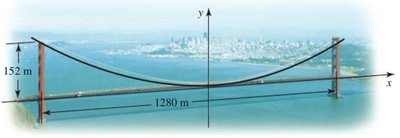
Q4. Golden Gate cables: Approximate the length of the cables that stretch between the tops of the two towers. (Setup integral only)
Background
Topic: Arc Length of a Parabola (Applied Problem)
This question models the cable of a suspension bridge as a parabola and asks you to set up (not evaluate) the integral for its length.
Key Terms and Formulas
Given: , (so runs from to $640$)
Arc Length Formula:
Step-by-Step Guidance
Find for .
Square and add 1 inside the square root.
Write the definite integral for arc length from to .
Do not evaluate the integral; just set it up as requested.
Try setting up the integral before revealing the answer!
Q5. Cosine vs. parabola: Which curve has the greater length on the interval [−1, 1], , or ? (Setup integral only)
Background
Topic: Comparing Arc Lengths of Different Curves
This question asks you to set up (not evaluate) the arc length integrals for two different curves over the same interval.
Key Terms and Formulas
Step-by-Step Guidance
For each curve, compute .
Square and add 1 for each curve.
Set up the definite integral for arc length from to for both curves.
Do not evaluate the integrals; just write them out for comparison.
Try setting up both integrals before revealing the answer!
Q6. Find the area of the surface generated when , , is revolved about the x-axis.
Background
Topic: Surface Area of Revolution
This question tests your ability to set up and compute the surface area generated by revolving a curve about the x-axis.
Key Terms and Formulas
Surface Area Formula (about x-axis):
Step-by-Step Guidance
Find for .
Square and add 1 inside the square root.
Set up the definite integral for surface area from to using the formula above.
Simplify the integrand as much as possible before integrating.
Try solving on your own before revealing the answer!
Q7. A 1.5 mm layer of paint is applied to one side of the surface generated when on is revolved about the x-axis. Find the approximate volume of paint needed.
Background
Topic: Surface Area and Volume Applications
This problem combines surface area of revolution with a real-world application: finding the volume of a thin layer (paint) covering a surface.
Key Terms and Formulas
Surface Area Formula (about x-axis):
Volume of paint Surface Area thickness (convert thickness to meters!)
Step-by-Step Guidance
Find for .
Set up the surface area integral from to .
Multiply the resulting surface area by the thickness (in meters) to get the volume.
Do not compute the final value; just set up the expressions.
Try setting up the expressions before revealing the answer!
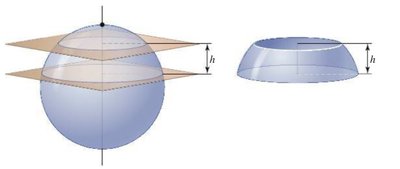
Q8. Zones of a sphere: Show that the surface area of the resulting zone on the sphere is , independent of the location of the cutting planes.
Background
Topic: Surface Area of a Spherical Zone
This question asks you to derive a formula for the surface area of a spherical zone (the region between two parallel planes cutting a sphere).
Key Terms and Formulas
Surface area of a sphere:
Zone height:
Radius:
Step-by-Step Guidance
Visualize the zone as a "band" around the sphere of height .
Recall that the lateral surface area of a cylinder of radius and height is .
Argue (using calculus or geometry) why the surface area of the spherical zone is the same as that of a cylinder of the same radius and height.
Set up the integral or geometric argument, but do not complete the proof.
Try reasoning through the setup before revealing the answer!
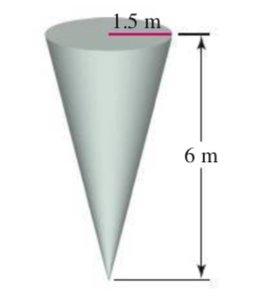
Q9. Emptying a conical tank: A water tank is shaped like an inverted cone with height 6 m and base radius 1.5 m. If the tank is full, how much work is required to pump the water to the level of the top of the tank and out of the tank?
Background
Topic: Work Done by Pumping Fluids
This question involves setting up an integral to compute the work required to pump water out of a tank with a conical shape.
Key Terms and Formulas
Work:
For fluids:
Volume of a thin slice:
Density of water:
Gravity:
Step-by-Step Guidance
Express the radius of a horizontal slice at height in terms of $y$ using similar triangles.
Write the volume of a thin slice at height as .
Find the weight of the slice: .
Set up the integral for work, where the distance each slice must be lifted is .
Write the definite integral for from $0.
Try setting up the integral before revealing the answer!
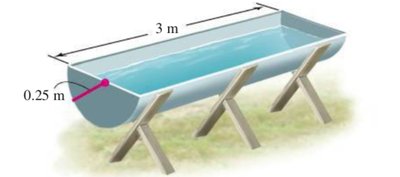
Q10. Emptying a water trough: A water trough has a semicircular cross section with a radius of 0.25 m and a length of 3 m. How much work is required to pump the water out of the trough when it is full?
Background
Topic: Work Done by Pumping Fluids
This problem involves setting up an integral to compute the work required to pump water out of a trough with a semicircular cross-section.
Key Terms and Formulas
Work:
For fluids:
Area of a horizontal slice at height in a semicircle:
Density of water:
Gravity:
Step-by-Step Guidance
Express the width of the water surface at height using the semicircle equation.
Write the area of a horizontal slice at height .
Find the weight of the slice: .
Set up the integral for work, where the distance each slice must be lifted is .
Write the definite integral for from $0.
Try setting up the integral before revealing the answer!
