 Back
Calculus Midterm Study Guidance
Study Guide - Smart Notes
 Tailored notes based on your materials, expanded with key definitions, examples, and context.
Q1. For the function , given in the following figure, find (make reasonable estimates from the grid, if necessary):
Background
Topic: Reading values and limits from a graph.
This question tests your ability to interpret a graph to find function values and limits at specific points.
Key Terms:
Function value: is the -value of the function at .
Limit: is the value the function approaches as gets close to .
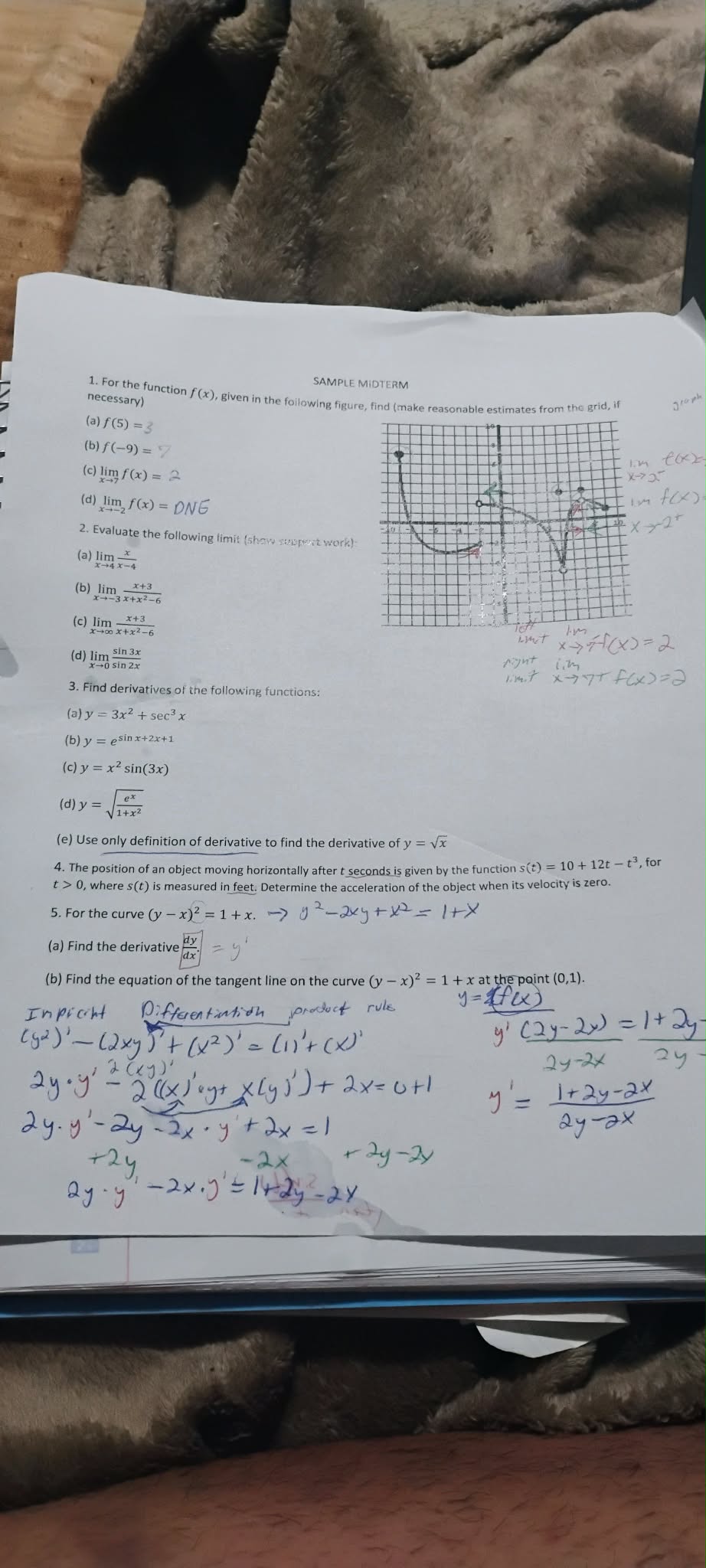
Step-by-Step Guidance
To find , locate on the -axis and read the corresponding -value on the graph.
To find , do the same for .
For , observe the behavior of as approaches $7$ from both sides. Check if the left and right limits agree.
For , look at the value approaches as approaches $2$ from the left only.
Try solving on your own before revealing the answer!
Final Answers:
does not exist (DNE)
These values are estimated by reading the graph at the specified points and considering the behavior as approaches the given values.
Q2. Evaluate the following limits (show supporting work):
Background
Topic: Limits and algebraic manipulation.
This question tests your ability to evaluate limits using substitution, factoring, and algebraic simplification.
Key Terms and Formulas:
Limit:
Factoring: Used to simplify expressions when direct substitution gives an indeterminate form.
L'Hospital's Rule: If gives or , then (if the limit exists).
Step-by-Step Guidance
For each limit, first try direct substitution of the value for .
If you get an indeterminate form (like ), factor or simplify the numerator and denominator.
For limits at infinity, divide numerator and denominator by the highest power of in the denominator.
For trigonometric limits, recall that .
Set up the simplified expression for each limit, but stop before plugging in the final value.
Try solving on your own before revealing the answer!
Final Answers:
(a) does not exist (infinite limit).
(b) is or $2$.
(c) is $0$.
(d) .
Each answer is found by applying the appropriate algebraic or trigonometric technique.
Q3. Find derivatives of the following functions:
Background
Topic: Differentiation rules (sum, product, chain, quotient, and implicit differentiation).
This question tests your ability to apply differentiation rules to various types of functions.
Key Terms and Formulas:
Power Rule:
Product Rule:
Chain Rule:
Quotient Rule:
Derivative of :
Derivative of :
Derivative of :
Step-by-Step Guidance
For each function, identify which differentiation rule(s) apply (sum, product, chain, or quotient).
Apply the rule to write the derivative in terms of (do not simplify fully yet).
For (e), use the definition of the derivative: .
Set up the derivative expressions, but stop before fully simplifying or plugging in values.
Try solving on your own before revealing the answer!
Final Answers:
(a)
(b)
(c)
(d)
(e)
Each derivative is found by applying the appropriate rule and simplifying as needed.
Q4. The position of an object moving horizontally after seconds is given by , for , where is measured in feet. Determine the acceleration of the object when its velocity is zero.
Background
Topic: Motion along a line (kinematics), derivatives as velocity and acceleration.
This question tests your understanding of how to find velocity and acceleration from a position function using derivatives.
Key Terms and Formulas:
Velocity:
Acceleration:
Step-by-Step Guidance
Find the velocity function by differentiating with respect to .
Set the velocity function equal to zero and solve for to find when the velocity is zero.
Find the acceleration function by differentiating the velocity function with respect to .
Substitute the value of (when velocity is zero) into the acceleration function, but do not compute the final value yet.
Try solving on your own before revealing the answer!
Final Answer:
The acceleration when velocity is zero is ft/s.
This is found by differentiating twice and evaluating at the correct value.
Q5. For the curve :
Background
Topic: Implicit differentiation and tangent lines.
This question tests your ability to use implicit differentiation to find and to find the equation of a tangent line at a given point.
Key Terms and Formulas:
Implicit Differentiation: Differentiate both sides with respect to , treating as a function of $x$.
Tangent Line: , where is the slope at .
Step-by-Step Guidance
Differentiate both sides of with respect to using the chain rule and product rule as needed.
Solve for in terms of and .
To find the tangent line at , substitute and into your expression for to get the slope.
Write the equation of the tangent line using the point-slope form, but do not simplify to the final equation yet.
Try solving on your own before revealing the answer!
Final Answers:
(a)
(b) The equation of the tangent line at is .
Implicit differentiation and substitution at the given point yield the slope and tangent line equation.
