 Back
BackCalculus Review: Differentiation, Integration, and Area Between Curves
Study Guide - Smart Notes
 Tailored notes based on your materials, expanded with key definitions, examples, and context.
Reviewing Differentiation
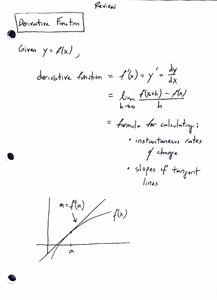
Derivative Function and Its Meaning
The derivative function measures the instantaneous rate of change of a function and the slope of the tangent line at any point. Given a function y = f(x), the derivative is defined as:
Notation: f'(x), y', or \( \frac{dy}{dx} \)
Definition:
Applications: Used to calculate rates of change and slopes of tangent lines.
Review of Derivative Rules
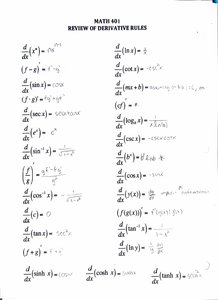
Common derivative rules are essential for solving differentiation problems. These include power, product, quotient, and chain rules, as well as derivatives of trigonometric, exponential, and logarithmic functions.
Power Rule:
Product Rule:
Quotient Rule:
Chain Rule:
Trigonometric Derivatives: ,
Exponential and Logarithmic Derivatives: ,
Worked Differentiation Examples
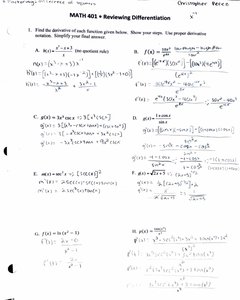
Applying the rules above, derivatives can be calculated for various functions, including polynomials, products, quotients, and compositions. Steps should be shown and answers simplified.
Example: For , use the product rule:
Example: For , use the quotient rule:
Reviewing Integration
Definite and Indefinite Integrals
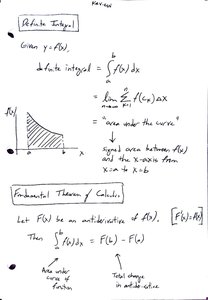
Integration is the reverse process of differentiation and is used to find areas under curves and accumulate quantities. The definite integral computes the net area between a function and the x-axis over an interval, while the indefinite integral finds the antiderivative.
Definite Integral:
Indefinite Integral:
Fundamental Theorem of Calculus: where F(x) is an antiderivative of f(x).
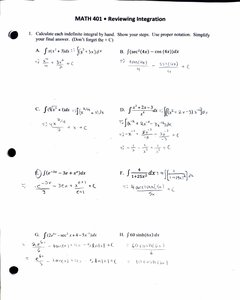
Basic Integration Rules and Examples
Common integration rules include the power rule, sum rule, and integrals of trigonometric, exponential, and logarithmic functions. Proper notation and simplification are important.
Power Rule: (for n ≠ -1)
Trigonometric Integrals: ,
Exponential and Logarithmic Integrals: ,
Integration Using u-Substitution
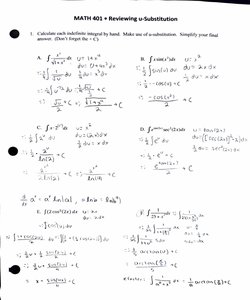
The u-substitution method simplifies integration by substituting part of the integrand with a new variable u, making the integral easier to solve. This is especially useful for composite functions.
Procedure:
Let u = g(x), then compute du = g'(x) dx.
Rewrite the integral in terms of u and du.
Integrate and substitute back for x.
Example: Let u = x^2+1, du = 2x dx, so
Applications of Definite Integrals: Area Between Curves
Area Between Two Curves (x as variable)
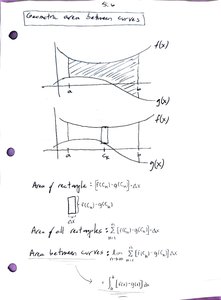
The area between two curves f(x) and g(x) from x = a to x = b is found by integrating the difference between the functions. This represents the region enclosed between the curves.
Formula:
Procedure:
Draw the curves and identify the region.
Set up the integral with the upper function minus the lower function.
Evaluate the definite integral.
Area Between Two Curves (y as variable)
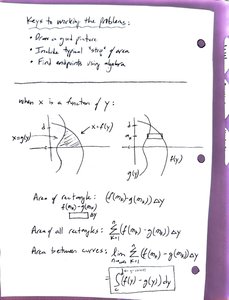
When x is expressed as a function of y, the area between curves can be calculated by integrating with respect to y. This is useful when the curves are better described in terms of y.
Formula:
Procedure:
Draw the curves and identify the region.
Set up the integral with the right function minus the left function.
Evaluate the definite integral.
Key Steps:
Draw a good picture.
Include typical 'slice' of area.
Find endpoints using algebra.
Summary Table: Area Between Curves
Variable | Area Formula |
|---|---|
x | |
y |
Example: To find the area between y = x^2 and y = x from x = 0 to x = 1, set up .
Additional info: These notes cover core topics from Calculus chapters on derivatives, integrals, and applications of definite integrals, including area between curves.
