 Back
BackCalculus Study Guidance: Related Rates, Optimization, and Graphing
Study Guide - Smart Notes
 Tailored notes based on your materials, expanded with key definitions, examples, and context.
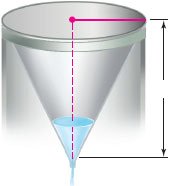
Q1. (Image 1) Water Draining from a Conical Tank
Background
Topic: Related Rates
This type of problem typically involves a conical tank with water draining out, where you are asked to relate the rates of change of the water's height, radius, or volume over time. These are classic related rates problems in calculus.
Key Terms and Formulas
Volume of a cone:
Related rates: Use implicit differentiation with respect to time
Similar triangles: Relate and if the cone's shape is fixed
Step-by-Step Guidance
Write the formula for the volume of the cone in terms of and .
Use similar triangles to express in terms of (if the cone's proportions are fixed).
Substitute into the volume formula so is a function of only.
Differentiate both sides with respect to to relate and .
Try solving on your own before revealing the answer!
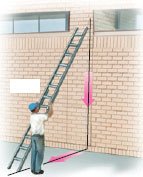
Q2. (Image 2) Ladder Sliding Down a Wall
Background
Topic: Related Rates
This is a classic related rates problem where a ladder is sliding down a wall. You are usually asked to find how fast the top or bottom of the ladder is moving at a certain instant.
Key Terms and Formulas
Pythagorean Theorem: (where is the ladder's length, is the distance from the wall, is the height on the wall)
Related rates: Differentiate both sides with respect to
Step-by-Step Guidance
Write the Pythagorean relationship between the distances and the ladder's length.
Differentiate both sides with respect to time to relate and .
Plug in the known values for , , and the rate you are given.
Solve for the unknown rate (but stop before the final calculation).
Try solving on your own before revealing the answer!
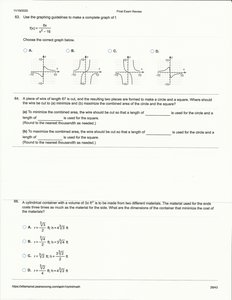
Q3. (Image 3) Exam Page: Graphing, Optimization, and Applications
Background
Topic: Graphing, Optimization, and Applications of Derivatives
This page contains several calculus questions, including graphing a function, maximizing/minimizing quantities, and applying calculus to real-world scenarios (such as container design).
Key Terms and Formulas
Critical points: Where or is undefined
First and second derivative tests for maxima/minima
Optimization: Express the quantity to be optimized as a function of one variable, use constraints to reduce variables, then find critical points
Linear approximation:
Percent error:
Step-by-Step Guidance
For graphing: Analyze the function's domain, intercepts, asymptotes, and behavior as .
For optimization: Write the quantity to be maximized/minimized in terms of one variable using constraints, then take the derivative and set it to zero to find critical points.
For linear approximation: Find and , then use the formula .
For percent error: Plug the approximation and exact value into the percent error formula.
Try solving on your own before revealing the answer!
