 Back
Calculus Study Guide: Average Velocity, Limits, Asymptotes, and Continuity
Study Guide - Smart Notes
 Tailored notes based on your materials, expanded with key definitions, examples, and context.
Q1. Find the average velocity of over the interval .
Background
Topic: Average Velocity (Difference Quotient)
This question tests your understanding of how to compute the average rate of change (velocity) of a function over a given interval, which is foundational for calculus and leads to the concept of derivatives.
Key formula:
: The function value at
: The endpoints of the interval
Step-by-Step Guidance
Calculate by plugging into the function: .
Calculate by plugging into the function: .
Set up the difference quotient: .
Perform the subtraction in the numerator and division in the denominator, but stop before calculating the final value.
Try solving on your own before revealing the answer!
Final Answer:
Plugging in the values: , , so .
This is the average velocity over the interval .
Q2. Find the average velocity of over the interval .
Background
Topic: Average Velocity (Difference Quotient)
This question again tests your ability to compute the average rate of change for a linear function over a specified interval.
Key formula:
: The function value at
: The endpoints of the interval
Step-by-Step Guidance
Calculate : .
Calculate : .
Set up the difference quotient: .
Subtract and divide, but stop before the final calculation.
Try solving on your own before revealing the answer!
Final Answer:
Plugging in: , , so .
This is the average velocity for the interval .
Q3. Find the average velocity of over the interval .
Background
Topic: Average Velocity (Difference Quotient)
This question tests your ability to apply the difference quotient to a quadratic function.
Key formula:
: The function value at
: The endpoints of the interval
Step-by-Step Guidance
Calculate : .
Calculate : .
Set up the difference quotient: .
Subtract and divide, but stop before the final calculation.
Try solving on your own before revealing the answer!
Final Answer:
Plugging in: , , so .
This is the average velocity for the interval .
Q4. Find the average velocity of over the interval .
Background
Topic: Average Velocity (Difference Quotient) with Trigonometric Functions
This question tests your ability to apply the difference quotient to a function involving trigonometric expressions.
Key formula:
: The function value at
: The endpoints of the interval
Step-by-Step Guidance
Calculate : .
Calculate : .
Set up the difference quotient: .
Perform the subtraction and division, but stop before the final calculation.
Try solving on your own before revealing the answer!
Final Answer:
Plugging in: , , so .
This is the average velocity for the interval .
Q5. Use the graph of the given function to find .
Background
Topic: Limits from Graphs
This question tests your ability to interpret a graph and determine the limit of a function as approaches a specific value, including checking for the existence of the limit.
Key Terms:
Right-hand limit:
Left-hand limit:
Limit exists if both one-sided limits are equal.
Step-by-Step Guidance
Examine the graph as approaches $0x \to 0^+x \to 0^-$).
Identify the -values the function approaches from each side.
Compare the right-hand and left-hand limits to determine if the overall limit exists.
If the values are not equal, the limit does not exist at .
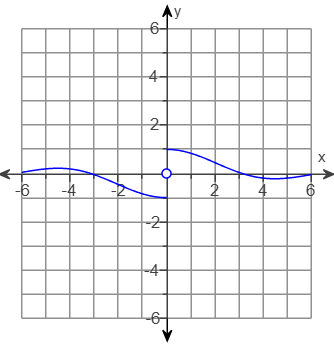
Try solving on your own before revealing the answer!
Final Answer: The limit does not exist.
The right-hand limit is $1-1\lim_{x \to 0} f(x)$ does not exist because the one-sided limits are not equal.
Q6. Use the graph of the given function to find .
Background
Topic: Limits from Graphs
This question tests your ability to interpret a graph and determine the limit of a function as approaches a specific value.
Key Terms:
Right-hand limit:
Left-hand limit:
Limit exists if both one-sided limits are equal.
Step-by-Step Guidance
Examine the graph as approaches $0$ from both sides.
Identify the -values the function approaches from each side.
Compare the right-hand and left-hand limits to determine if the overall limit exists.
If the values are equal, the limit exists at .
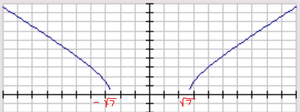
Try solving on your own before revealing the answer!
Final Answer:
Both one-sided limits approach $0.
Q7. Use the graph of the given function to find .
Background
Topic: Limits from Graphs
This question tests your ability to interpret a graph and determine the limit of a function as approaches a specific value, including checking for the existence of the limit.
Key Terms:
Right-hand limit:
Left-hand limit:
Limit exists if both one-sided limits are equal.
Step-by-Step Guidance
Examine the graph as approaches $0$ from the right and left.
Identify the -values the function approaches from each side.
Compare the right-hand and left-hand limits to determine if the overall limit exists.
If the values are not equal, the limit does not exist at .
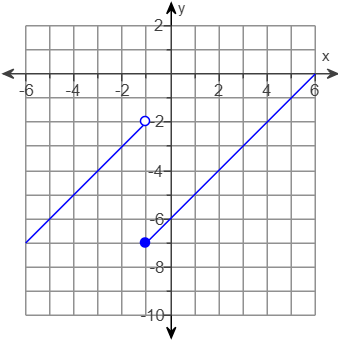
Try solving on your own before revealing the answer!
Final Answer: The limit does not exist.
The right-hand limit is $1-1\lim_{x \to 0} f(x)$ does not exist because the one-sided limits are not equal.
Q8. Use the graph of the given function to find .
Background
Topic: Limits from Graphs
This question tests your ability to interpret a graph and determine the limit of a function as approaches a specific value.
Key Terms:
Right-hand limit:
Left-hand limit:
Limit exists if both one-sided limits are equal.
Step-by-Step Guidance
Examine the graph as approaches $0$ from both sides.
Identify the -values the function approaches from each side.
Compare the right-hand and left-hand limits to determine if the overall limit exists.
If the values are equal, the limit exists at .
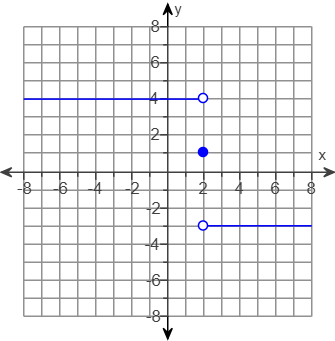
Try solving on your own before revealing the answer!
Final Answer:
Both one-sided limits approach , so the limit exists and equals $-2$.
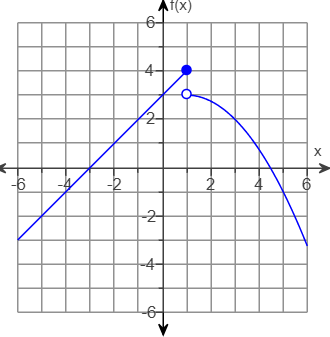
Q9. Use the graph of the given function to find .
Background
Topic: Limits from Graphs
This question tests your ability to interpret a graph and determine the limit of a function as approaches a specific value.
Key Terms:
Right-hand limit:
Left-hand limit:
Limit exists if both one-sided limits are equal.
Step-by-Step Guidance
Examine the graph as approaches $0$ from both sides.
Identify the -values the function approaches from each side.
Compare the right-hand and left-hand limits to determine if the overall limit exists.
If the values are equal, the limit exists at .
Try solving on your own before revealing the answer!
Final Answer:
Both one-sided limits approach , so the limit exists and equals $-2$.
