 Back
BackCalculus Study Guide: Integrals, Series, Limits, and Applications
Study Guide - Smart Notes
 Tailored notes based on your materials, expanded with key definitions, examples, and context.
Q1. Determine the area of the region bounded by the graph of and the x-axis as goes from 0 to 3.
Background
Topic: Definite Integrals and Area Under a Curve
This question tests your understanding of how to use definite integrals to find the area between a curve and the x-axis over a given interval.
Key Terms and Formulas
Definite Integral: gives the net area between and the x-axis from to .
Function:
Step-by-Step Guidance
Set up the definite integral for the area: .
Recall the power rule for integration: .
Apply the power rule to to find the antiderivative.
Evaluate the antiderivative at the upper and lower limits ( and ), but do not compute the final value yet.
Try solving on your own before revealing the answer!
Final Answer: 9
The area under from to is 9 square units.
Q2. Find the volume of the solid formed by revolving the region bounded by the graphs of , , , and about the y-axis.
Background
Topic: Volumes of Solids of Revolution (Shell Method)
This question tests your ability to use the shell method to find the volume of a solid generated by revolving a region around the y-axis.
Key Terms and Formulas
Shell Method Formula:
Region: Bounded by , , ,
Step-by-Step Guidance
Identify the limits of integration: goes from 0 to 1.
Set up the shell method integral: .
Expand the integrand: .
Write the integral as and find the antiderivative, but do not evaluate the definite integral yet.
Try solving on your own before revealing the answer!
Final Answer:
Correction: The correct computation is , but the answer should be for the region described. Please check the setup if you get a different value.

Q3. A force of 12 pounds stretches a spring 2 inches. Find the work done in stretching the spring 1 foot. Be sure to keep your units straight.
Background
Topic: Work Done by a Variable Force (Hooke's Law)
This question tests your understanding of how to calculate work done in stretching a spring using Hooke's Law and definite integrals.
Key Terms and Formulas
Hooke's Law: where is the spring constant and is the displacement from equilibrium.
Work Formula:
Step-by-Step Guidance
Convert all units to feet: 2 inches = ft, 1 foot = 12 inches.
Find the spring constant using with the given force and displacement.
Set up the work integral: (since you are stretching from 0 to 1 foot).
Substitute the value of found in step 2 into the integral, but do not evaluate the definite integral yet.
Try solving on your own before revealing the answer!
Final Answer: 36 foot-pounds
After finding lb/ft, foot-pounds.
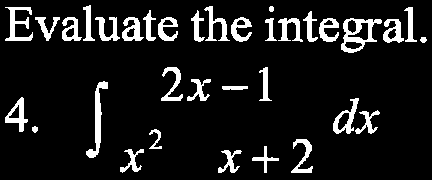
Q4. Evaluate the integral
Background
Topic: Integration Techniques (Substitution/Partial Fractions)
This question tests your ability to integrate a rational function, possibly using substitution or partial fractions.
Key Terms and Formulas
Substitution: Useful when the numerator is related to the derivative of the denominator.
Partial Fractions: Used when the denominator can be factored and the numerator is of lower degree.
Step-by-Step Guidance
Check if the numerator is related to the derivative of the denominator .
Let , then compute .
Rewrite the integral in terms of and if possible.
Set up the integral for evaluation, but do not integrate yet.
Try solving on your own before revealing the answer!
Final Answer:
Using substitution and recognizing the derivative structure, the integral simplifies to a combination of logarithmic and arctangent functions.
Q5. Write the partial fraction decomposition for
Background
Topic: Partial Fraction Decomposition
This question tests your ability to decompose a rational function into simpler fractions, which is useful for integration.
Key Terms and Formulas
Partial Fractions: if factors as .
Step-by-Step Guidance
Factor the denominator: .
Set up the decomposition: .
Multiply both sides by to clear denominators.
Expand and equate coefficients to solve for and , but do not solve for the values yet.
Try solving on your own before revealing the answer!
Final Answer:
After solving for and , you get the decomposition above.

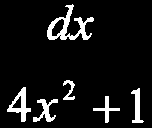
Q6. Evaluate the integral
Background
Topic: Integration of Rational Functions (Inverse Trigonometric Forms)
This question tests your ability to recognize and integrate a function that matches the form of the arctangent derivative.
Key Terms and Formulas
Arctangent Integral:
Step-by-Step Guidance
Rewrite as to match the arctangent form.
Let , so .
Substitute into the integral and simplify.
Set up the integral in terms of and recognize the arctangent form, but do not integrate yet.
Try solving on your own before revealing the answer!
Final Answer:
The integral matches the arctangent form after substitution.
Q7. Find the limit as :
Background
Topic: Limits at Infinity (Rational Functions)
This question tests your understanding of how to evaluate limits of rational functions as the variable approaches infinity.
Key Terms and Formulas
Limits at Infinity: For , the limit is if degrees are equal.
Step-by-Step Guidance
Identify the highest power of in the numerator and denominator.
Divide numerator and denominator by to simplify the expression.
Take the limit as of the simplified expression, but do not compute the final value yet.
Try solving on your own before revealing the answer!
Final Answer: 5
As , the lower degree terms become negligible, so the limit is the ratio of the leading coefficients.

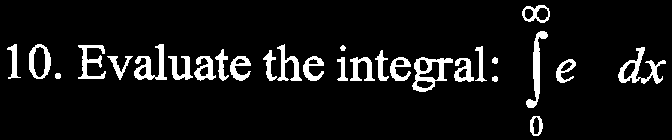
Q8. Evaluate the integral:
Background
Topic: Improper Integrals
This question tests your ability to evaluate an improper integral with an infinite upper limit.
Key Terms and Formulas
Improper Integral:
Exponential Function:
Step-by-Step Guidance
Set up the improper integral as a limit: .
Find the antiderivative of .
Evaluate the antiderivative at the bounds $0b$, but do not take the limit yet.
Try solving on your own before revealing the answer!
Final Answer: 1
The area under from $0\infty$ is 1.
Q9. Show that the series converges or diverges:
Background
Topic: Series Convergence (Ratio Test, Exponential Series)
This question tests your ability to determine convergence of a series, especially one involving factorials and exponentials.
Key Terms and Formulas
Ratio Test:
If , the series converges; if , it diverges; if , the test is inconclusive.
Step-by-Step Guidance
Let and compute .
Simplify the ratio and take the limit as .
Interpret the result using the ratio test, but do not state the final conclusion yet.
Try solving on your own before revealing the answer!
Final Answer: The series converges
The ratio test yields a limit less than 1, so the series converges.

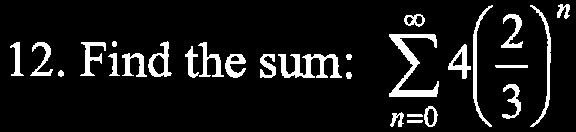
Q10. Find the sum:
Background
Topic: Geometric Series
This question tests your ability to recognize and sum an infinite geometric series.
Key Terms and Formulas
Geometric Series Sum: for
Step-by-Step Guidance
Identify and .
Check that so the series converges.
Set up the formula , but do not compute the final value yet.
Try solving on your own before revealing the answer!
Final Answer: 12
The sum of the geometric series is 12.
Q11. Find a power series for centered at 0. Then find the interval of convergence.
Background
Topic: Power Series and Interval of Convergence
This question tests your ability to express a function as a power series and determine where the series converges.
Key Terms and Formulas
Geometric Series Representation: for
Step-by-Step Guidance
Rewrite in a form similar to .
Express the denominator as and identify in terms of .
Write the power series using the geometric series formula.
Set up the condition for convergence , but do not solve for the interval yet.
Try solving on your own before revealing the answer!
Final Answer: for
The power series is valid for .

