 Back
BackCalculus Study Guide: Limits and Continuity (Chapter 2)
Study Guide - Smart Notes
 Tailored notes based on your materials, expanded with key definitions, examples, and context.
Section 2.1 – The Idea of Limits
Review of Slope and Lines
Calculus begins with concepts from algebra, such as finding the slope and equation of a line. These ideas are foundational for understanding limits, average velocity, and the slope of tangent lines.
Slope Formula: The slope m between two points and is given by:
Equation of a Line: The point-slope form is:
Example: For points (2, 4) and (4, 16): Equation:
Introduction to Limits
A limit describes the value that the outputs of a function approach as the inputs approach a given value. This concept is central to calculus, especially in defining instantaneous velocity and the slope of a tangent line.
Limit Notation:
Secant Line: A line passing through two points on a graph; its slope represents average velocity.
Tangent Line: A line touching the graph at one point; its slope represents instantaneous velocity.
Average and Instantaneous Velocity
Average velocity is calculated over an interval, while instantaneous velocity is the limit as the interval shrinks to a single point.
Average Velocity Formula:
Instantaneous Velocity: The limit of average velocity as :
Example: Using a table of positions, as the interval shrinks, the average velocity approaches the instantaneous velocity.
Section 2.2 – Definition of Limits
Informal and One-Sided Limits
Limits can be approached from the left or right. The notation distinguishes these cases:
Right-Sided Limit:
Left-Sided Limit:
Limit of a Function: if approaches as approaches (but ).
Existence of Limit: The limit exists if both one-sided limits are equal.
Examples Using Graphs and Tables
Piecewise Functions: Limits may differ from the function value at a point.
Example: For , is undefined, but .
Section 2.3 – Techniques for Computing Limits
Limit Laws and Theorems
Several laws simplify the computation of limits for sums, differences, products, quotients, powers, and roots.
Sum Law:
Difference Law:
Product Law:
Quotient Law: (if denominator limit is not zero)
Power Law:
Root Law: (if for even )
Limits of Polynomial and Rational Functions
Polynomial:
Rational: (if )
Squeeze Theorem
The Squeeze Theorem helps find limits when a function is bounded between two others with the same limit.
Theorem: If near and , then .
Example: by bounding between and .

Trigonometric Limits
Example:
Indeterminate Forms: Direct substitution may fail; use identities or algebraic manipulation.
Section 2.4 and 2.5 – Limits Involving Infinity
Infinite Limits and Limits at Infinity
Limits involving infinity occur when function values grow without bound or when the input variable approaches infinity.
Infinite Limit: or if grows arbitrarily large as approaches .
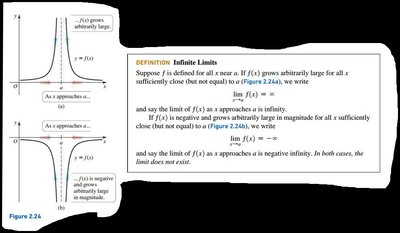
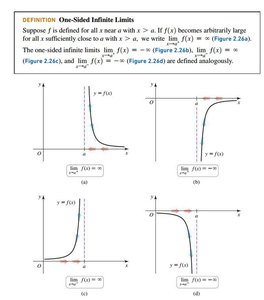
One-Sided Infinite Limits: or ; or $-\infty$.
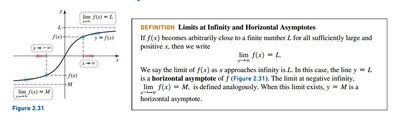
Limit at Infinity: if approaches a finite value as grows large.
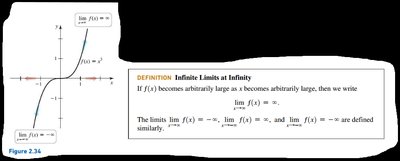
Infinite Limits at Infinity: or if grows without bound as increases.
Vertical and Horizontal Asymptotes
Vertical Asymptote (VA): Occurs where the denominator of a rational function is zero and the function grows without bound.
Horizontal Asymptote (HA): Occurs when approaches a finite value as approaches infinity.
Degree Comparison:
If degree of numerator > degree of denominator: No HA
If degrees are equal: HA is ratio of leading coefficients
If degree of numerator < degree of denominator: HA is
End Behavior of Exponential and Logarithmic Functions
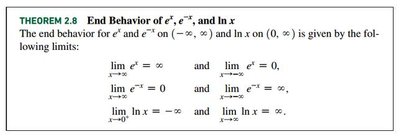
Theorem 2.8: End behavior for , , and :
Function | ||
|---|---|---|
$0$ | ||
$0$ | ||
Section 2.6 – Continuity
Definition and Checklist for Continuity
A function is continuous at a point if its graph has no holes, jumps, or breaks. Most familiar functions are continuous everywhere, but some have points of discontinuity.
Continuity Checklist:
is defined (a is in the domain).
exists.
Point of Discontinuity: Where the function fails to be continuous.
Types of Functions and Continuity
Polynomial Functions: Continuous everywhere.
Rational Functions: Continuous where denominator is not zero.
Composite Functions: If is continuous at and is continuous at , then is continuous at $a$.
Root Functions: If is odd, is continuous wherever is continuous. If $n$ is even, $\sqrt[n]{f(x)}$ is continuous where .
Inverse Functions: If is continuous and invertible on an interval, is also continuous on the image of that interval.
Continuity at Endpoints and on Intervals
Right-Continuous:
Left-Continuous:
Continuous on Interval: Continuous at every point in the interval; at endpoints, continuous from the appropriate side.
Intermediate Value Theorem (IVT)
The IVT states that if is continuous on and is between and , then there exists in such that . This theorem guarantees the existence of a value but not its exact location.
Application: Used to show that a solution exists for equations involving continuous functions.
Example: If you invest $1000 after 5 years, IVT guarantees an interest rate between and will achieve this.
