 Back
BackCalculus Study Guide: Maxima, Minima, Derivatives, and Optimization
Study Guide - Smart Notes
 Tailored notes based on your materials, expanded with key definitions, examples, and context.
Q1. Find the absolute extrema of on the interval .
Background
Topic: Absolute Extrema on a Closed Interval
This question tests your ability to find the maximum and minimum values of a function on a closed interval using calculus. This involves finding critical points and evaluating the function at endpoints.
Key Terms and Formulas
Critical Point: Where or is undefined.
Absolute Extrema: The highest (maximum) and lowest (minimum) values of on the interval.
Derivative: gives the slope of the tangent line to .
Step-by-Step Guidance
Find the derivative: .
Set and solve for to find critical points inside the interval.
Evaluate at the critical point(s) and at the endpoints and .
Compare these values to determine which is the largest (absolute maximum) and which is the smallest (absolute minimum).
Try solving on your own before revealing the answer!
Q2. Find the absolute extrema of on the interval .
Background
Topic: Absolute Extrema on a Closed Interval
This question is similar to Q1, but with a cubic function. You will use the same process: find critical points, evaluate at endpoints, and compare values.
Key Terms and Formulas
Critical Point: Where or is undefined.
Absolute Extrema: The highest and lowest values of on the interval.
Derivative: gives the slope of the tangent line to .
Step-by-Step Guidance
Find the derivative: .
Set and solve for to find critical points inside the interval.
Evaluate at the critical point(s) and at the endpoints and .
Compare these values to determine the absolute maximum and minimum.
Try solving on your own before revealing the answer!
Q3. Find the intervals of increase/decrease and the x-coordinates of the local extrema for .
Background
Topic: First and Second Derivative Tests
This question tests your ability to use the first derivative to find where a function is increasing or decreasing, and to use the second derivative to classify local extrema (maxima and minima).
Key Terms and Formulas
Increasing/Decreasing: Where (increasing), (decreasing).
Local Extrema: Points where and the sign of changes.
Second Derivative Test: tells you if a critical point is a max () or min ().
Step-by-Step Guidance
Find the first derivative: .
Set and solve for to find critical points.
Use the second derivative to classify each critical point as a local maximum or minimum.
Determine the intervals where is positive (increasing) or negative (decreasing).
Try solving on your own before revealing the answer!
Q4. Find the intervals of increase/decrease and the x-coordinates of the local extrema for .
Background
Topic: First and Second Derivative Tests
This question is similar to Q3, but with a different cubic function. The process is the same: use the first and second derivatives to analyze the function.
Key Terms and Formulas
Increasing/Decreasing: Where (increasing), (decreasing).
Local Extrema: Points where and the sign of changes.
Second Derivative Test: tells you if a critical point is a max () or min ().
Step-by-Step Guidance
Find the first derivative: .
Set and solve for to find critical points.
Use the second derivative to classify each critical point as a local maximum or minimum.
Determine the intervals where is positive (increasing) or negative (decreasing).
Try solving on your own before revealing the answer!
Q5. Find the intervals of increase/decrease and the x-coordinates of the local extrema for .
Background
Topic: Product Rule, First and Second Derivative Tests
This question involves differentiating a product of functions and analyzing the resulting critical points and intervals.
Key Terms and Formulas
Product Rule:
Critical Points: Where or undefined.
Second Derivative Test: classifies extrema.
Step-by-Step Guidance
Find the first derivative using the product rule: .
Factor and set to find critical points.
Use the second derivative to classify each critical point as a local maximum or minimum.
Determine the intervals where is positive (increasing) or negative (decreasing).
Try solving on your own before revealing the answer!
Q6. Find the intervals of concavity and the inflection points for .
Background
Topic: Concavity and Inflection Points
This question tests your ability to use the second derivative to determine where a function is concave up or down, and to find inflection points.
Key Terms and Formulas
Concave Up: Where .
Concave Down: Where .
Inflection Point: Where changes sign.
Step-by-Step Guidance
Find the second derivative: .
Set and solve for to find possible inflection points.
Test intervals around these points to determine where the function is concave up or down.
Try solving on your own before revealing the answer!
Q7. Find the intervals of concavity and the inflection points for .
Background
Topic: Concavity and Inflection Points
This question is similar to Q6, but with a higher-degree polynomial. The process is the same: use the second derivative to analyze concavity and inflection points.
Key Terms and Formulas
Concave Up: Where .
Concave Down: Where .
Inflection Point: Where changes sign.
Step-by-Step Guidance
Find the second derivative: .
Set and solve for to find possible inflection points.
Test intervals around these points to determine where the function is concave up or down.
Try solving on your own before revealing the answer!
Q8. Graph and determine the intervals of increase/decrease, concavity, asymptotes, and intercepts for .
Background
Topic: Graphing Polynomials
This question asks you to analyze a cubic function by finding its intercepts, critical points, inflection points, and intervals of increase/decrease and concavity.
Key Terms and Formulas
Intercepts: Where the graph crosses the axes.
Critical Points: Where .
Inflection Points: Where .
Intervals: Use sign charts for and .
Step-by-Step Guidance
Find - and -intercepts by setting and respectively.
Find critical points by solving .
Find possible inflection points by solving .
Use sign charts to determine intervals of increase/decrease and concavity.
Try solving on your own before revealing the answer!
Q9. Graph and determine the intervals of increase/decrease, concavity, asymptotes, and intercepts for .
Background
Topic: Graphing Rational Functions
This question asks you to analyze a rational function by finding its domain, intercepts, asymptotes, and intervals of increase/decrease and concavity.
Key Terms and Formulas
Vertical Asymptote: Where the denominator is zero.
Horizontal Asymptote: Compare degrees of numerator and denominator.
Intercepts: Set numerator or .
Critical Points: Where .
Concavity: Use .
Step-by-Step Guidance
Find the domain by setting the denominator not equal to zero.
Find vertical and horizontal asymptotes.
Find - and -intercepts.
Find critical points and intervals of increase/decrease and concavity using derivatives.
Try solving on your own before revealing the answer!
Q10. Of all numbers whose sum is 80, find the two that have the maximum product. What is this product?
Background
Topic: Optimization
This question tests your ability to set up and solve an optimization problem using calculus. You will express the product in terms of one variable, find its maximum, and interpret the result.
Key Terms and Formulas
Optimization: Maximizing or minimizing a quantity given a constraint.
Product: where .
Substitute: so .
Find maximum by setting .
Step-by-Step Guidance
Express the product in terms of one variable using the constraint.
Find the derivative and set it equal to zero to find the critical point.
Solve for and then using the constraint.
Calculate the maximum product using these values.
Try solving on your own before revealing the answer!
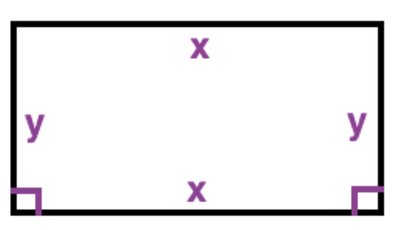
Q11. A carpenter is building a rectangular shed with a fixed perimeter of 100 ft. What are the dimensions of the largest shed that can be built? What is its area?
Background
Topic: Optimization with Constraints
This question asks you to maximize the area of a rectangle given a fixed perimeter. This is a classic optimization problem in calculus.
Key Terms and Formulas
Perimeter:
Area:
Express in terms of one variable using the perimeter constraint.
Find maximum by setting .
Step-by-Step Guidance
Express in terms of using the perimeter constraint.
Write the area as a function of .
Find the derivative and set it equal to zero to find the critical point.
Solve for and to find the dimensions of the largest shed.
Try solving on your own before revealing the answer!
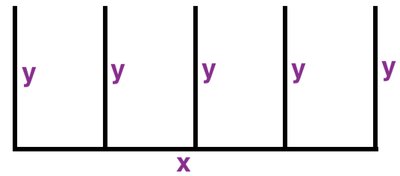
Q12. A rancher has 1500 ft. of fencing to create a rectangular pen and subdivide the pen into four rectangular partitions. The pen will border a barn on one side and need no fence for that border. What dimensions of the pen will maximize the enclosed area of the pen?
Background
Topic: Optimization with Multiple Constraints
This question involves maximizing the area of a rectangular pen with a fixed amount of fencing, where the pen is subdivided and one side is bordered by a barn (so no fencing is needed on that side). This is a more advanced optimization problem.
Key Terms and Formulas
Fencing constraint: (since there are 5 vertical partitions and 1 horizontal side to fence).
Area:
Express in terms of one variable using the constraint.
Find maximum by setting .
Step-by-Step Guidance
Express in terms of using the fencing constraint.
Write the area as a function of .
Find the derivative and set it equal to zero to find the critical point.
Solve for and then to find the dimensions that maximize the area.
Try solving on your own before revealing the answer!
