 Back
BackCalculus Study Guide: Techniques of Integration, Applications, Series, and Partial Differentiation
Study Guide - Smart Notes
 Tailored notes based on your materials, expanded with key definitions, examples, and context.
Techniques of Integration
Simple Techniques and Trigonometric Identities
Integration often requires transforming the integrand into a more manageable form. Trigonometric identities are especially useful for simplifying products and powers of trigonometric functions.
Key Identities:
cos 2A = 2 cos^2 A − 1
sin^2 A = (1 − cos 2A)/2
sin A cos B = [sin(A − B) + sin(A + B)]/2
cos A cos B = [cos(A − B) + cos(A + B)]/2
sin A sin B = [cos(A − B) − cos(A + B)]/2
Example: To integrate , use the product-to-sum identity.
Differentials
The differential dy of a function y = f(x) is defined as . This concept is foundational for substitution in integration and for understanding the chain rule.
Example: If , then .
Integration by Substitution
Substitution is used when the integrand contains a function and its derivative. Let , then and .
Example: with , .
Indirect (Trigonometric) Substitution
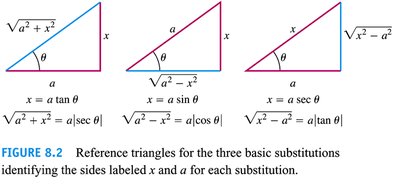
For integrals involving square roots of quadratic expressions, trigonometric substitutions are effective. The choice of substitution depends on the form:
Form | Substitution | Identity Used |
|---|---|---|
Partial Fractions
Rational functions can often be decomposed into simpler fractions, which are easier to integrate. This is especially useful when the degree of the numerator is less than the denominator.
Example: can be split into partial fractions.
Integration by Parts
This technique is based on the product rule for differentiation. For .
Guideline: Choose u and dv such that differentiating u and integrating dv simplifies the integral. The LIATE rule (Logarithmic, Inverse trig, Algebraic, Trig, Exponential) helps prioritize choices.
Example: with , .
Applications of Definite Integrals
Areas and Arc Lengths
Definite integrals are used to compute areas under curves, between curves, and arc lengths. For a curve from to :
Area:
Arc Length:
Parametric and Polar Curves
For curves given by , , the area and arc length are:
Area:
Arc Length:
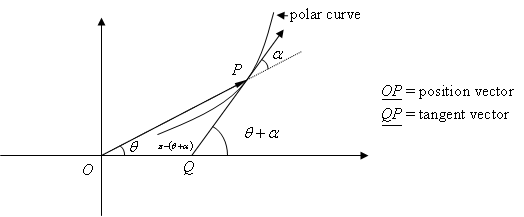
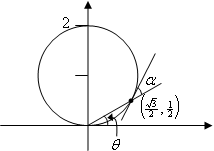
For polar curves :
Area:
Arc Length:
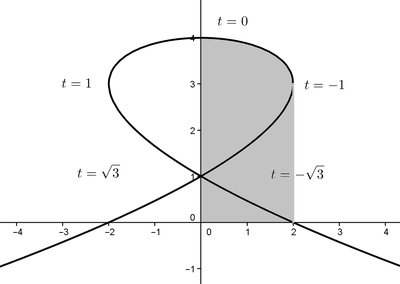
Areas Enclosed by Loops
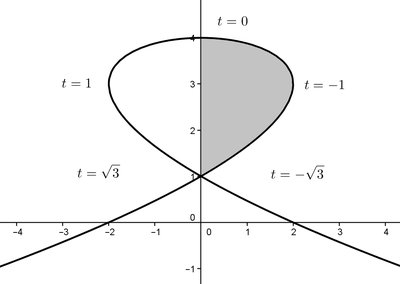
For curves with loops, the area can be found by integrating over the parameter values that trace the loop.
Curved Surface Area
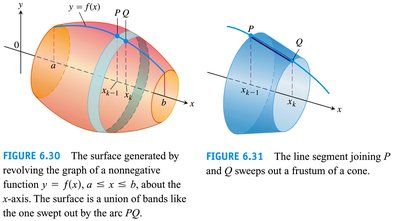
When a curve is revolved about the x-axis, the surface area is:
Surface Area:
Advanced Applications of Differentiation
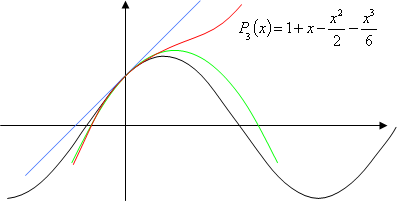
Taylor Polynomials and Series
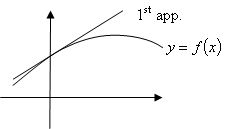
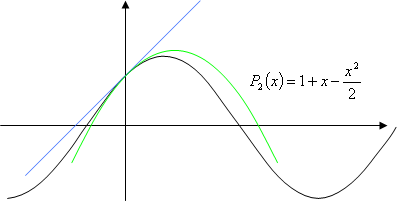
Taylor polynomials approximate functions near a point. The nth Taylor polynomial for about is:
The Maclaurin series is the Taylor series about .
Example: For , the Maclaurin series is .
Taylor's Theorem and Error
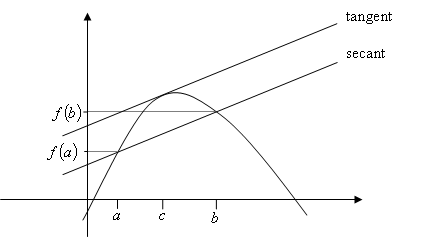
The error in approximating by its nth Taylor polynomial is given by:
for some between and .
Binomial Series
The binomial series generalizes the binomial theorem for any real exponent :
Indeterminate Forms and L'Hôpital's Rule
For limits of the form or , L'Hôpital's Rule states:
If and , then (if the latter limit exists).
Partial Differentiation and Quadric Surfaces
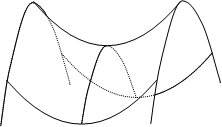
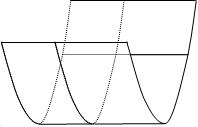
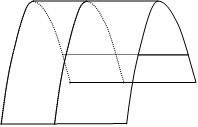
Quadric Surfaces
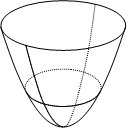
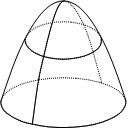
Quadric surfaces are second-degree surfaces in three variables. The general form is . By rotating axes and shifting the origin, canonical forms are obtained:
Form | Equation | Name |
|---|---|---|
Both positive | Elliptic paraboloid (cup) | |
Both negative | Elliptic paraboloid (cap) | |
One positive, one negative | Hyperbolic paraboloid (saddle) | |
One zero | or | Parabolic cylinder |
Partial Derivatives
For , the partial derivatives are:
: Differentiate with respect to , treating as constant.
: Differentiate with respect to , treating as constant.
Second partial derivatives include , , , and . For most well-behaved functions, (Clairaut's theorem).
Chain Rule for Partial Derivatives
If , and , , then:
Differentials and First Approximations
The differential gives the first-order approximation to the change in due to small changes in and :
Inverse Functions and Jacobians
If and are functions of and , and vice versa, the matrices of partial derivatives are inverses of each other. This is important in change of variables and transformations.
Differential Equations
Types of First-Order Differential Equations
Variable Separable: , solved by separating variables and integrating both sides.
Homogeneous: where and are homogeneous functions of the same degree. Use substitution .
Exact: is exact if . Find a potential function such that .
Linear: . Use integrating factor .
Appendix: Common Curve Sketches
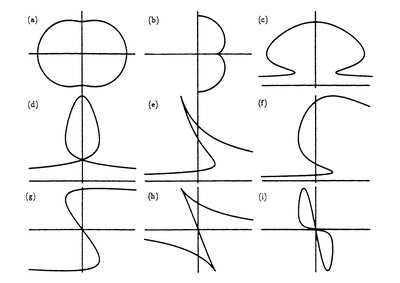
Additional info: This guide covers the main topics from the provided Calculus course material, including techniques of integration, applications of definite integrals, Taylor and Maclaurin series, partial differentiation, and first-order differential equations. For each topic, key definitions, formulas, and examples are provided, with relevant images included to reinforce understanding where appropriate.
