 Back
BackChapter 13 Calculus Review: Integration and Applications
Study Guide - Smart Notes
 Tailored notes based on your materials, expanded with key definitions, examples, and context.
Q1a. Integrate the following:
Background
Topic: Basic Integration
This question tests your understanding of integrating a constant with respect to a variable.
Key Terms and Formulas
Indefinite Integral: , where is a constant and is the constant of integration.
Step-by-Step Guidance
Recognize that 8 is a constant with respect to .
Recall the rule for integrating a constant: .
Apply this rule to the given integral.
Try solving on your own before revealing the answer!
Q1b. Integrate the following:
Background
Topic: Exponential Functions and Integration
This question tests your ability to integrate exponential functions with respect to .
Key Terms and Formulas
Exponential Integral:
Constant Multiple Rule:
Step-by-Step Guidance
Identify the constant (8) and the exponential function .
Apply the constant multiple rule: factor out the 8.
Integrate with respect to .
Try solving on your own before revealing the answer!
Q1c. Integrate the following:
Background
Topic: Integration of Rational Functions
This question tests your ability to integrate a rational function, which may require algebraic manipulation such as factoring or substitution.
Key Terms and Formulas
Partial Fraction Decomposition: Used to break down complex rational expressions.
Basic Integrals:
Step-by-Step Guidance
Factor the denominator if possible to simplify the integral.
Set up partial fractions if the denominator can be factored.
Write the integral as a sum of simpler fractions and integrate each term.
Try solving on your own before revealing the answer!
Q2. Find the Cost function if the marginal cost is and the fixed cost is $2$.
Background
Topic: Applications of Integration in Economics
This question tests your ability to find a cost function from its marginal cost (the derivative) and a given fixed cost (initial value).
Key Terms and Formulas
Marginal Cost: is the derivative of the cost function.
To find , integrate with respect to and add the fixed cost.
Step-by-Step Guidance
Integrate with respect to to find .
Add the constant of integration, which represents the fixed cost.
Use the given fixed cost to solve for the constant of integration.
Try solving on your own before revealing the answer!
Q3a. Integrate the following:
Background
Topic: Power Rule for Integration
This question tests your ability to use the power rule to integrate a monomial.
Key Terms and Formulas
Power Rule: , for
Step-by-Step Guidance
Identify the exponent .
Apply the power rule to integrate .
Simplify the expression.
Try solving on your own before revealing the answer!
Q3b. Integrate the following:
Background
Topic: Integration by Parts
This question tests your ability to use integration by parts, a technique for integrating products of functions.
Key Terms and Formulas
Integration by Parts:
Step-by-Step Guidance
Let and .
Compute and .
Apply the integration by parts formula.
You may need to apply integration by parts a second time for the remaining integral.
Try solving on your own before revealing the answer!
Q3c. Integrate the following:
Background
Topic: Integration of Rational Functions
This question tests your ability to integrate a rational function, which may require factoring and partial fractions.
Key Terms and Formulas
Partial Fraction Decomposition
Basic Integrals:
Step-by-Step Guidance
Factor the denominator as much as possible.
Set up partial fractions for the decomposed denominator.
Integrate each term separately.
Try solving on your own before revealing the answer!
Q4. Use the numeric integration function on your calculator to graph and integrate the function from to .
Background
Topic: Definite Integrals and Graphing
This question tests your ability to use technology to evaluate definite integrals and understand the graphical representation of the area under a curve.
Key Terms and Formulas
Definite Integral: gives the net area under from to .
Natural Logarithm:
Step-by-Step Guidance
Enter the function into your calculator's graphing utility.
Set the window to include to .
Use the numeric integration function to evaluate .
Interpret the result as the area under the curve from to .
Try solving on your own before revealing the answer!
Q5. When we define the integral on an interval , what is a necessary condition for the function ?
Background
Topic: Properties of Definite Integrals
This question tests your understanding of the requirements for a function to be integrable on a closed interval.
Key Terms and Formulas
Continuity
Integrability
Step-by-Step Guidance
Recall the definition of the definite integral and the types of functions that are integrable.
Think about what properties must have on for the integral to exist.
Try solving on your own before revealing the answer!
Q6a. Evaluate the definite integral
Background
Topic: Definite Integrals and the Fundamental Theorem of Calculus
This question tests your ability to compute a definite integral using antiderivatives and evaluate at the bounds.
Key Terms and Formulas
Fundamental Theorem of Calculus: , where is an antiderivative of .
Power Rule for Integration
Step-by-Step Guidance
Find the antiderivative of .
Evaluate the antiderivative at the upper and lower limits ( and ).
Subtract the value at from the value at .
Try solving on your own before revealing the answer!
Q6b. Evaluate the definite integral
Background
Topic: Definite Integrals and Logarithmic Integration
This question tests your ability to integrate a rational function and evaluate the result over a given interval.
Key Terms and Formulas
Logarithmic Integral:
Fundamental Theorem of Calculus
Step-by-Step Guidance
Factor out the constant 4.
Integrate with respect to .
Evaluate the result at and , then subtract.
Try solving on your own before revealing the answer!
Q6c. Evaluate the definite integral
Background
Topic: Integration of Rational Functions
This question tests your ability to simplify and integrate a rational function, possibly using substitution or partial fractions.
Key Terms and Formulas
Substitution Method
Partial Fraction Decomposition
Fundamental Theorem of Calculus
Step-by-Step Guidance
Factor the denominator if possible.
Check if the numerator is the derivative of the denominator (suggesting substitution).
Set up the substitution and integrate.
Evaluate the result at the bounds and .
Try solving on your own before revealing the answer!
Q6d. Evaluate the definite integral
Background
Topic: Definite Integrals and Logarithmic Integration
This question tests your ability to integrate a rational function using substitution and evaluate the result over a given interval.
Key Terms and Formulas
Substitution Method
Logarithmic Integral:
Fundamental Theorem of Calculus
Step-by-Step Guidance
Let and find .
Rewrite the integral in terms of .
Integrate and substitute back in terms of .
Evaluate at and .
Try solving on your own before revealing the answer!
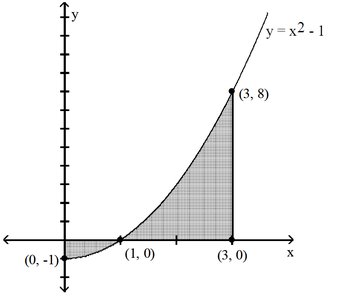
Q7. Find the shaded area under from to and above the -axis.
Background
Topic: Area Between a Curve and the -Axis
This question tests your ability to set up and evaluate definite integrals to find the area between a curve and the -axis, considering where the curve is above or below the axis.
Key Terms and Formulas
Area under a curve:
For regions below the -axis, take the absolute value of the integral over those intervals.
Step-by-Step Guidance
Find the -intercepts of by solving .
Determine the intervals where the curve is below and above the -axis between and .
Set up the definite integrals for each region (below and above the -axis).
Take the absolute value of the integral where the curve is below the -axis, and add the areas together.
Try solving on your own before revealing the answer!
Q8. The Demand for a certain item is given by . The Supply and Demand are in equilibrium at . Find the consumers’ surplus.
Background
Topic: Consumer Surplus in Economics
This question tests your ability to use definite integrals to find the consumer surplus, which is the area between the demand curve and the equilibrium price up to the equilibrium quantity.
Key Terms and Formulas
Consumer Surplus: , where is the equilibrium point.
Step-by-Step Guidance
Set up the integral using the given demand function.
Calculate using the equilibrium values .
Subtract from the value of the definite integral to find the consumer surplus.
Try solving on your own before revealing the answer!
