 Back
BackChapter 6: Applications of Integration – Area, Volume, Arc Length, and Physical Applications
Study Guide - Smart Notes
 Tailored notes based on your materials, expanded with key definitions, examples, and context.
6.1 Velocity and Net Change
Velocity-Displacement Problems
Integration is used to relate position, velocity, and acceleration in motion problems. The position function s(t) describes the location of an object at time t, while its derivative gives the velocity v(t). The integral of velocity over a time interval yields displacement.
Position:
Velocity:
Displacement:
Distance:
Future Position:
Velocity from Acceleration:
General Problems
Quantity:
Rate of Change:
Net Change:
Future Value:
6.2 Area of Region Between Curves
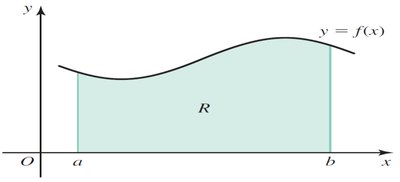
Area Under a Curve
The area under a curve y = f(x) from x = a to x = b is found using definite integration.
Formula:
Example: Find the area under y = x^2 from x = 0 to x = 2.
Area Between Two Curves (Vertical Slices)
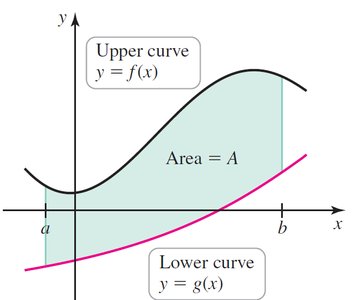
To find the area between two curves y = f(x) (upper) and y = g(x) (lower) from x = a to x = b, subtract the lower curve from the upper curve and integrate.
Formula:
Example: Area between y = x^2 and y = x from x = 0 to x = 1.
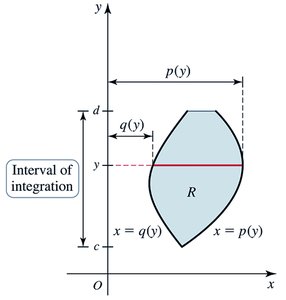
Area Between Two Curves (Horizontal Slices)
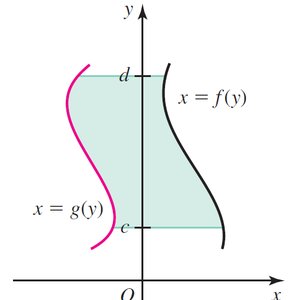
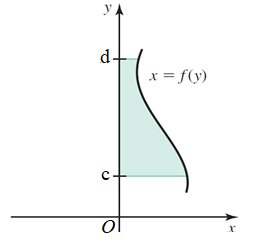
When curves are defined as x = f(y) and x = g(y), the area between them from y = c to y = d is:
Formula:
6.3 Volume by Slicing
Volume of Solids with Known Cross Section
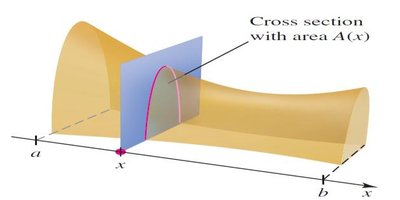
The volume of a solid with cross-sectional area A(x) perpendicular to the x-axis from x = a to x = b is:
Formula:
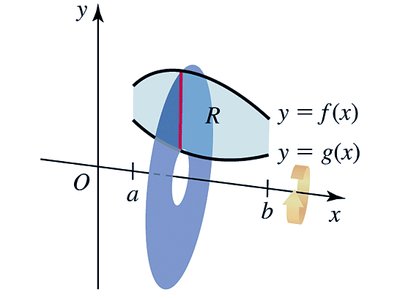
Volume by Rotation (Disk/Washer Method)
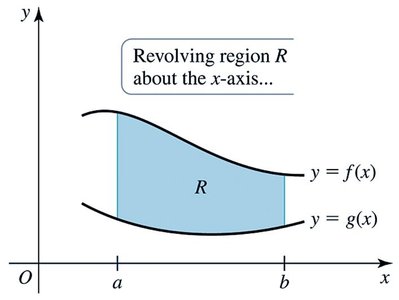
When a region is revolved about an axis, the volume can be found using the disk or washer method.
Disk Method (about x-axis):
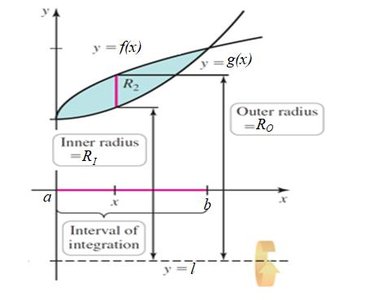
Washer Method (about x-axis):
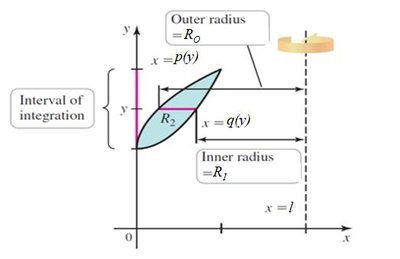
Disk/Washer Method (about y-axis): or
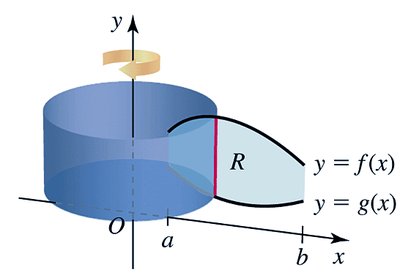
Volume by Slicing (Advanced)
For solids generated by rotating a region about a line parallel to the x- or y-axis, the volume is:
Formula (x-axis):
Formula (y-axis):
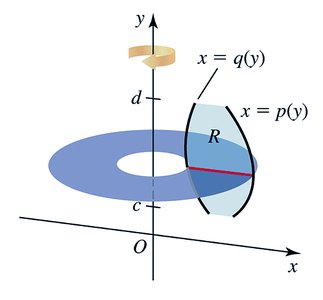
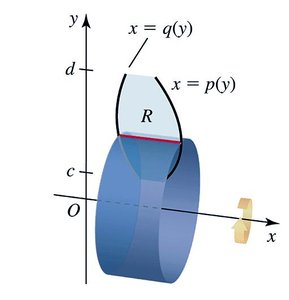
6.4 Volume by Shells
Shell Method (in x)
The shell method is used when slicing parallel to the y-axis. The volume is calculated by integrating cylindrical shells.
Formula: (for height )
Formula (between two curves):
6.5 Arc Length
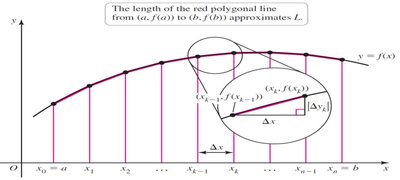
Arc Length of a Curve
The length of a smooth curve y = f(x) from x = a to x = b is given by:
Formula:
For x = g(y):
6.6 Surface Area
Surface Area of Revolution
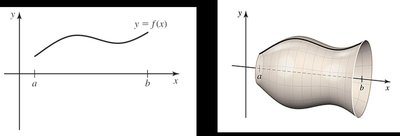
The surface area of a solid generated by revolving y = f(x) about the x-axis from x = a to x = b is:
Formula:
For x = g(y) about y-axis:
6.7 Physical Applications
Mass and Work
Integration is used to solve physical problems such as finding mass and work.
Mass of a thin bar/wire: where is the density function.
Work done by a force:
Work to lift a chain:
Work to lift a fluid:
Summary Table: Area and Volume Formulas
Concept | Formula | Variables |
|---|---|---|
Area under curve | , , | |
Area between curves | , , , | |
Volume (disk) | , , | |
Volume (washer) | , , , | |
Volume (shell) | , , , | |
Arc length | , , | |
Surface area | , , |
