Back
Chapter 6: Applications of Integration – Velocity, Net Change, and Physical Applications
Study Guide - Smart Notes
 Tailored notes based on your materials, expanded with key definitions, examples, and context.
6.1 Velocity and Net Change
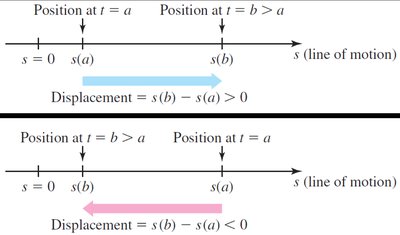
Displacement and Distance Traveled
In calculus, integration is used to analyze motion along a straight line by relating position, velocity, and acceleration. The displacement of an object is the net change in its position over a time interval, while the distance traveled is the total length of the path, regardless of direction.
Displacement: If s(t) is the position function, the displacement over [a, b] is s(b) - s(a).
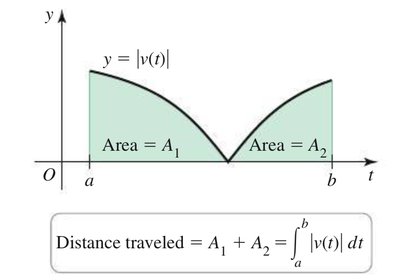
Distance Traveled: The total distance is the integral of the speed (the absolute value of velocity):
Velocity and Position: Velocity is the derivative of position: v(t) = s'(t).
Fundamental Theorem of Calculus (FTC): Relates the integral of velocity to displacement:
Example: Jogger's Motion
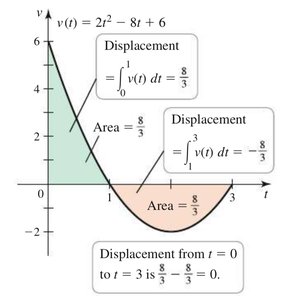
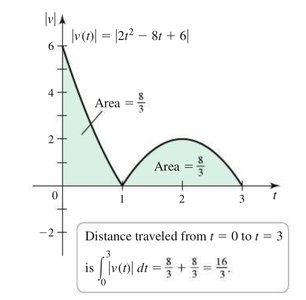
Consider a jogger with velocity function v(t) = 2t^2 - 8t + 6 for 0 \leq t \leq 3 (in mi/hr). We analyze the motion as follows:
Direction of Motion: The jogger moves in the positive direction when v(t) > 0 and in the negative direction when v(t) < 0.
Displacement on Intervals:
On [0, 1]:
On [1, 3]:
On [0, 3]:
Distance Traveled:
Position from Velocity
Given the velocity function and initial position, the position at any time t is found by integrating velocity:
Theorem 6.1:
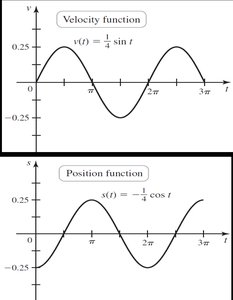
Example: If v(t) = \frac{1}{4} \sin t, s(0) = -\frac{1}{4}, then
Piecewise Velocity Example
For a skydiver with a piecewise velocity function, the total distance is the sum of integrals over each interval:
Velocity from Acceleration
Given acceleration a(t) and initial velocity v(0), the velocity is:
Example: Projectile Motion
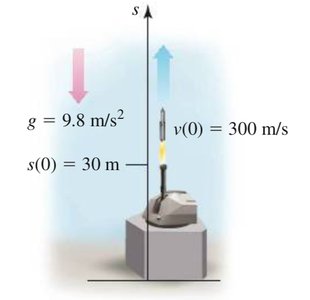
An artillery shell is fired upward with v(0) = 300 m/s from s(0) = 30 m. Gravity acts with a(t) = -9.8 m/s2.
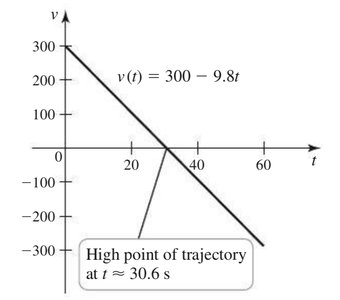
Velocity:
Position:
Highest Point: Occurs when s, m
Time to Ground: Solve s
6.1 Net Change and Future Value
Net Change Theorem
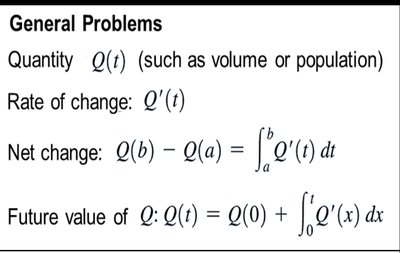
The Net Change Theorem states that the net change in a quantity Q(t) over [a, b] is the integral of its rate of change:
Future value from initial value:
Example: Population Growth
A town has initial population 250 and grows at rate .
Net Change (10 to 20 years):
Population at time t:
Summary Tables
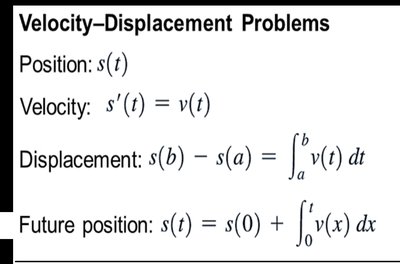
Velocity–Displacement Problems |
|---|
Position: |
Velocity: |
Displacement: |
Future position: |
General Problems |
|---|
Quantity: (e.g., volume, population) |
Rate of change: |
Net change: |
Future value: |