 Back
Comprehensive Calculus Final Exam Study Guide
Study Guide - Smart Notes
 Tailored notes based on your materials, expanded with key definitions, examples, and context.
Q1. For the curve :
a) Find the value(s) of where the velocity vector of is orthogonal to the vector , where and .
b) Compute the unit tangent vector .
Background
Topic: Vector Calculus – Parametric Curves and Tangent Vectors
This question tests your understanding of parametric curves, velocity vectors, orthogonality, and unit tangent vectors.
Key Terms and Formulas
Velocity vector:
Orthogonality: Two vectors and are orthogonal if
Unit tangent vector:
Step-by-Step Guidance
Compute by differentiating each component of with respect to .
Find the vector by subtracting from .
Set up the dot product and set it equal to zero to find the value(s) of where the vectors are orthogonal.
For part (b), recall that the unit tangent vector is the normalized velocity vector: .
Calculate by taking the square root of the sum of the squares of the components.
Try solving on your own before revealing the answer!
Final Answer:
a) The value(s) of where the velocity vector is orthogonal to are and .
b) The unit tangent vector is .
For part (a), we solved and found the values of . For part (b), we computed the unit tangent vector using the velocity vector and its magnitude.
Q2. For the rectangular plate bounded by , , , and temperature function :
a) Find the critical point of in the interior and classify it using the second derivative test.
b) State the important fact from section 14.7 that guarantees takes on an absolute maximum and minimum on .
c) Determine the hottest point(s) on the plate.
Background
Topic: Multivariable Calculus – Optimization and Critical Points
This question tests your ability to find and classify critical points, and to understand absolute extrema on closed bounded regions.
Key Terms and Formulas
Critical point: Where
Second derivative test: Use the Hessian matrix to classify the critical point
Extreme Value Theorem: Guarantees absolute extrema on closed bounded regions
Step-by-Step Guidance
Compute the partial derivatives and and set them equal to zero to find the critical point(s).
Calculate the second partial derivatives and form the Hessian matrix .
Evaluate the Hessian at the critical point to classify it (minimum, maximum, saddle).
Recall the Extreme Value Theorem: a continuous function on a closed bounded region attains its absolute maximum and minimum.
Check the boundary of to find the hottest point(s) by evaluating at the edges and corners.
Try solving on your own before revealing the answer!
Final Answer:
a) The critical point in the interior is , and it is a saddle point.
b) The Extreme Value Theorem guarantees absolute maximum and minimum on .
c) The hottest point is at , where .
We found the critical point by solving , classified it using the Hessian, and checked the boundary for absolute extrema.
Q3. For the function :
a) Compute the gradient .
b) On the level surface , find points and where the tangent plane's normal points in the direction . $P_1$ has all positive coordinates.
c) For , find the work done by along the line segment from to .
Background
Topic: Multivariable Calculus – Gradients, Level Surfaces, and Work
This question tests your ability to compute gradients, analyze level surfaces, and calculate work using vector fields.
Key Terms and Formulas
Gradient:
Level surface: Set
Work:
Step-by-Step Guidance
Compute the partial derivatives of with respect to , , and to find .
Set and solve for points where the gradient is parallel to .
Choose with positive coordinates and with negative or zero coordinates as required.
For the work, recall that is conservative, so work is .
Set up the calculation for the work along the segment from to .
Try solving on your own before revealing the answer!
Final Answer:
a)
b) and
c) The work done is $0$.
We computed the gradient, found points on the level surface with the required normal direction, and used the conservative property of to find the work.
Q4. For a differentiable function with , and , , find the directional derivative of at in the direction .
Background
Topic: Multivariable Calculus – Chain Rule and Directional Derivatives
This question tests your ability to use the multivariable chain rule and compute directional derivatives.
Key Terms and Formulas
Chain rule:
Directional derivative:
Step-by-Step Guidance
Compute and , and similarly for .
Use the chain rule to find and at .
Form the gradient at the point.
Take the dot product of with the unit vector .
Set up the calculation for the directional derivative.
Try solving on your own before revealing the answer!
Final Answer:
The directional derivative at in the direction is .
We used the chain rule to compute the gradient and then took the dot product with the unit direction vector.
Q5. Let be the quadrilateral with vertices , , , and in the -plane. Use a double integral to calculate the volume above $Q$ and below .
Background
Topic: Multivariable Calculus – Double Integrals and Volumes
This question tests your ability to set up and evaluate double integrals to find volumes under surfaces.
Key Terms and Formulas
Volume:
Limits of integration: Determined by the geometry of
Step-by-Step Guidance
Sketch or describe the region and determine the limits for and .
Set up the double integral using the appropriate bounds.
Integrate with respect to first, then , or vice versa, depending on the region's shape.
Evaluate the inner integral, then set up the outer integral.
Prepare to compute the final value by plugging in the limits.
Try solving on your own before revealing the answer!
Final Answer:
The volume is $40$.
We set up the double integral over the quadrilateral and evaluated it to find the volume under the plane.
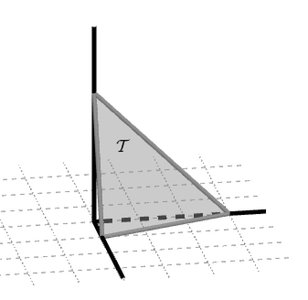
Q6. Let be the triangle with vertices , , . If cheese is distributed according to , use a surface integral to calculate the amount of cheese on the pizza: . Parametrize $T$ using and .
Background
Topic: Multivariable Calculus – Surface Integrals and Parametrization
This question tests your ability to parametrize a surface and evaluate a surface integral.
Key Terms and Formulas
Surface integral:
Parametrization: Express in terms of and for the triangle
Surface area element:
Step-by-Step Guidance
Find a parametrization for the triangle using and as parameters.
Express in terms of and based on the triangle's geometry.
Compute the surface area element using the cross product of partial derivatives.
Set up the surface integral with the correct bounds for and .
Prepare to evaluate the integral by plugging in the parametrization and area element.
Try solving on your own before revealing the answer!
Final Answer:
The amount of cheese is $54$ ounces.
We parametrized the triangle, computed the surface area element, and evaluated the surface integral.
Q7. Let be the region inside the sphere and outside the sphere . Using spherical coordinates, evaluate .
Background
Topic: Multivariable Calculus – Triple Integrals in Spherical Coordinates
This question tests your ability to set up and evaluate triple integrals using spherical coordinates.
Key Terms and Formulas
Spherical coordinates: , ,
Volume element:
Step-by-Step Guidance
Express the boundaries of in terms of spherical coordinates.
Set up the triple integral using the spherical volume element.
Determine the limits for , , and based on the spheres' equations.
Integrate with respect to first, then , then .
Prepare to evaluate the integral by plugging in the limits.
Try solving on your own before revealing the answer!
Final Answer:
The value of the integral is .
We set up the triple integral in spherical coordinates and evaluated it over the region between the two spheres.
Q8. Let be the region above and inside the circle . Use Green's Theorem to calculate the circulation of around the boundary of $D$ in the counterclockwise sense.
Background
Topic: Multivariable Calculus – Green's Theorem and Circulation
This question tests your ability to apply Green's Theorem to compute circulation around a region.
Key Terms and Formulas
Green's Theorem:
Circulation: Line integral around the boundary
Step-by-Step Guidance
Identify and .
Compute and .
Set up the double integral over using the result from Green's Theorem.
Determine the limits for and based on the region above and inside the circle.
Prepare to evaluate the integral by plugging in the limits.
Try solving on your own before revealing the answer!
Final Answer:
The circulation is .
We applied Green's Theorem, computed the partial derivatives, and evaluated the double integral over the specified region.
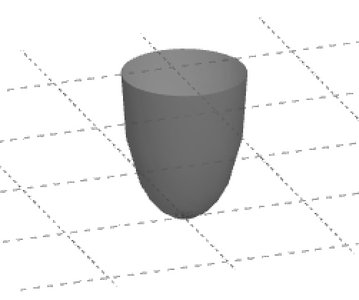
Q9. Let be the sake cup surface parametrized by , , for , . Use Stokes' Theorem to calculate the outward flux of the curl of through $S$.
Background
Topic: Multivariable Calculus – Stokes' Theorem and Surface Integrals
This question tests your ability to parametrize a surface and apply Stokes' Theorem to compute flux.
Key Terms and Formulas
Stokes' Theorem:
Parametrization: Express in terms of and
Step-by-Step Guidance
Parametrize the surface using and .
Compute the curl .
Set up the surface integral using the parametrization.
Determine the boundary curve and set up the line integral if needed.
Prepare to evaluate the integral by plugging in the parametrization and limits.
Try solving on your own before revealing the answer!
Final Answer:
The outward flux is .
We parametrized the surface, computed the curl, and applied Stokes' Theorem to evaluate the flux.
Q10. Let be the region below and above the -plane. For , verify the Divergence Theorem by calculating the outward flux through the boundary in two ways:
i) Using the surface integral
ii) Using the triple integral
Background
Topic: Multivariable Calculus – Divergence Theorem and Flux
This question tests your ability to compute flux using both surface and volume integrals, and to verify the Divergence Theorem.
Key Terms and Formulas
Divergence Theorem:
Divergence:
Step-by-Step Guidance
Compute the divergence .
Set up the triple integral over the region below the paraboloid and above the -plane.
Set up the surface integral for the boundary .
Express the region and surface in cylindrical coordinates for easier integration.
Prepare to evaluate both integrals and compare the results.
Try solving on your own before revealing the answer!
Final Answer:
The outward flux through is , and the triple integral also yields $128\pi$, verifying the Divergence Theorem.
We computed both the surface and volume integrals and confirmed that they are equal, as predicted by the theorem.
