 Back
BackComprehensive Calculus II Exam Review: Derivatives, Curve Sketching, and Analysis
Study Guide - Smart Notes
 Tailored notes based on your materials, expanded with key definitions, examples, and context.
Q1. Find the derivatives of the following functions. You do not need to simplify your final answers.
Background
Topic: Differentiation Rules
This question tests your ability to apply the basic rules of differentiation, including the power rule, product rule, quotient rule, chain rule, and derivatives of exponential, logarithmic, trigonometric, and inverse trigonometric functions.
Key Terms and Formulas:
Power Rule:
Product Rule:
Quotient Rule:
Chain Rule:
Derivatives of basic functions (e.g., , , , , , etc.)
Step-by-Step Guidance
For each function, first identify which rule(s) apply: Is it a product, quotient, or composition of functions?
Write down the function and label and if using product or quotient rule.
Apply the appropriate differentiation rule(s) step by step, showing each derivative taken.
For composite functions, use the chain rule and clearly indicate the inner and outer functions.
For higher-order derivatives, repeat the differentiation process as needed.
Try solving on your own before revealing the answer!
Q2. Find all x-values at which has a horizontal tangent line.
Background
Topic: Critical Points and Tangent Lines
This question is about finding where the derivative of a function equals zero, which corresponds to horizontal tangent lines on the graph of the function.
Key Terms and Formulas:
Horizontal tangent line: Occurs where
Quotient Rule:
Step-by-Step Guidance
Let and .
Find and separately.
Apply the quotient rule to find .
Set and solve for to find where the tangent is horizontal.
Try solving on your own before revealing the answer!
Q3. Find the second derivative of .
Background
Topic: Higher-Order Derivatives
This question asks you to find the second derivative, which means differentiating the function twice. This is useful for analyzing concavity and points of inflection.
Key Terms and Formulas:
First derivative of :
Product Rule:
Derivative of :
Step-by-Step Guidance
Find the first derivative: .
Apply the product rule to to find .
Differentiate and as needed in the product rule.
Combine like terms and simplify as much as possible, but do not fully expand or combine all terms yet.
Try solving on your own before revealing the answer!
Q4. Find the fourth derivative of .
Background
Topic: Higher-Order Derivatives
This question tests your ability to repeatedly differentiate a function, using the rules for polynomials, exponentials, and logarithms.
Key Terms and Formulas:
Power Rule:
Derivative of :
Derivative of :
Step-by-Step Guidance
Find the first derivative of each term separately.
Continue differentiating each term until you reach the fourth derivative.
For the polynomial, note that after a certain number of derivatives, the term will become zero.
For the exponential and logarithmic terms, apply the rules for each differentiation step.
Try solving on your own before revealing the answer!
Q5. Find at least three different ways (by algebraically rewriting the function) to evaluate the derivative of , and simplify each derivative to show that they are all equivalent.
Background
Topic: Algebraic Manipulation and Differentiation
This question is about recognizing that a function can be rewritten in different forms, and that the derivative should be the same regardless of the form used. It reinforces understanding of the product, quotient, and chain rules.
Key Terms and Formulas:
Quotient Rule:
Product Rule:
Chain Rule:
Step-by-Step Guidance
Rewrite in at least three different algebraic forms (e.g., expand numerator, write as a product, or use negative exponents).
For each form, apply the appropriate differentiation rule (product, quotient, or chain rule).
Simplify each derivative as much as possible to show equivalence.
Compare the simplified derivatives to confirm they are the same.
Try solving on your own before revealing the answer!
Q6. Use technology to graph the functions and its first two derivatives. Compare and contrast the three graphs - what do they all have in common? What features of are related to features of , and how? What about $y = f(x)$ vs ? Or $y = f'(x)$ vs $y = f''(x)$?
Background
Topic: Graphical Analysis of Functions and Their Derivatives
This question asks you to interpret and compare the graphs of a function and its derivatives, focusing on how features such as maxima, minima, and inflection points relate between the graphs.
Key Terms and Concepts:
Critical points: Where or is undefined
Inflection points: Where or changes sign
Relationship between , , and
Step-by-Step Guidance
Graph and its first two derivatives using graphing technology.
Identify key features on each graph: maxima, minima, points of inflection, and intervals of increase/decrease.
Compare where has horizontal tangents to where crosses the x-axis.
Discuss how the concavity of relates to the sign of .
Try analyzing the graphs and relationships before reading the sample explanations!
Q7. Sketch a function with the following characteristics: Increasing on , ; decreasing on ; concave up on ; concave down on ; local maximum at ; local minimum at , point of inflection at .
Background
Topic: Curve Sketching
This question tests your ability to synthesize information about increasing/decreasing intervals, concavity, extrema, and inflection points to sketch a function.
Key Terms and Concepts:
Increasing/Decreasing Intervals: Determined by the sign of
Concavity: Determined by the sign of
Local Maximum/Minimum: Where and indicates concavity
Point of Inflection: Where changes sign
Step-by-Step Guidance
Mark the given points: local max at , local min at , inflection at .
Draw the function increasing on and , decreasing on .
Ensure the graph is concave down on and concave up on , with a change at .
Connect the points smoothly, respecting the required behavior.
Try sketching the graph before checking a sample!
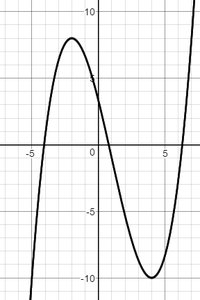
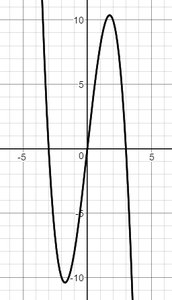
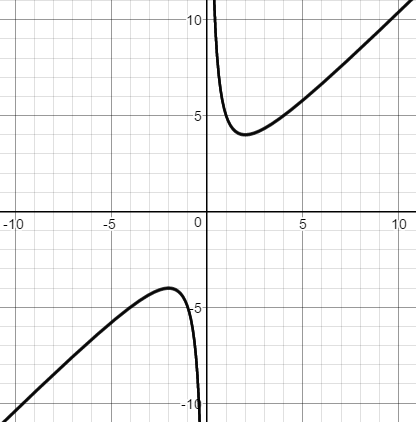
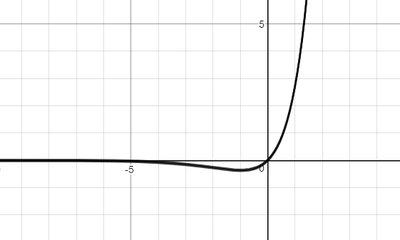
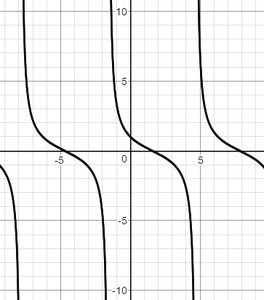
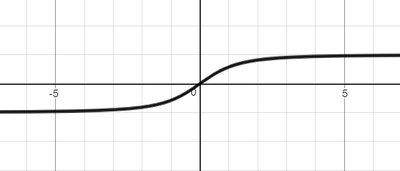
Q8. For each of the following functions, state any intervals on which the graph is increasing, decreasing, concave up, and concave down. List all local extrema and points of inflection. Use this information, along with any additional information about the domain, intercepts, or asymptotes of the function to draw a graph.
Background
Topic: Curve Sketching and Analysis
This question asks you to analyze a function using calculus to determine its behavior and sketch its graph. You will use the first and second derivatives to find intervals of increase/decrease, concavity, extrema, and inflection points.
Key Terms and Formulas:
Critical points: Where or is undefined
Intervals of increase/decrease: Determined by the sign of
Concavity: Determined by the sign of
Points of inflection: Where changes sign
Domain, intercepts, asymptotes
Step-by-Step Guidance
Find the first derivative and solve to locate critical points.
Test intervals between critical points to determine where the function is increasing or decreasing.
Find the second derivative and solve to locate possible inflection points.
Test intervals between inflection points to determine concavity.
Use all this information to sketch the graph, marking intercepts, asymptotes, and key points.
Try analyzing and sketching each function before checking the sample graphs!
Q9. Use a limit and l’Hôpital’s Rule for the following:
(a) Describe the behavior of around .
(b) Describe the end behavior of as .
(c) Describe the end behavior of as .
(d) Describe the behavior of as .
(e) Describe the behavior of as .
Background
Topic: Limits and L’Hôpital’s Rule
This question tests your ability to evaluate limits that result in indeterminate forms using L’Hôpital’s Rule, which involves differentiating the numerator and denominator until the limit can be evaluated.
Key Terms and Formulas:
L’Hôpital’s Rule: If yields or , then (if the limit exists).
Indeterminate forms: , , , , etc.
Step-by-Step Guidance
For each limit, first substitute the value to check if it is indeterminate.
If indeterminate, apply L’Hôpital’s Rule by differentiating numerator and denominator as needed.
Repeat the process if the result is still indeterminate.
Interpret the result in terms of the behavior of the function near the point or as .
Try working through the limits before checking the solutions!
