 Back
BackComprehensive Calculus II Exam Review: Derivatives, Curve Sketching, and Limits
Study Guide - Smart Notes
 Tailored notes based on your materials, expanded with key definitions, examples, and context.
Q1. Find the derivatives of the following functions. You do not need to simplify your final answers.
Background
Topic: Differentiation Rules (Product, Quotient, Chain, and Basic Derivatives)
This question tests your ability to recognize and apply the correct differentiation rules to a variety of functions, including polynomials, exponentials, logarithms, trigonometric, and inverse trigonometric functions. You will need to identify when to use the product rule, quotient rule, and chain rule, and combine them as needed.
Key Terms and Formulas
Product Rule:
Quotient Rule:
Chain Rule:
Basic Derivatives: , , , , , etc.
Step-by-Step Guidance
For each function, first identify its structure: is it a product, quotient, composition (chain), or a combination?
Write down the rule(s) you will need for that function (e.g., product rule for , quotient rule for , chain rule for , etc.).
Compute the derivatives of the inner and outer functions as needed. For example, if using the chain rule, find the derivative of the outer function and multiply by the derivative of the inner function.
Combine the results according to the rule. For the product rule, add the two terms; for the quotient rule, subtract and divide as indicated; for the chain rule, multiply as required.
Stop before simplifying the final expression. Do not combine like terms or reduce the expression further.
Try solving on your own before revealing the answer!
Q2. Find all x-values at which has a horizontal tangent line.
Background
Topic: Critical Points and Horizontal Tangents
This question is about finding where the derivative of a function is zero, which corresponds to horizontal tangent lines on the graph of the function. These points are important for identifying local maxima, minima, or points of inflection.
Key Terms and Formulas
Horizontal Tangent: Occurs where .
Derivative of a Quotient: Use the quotient rule as above.
Step-by-Step Guidance
Let . Identify and .
Apply the quotient rule to find : .
Compute and . Recall and .
Set and solve for . This will give you the x-values where the tangent is horizontal.
Try solving on your own before revealing the answer!
Q3. Find the second derivative of .
Background
Topic: Higher-Order Derivatives
This question asks you to find the second derivative, which means you must first find the first derivative and then differentiate again. This is useful for analyzing concavity and points of inflection.
Key Terms and Formulas
First Derivative:
Product Rule:
Derivative of :
Step-by-Step Guidance
Start by finding .
To find , differentiate using the product rule.
Let and . Compute and .
Combine the results using the product rule formula, but do not simplify the final expression yet.
Try solving on your own before revealing the answer!
Q4. Find the fourth derivative of .
Background
Topic: Higher-Order Derivatives and Linearity of Differentiation
This question tests your ability to repeatedly differentiate a sum of functions, using the power rule, exponential rule, and logarithmic rule as needed.
Key Terms and Formulas
Power Rule:
Exponential Rule:
Logarithmic Rule:
Step-by-Step Guidance
Differentiate four times, four times, and four times, using the appropriate rules for each term.
Add the results together, since differentiation is linear.
Stop before simplifying the final expression.
Try solving on your own before revealing the answer!
Q5. For , find at least three different ways (by algebraically rewriting the function) to evaluate the derivative, and simplify each derivative to show they are all equivalent.
Background
Topic: Algebraic Manipulation and Differentiation
This question is about recognizing that a function can be rewritten in different forms, which may make differentiation easier or require different rules. It also reinforces the equivalence of different approaches.
Key Terms and Formulas
Product Rule, Quotient Rule, Chain Rule (as above)
Algebraic manipulation: Expand numerator, rewrite as a product, or use negative exponents.
Step-by-Step Guidance
Rewrite in three different forms: as a quotient, as a product with negative exponents, and by expanding the numerator.
For each form, apply the appropriate differentiation rule (quotient, product, or chain rule).
Show the derivative for each form, but do not fully simplify or combine the results yet.
Try solving on your own before revealing the answer!
Q6. Use technology to graph and its first two derivatives. Compare and contrast the three graphs - what do they all have in common? What features of are related to features of , and how? What about vs ? Or vs ?
Background
Topic: Graphical Interpretation of Functions and Their Derivatives
This question asks you to interpret and compare the graphs of a function and its derivatives, focusing on how features such as maxima, minima, and inflection points relate between the graphs.
Key Terms and Concepts
Critical Points: Where (horizontal tangents on )
Inflection Points: Where (change in concavity on )
Relationship: Maxima/minima of correspond to zeros of ; inflection points of correspond to zeros of .
Step-by-Step Guidance
Graph , , and using technology or graphing software.
Identify where has horizontal tangents (max/min), and observe how these correspond to zeros of .
Look for points where changes concavity (inflection points), and see how these relate to zeros of .
Compare the overall shape and behavior of the three graphs, noting similarities and differences.
Try analyzing the graphs and relationships before revealing the answer!
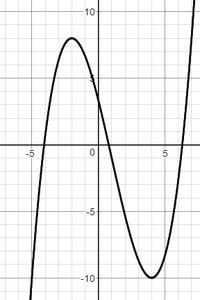
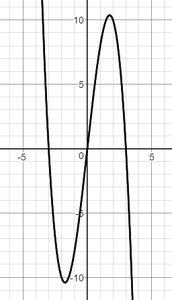
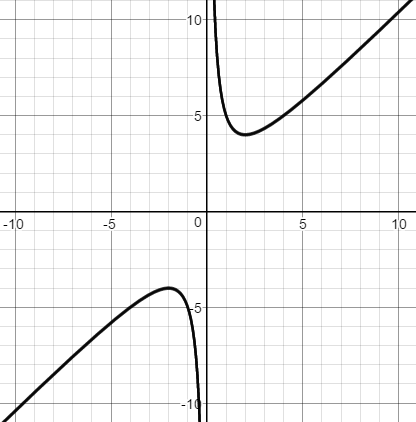
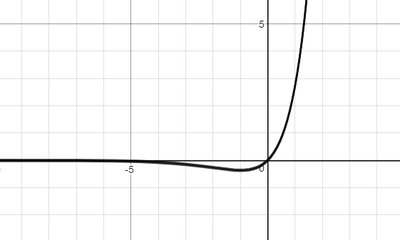
Q7. For each of the following functions, state any intervals on which the graph is increasing, decreasing, concave up, and concave down. List all local extrema and points of inflection. Use this information, along with any additional information about the domain, intercepts, or asymptotes of the function to draw a graph.
Background
Topic: Curve Sketching and Analysis
This question tests your ability to analyze a function using its first and second derivatives to determine intervals of increase/decrease, concavity, extrema, and inflection points. This is a key skill for sketching accurate graphs of functions.
Key Terms and Formulas
Increasing/Decreasing: (increasing), (decreasing)
Concave Up/Down: (concave up), (concave down)
Critical Points: Where or is undefined
Inflection Points: Where and concavity changes
Step-by-Step Guidance
Find the first derivative and solve to find critical points (potential extrema).
Find the second derivative and solve to find possible inflection points.
Test intervals between critical points and inflection points to determine where the function is increasing/decreasing and concave up/down.
Use this information, along with domain, intercepts, and asymptotes, to sketch the graph.
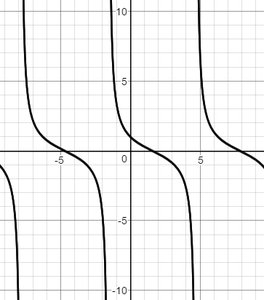
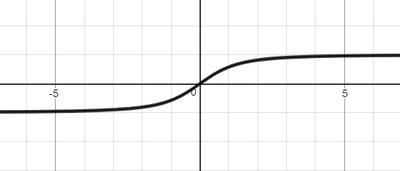
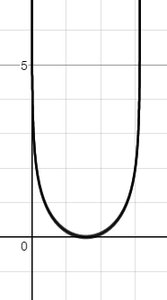
Try analyzing the intervals and sketching the graph before revealing the answer!
