 Back
BackComprehensive Calculus Study Notes: Limits, Derivatives, Integrals, and Applications
Study Guide - Smart Notes
 Tailored notes based on your materials, expanded with key definitions, examples, and context.
Limits and Continuity
Definitions and Properties of Limits
Limits are foundational to calculus, describing the behavior of functions as inputs approach specific values. Understanding limits is essential for defining derivatives and integrals.
Precise Definition: if for every there exists such that whenever , .
Working Definition: if can be made arbitrarily close to by taking sufficiently close to (but not equal to $a$).
One-Sided Limits: Right-hand limit () and left-hand limit () are defined similarly, but approaches from the right or left, respectively.
Limit at Infinity: means approaches as becomes large and positive; similarly for .
Infinite Limits: if grows arbitrarily large as approaches .
Relationship between Limits and One-Sided Limits:
If both one-sided limits exist and are equal, the two-sided limit exists and equals that value.
If the one-sided limits differ, the two-sided limit does not exist.
Properties of Limits
Linearity:
Addition/Subtraction:
Product:
Quotient: (if denominator limit is not zero)
Powers:
Basic Limit Evaluations at Infinity
,
,
For polynomials, the highest degree term dominates as .
Continuous Functions
A function is continuous at if .
Common continuous functions: polynomials (all ), rational functions (except where denominator is zero), , (), trigonometric functions (with domain restrictions).
Intermediate Value Theorem
If is continuous on and is between and , then there exists in such that .
Derivatives
Definition and Notation
The derivative measures the instantaneous rate of change of a function. It is defined as:
Alternative notations: , , , etc.
Interpretation of the Derivative
Slope of the tangent line: At , the slope is .
Instantaneous rate of change: gives the rate at which changes at .
Velocity: If is position, is velocity.
Basic Properties and Formulas
Constant Rule:
Power Rule:
Sum/Difference Rule:
Product Rule:
Quotient Rule:
Chain Rule:
Common Derivatives
,
Higher Order Derivatives
The second derivative: , measures concavity.
The th derivative: .
Implicit Differentiation
Used when is defined implicitly as a function of . Differentiate both sides with respect to $x$, applying the chain rule to terms involving $y$.
Applications of Derivatives
Critical Points, Extrema, and Tests
Critical Point: is a critical point if or does not exist.
Absolute Extrema: Maximum or minimum values on the entire domain.
Relative (Local) Extrema: Maximum or minimum values in a neighborhood.
First Derivative Test: Determines relative extrema by analyzing sign changes of around critical points.
Second Derivative Test: If , has a local minimum at ; if , a local maximum.
Mean Value Theorem
If is continuous on and differentiable on , then there exists in $(a, b)$ such that .
Newton’s Method
An iterative method for approximating roots of :
Related Rates
Used to find the rate at which one quantity changes with respect to another, often time. Differentiate both sides of an equation with respect to time .
Optimization
Finds maximum or minimum values of a function subject to constraints. Steps include expressing the quantity to be optimized in terms of one variable, finding critical points, and verifying extrema.
Integrals
Definitions
Definite Integral: represents the signed area under from to .
Antiderivative: is an antiderivative of if .
Indefinite Integral:
Fundamental Theorem of Calculus
Part I: If , then .
Part II: , where is any antiderivative of .
Properties of Integrals
Linearity:
Reversal of limits:
Zero width:
Common Integrals
,
Standard Integration Techniques
u-Substitution: For , ,
Integration by Parts:
Trig Substitutions: Used for integrals involving , , or
Partial Fractions: Decompose rational functions into simpler fractions for integration.
Applications of Integrals
Net Area and Area Between Curves
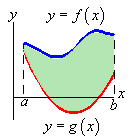
The definite integral gives the net area between and the -axis. To find the area between two curves and from to , use:
where on .
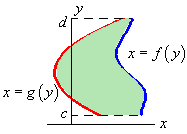
Alternatively, for curves defined as and from to :
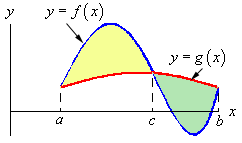
If the curves cross within the interval, split the integral at the intersection point:
Volumes of Revolution
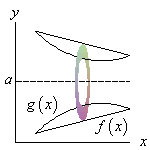
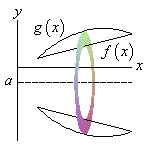
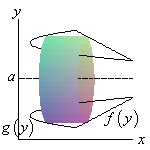
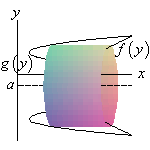
Volumes of solids of revolution can be computed using the disk/washer or cylindrical shell methods.
Disk/Washer Method:
Cylindrical Shell Method:
For rotation about horizontal or vertical axes, adjust the limits and functions accordingly.
Other Applications
Work: where is the force as a function of position.
Average Value:
Arc Length:
Surface Area (about x-axis):
Improper Integrals
Improper integrals involve infinite limits or discontinuous integrands. They are evaluated as limits:
Convergent if the limit exists and is finite; divergent otherwise.
Approximating Definite Integrals
Midpoint Rule:
Trapezoid Rule:
Simpson’s Rule: (n even)
