 Back
Back2.6 Continuity of Functions
Study Guide - Smart Notes
 Tailored notes based on your materials, expanded with key definitions, examples, and context.
Continuity of Functions
Definition and Basic Concepts
Continuity is a fundamental property of functions in calculus, describing whether a function's graph is unbroken and free of holes, jumps, or gaps at a given point or over an interval. A function is continuous at a point if its graph can be traced without lifting the pencil from the paper at that point.
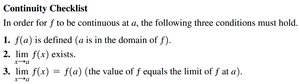
Continuity Checklist
f(a) is defined: The point a is in the domain of f.
limx→a f(x) exists: The limit of f(x) as x approaches a exists.
limx→a f(x) = f(a): The value of the function at a equals the limit as x approaches a.
Discontinuity
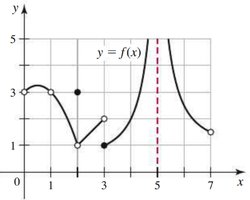
If any of the above conditions fail, the function has a discontinuity at a, and a is called a point of discontinuity.

Continuity of Polynomial and Rational Functions
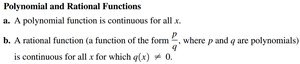
Polynomials and rational functions have well-defined continuity properties:
Polynomial functions: Continuous at every real number.
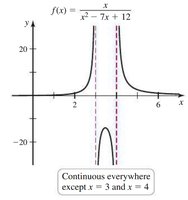
Rational functions: Continuous at every number in their domain (where the denominator is nonzero).
Continuity Rules
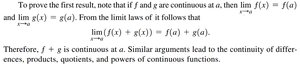
If f and g are continuous at a, then the following functions are also continuous at a:
f + g
f - g
cf (where c is a constant)
fg
f/g, provided g(a) ≠ 0
(f(x))n for integer n > 0
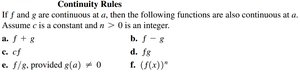
These rules allow us to build new continuous functions from existing ones.
Continuity of Composite Functions
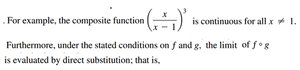
If g is continuous at a and f is continuous at g(a), then the composite function f ∘ g is continuous at a.

For example, the composite function is continuous for all x ≠ 1.
Limits of Composite Functions
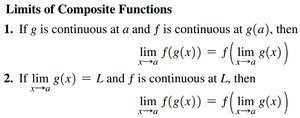
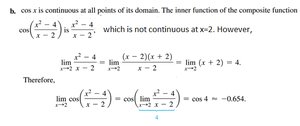
If g is continuous at a and f is continuous at g(a), then
If and f is continuous at L, then
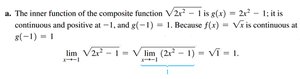
Examples
Continuity at Endpoints and on Intervals
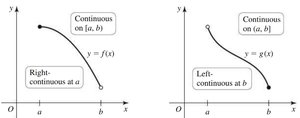
A function can be continuous from the right or left at endpoints of a closed interval. If f is continuous at all points of an interval I, and at endpoints from the appropriate side, it is continuous on I.
Right-continuous at a:
Left-continuous at b:

Examples
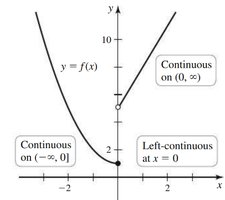
Piecewise functions may be continuous on intervals but only right- or left-continuous at endpoints.
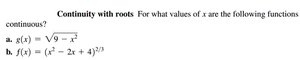
Continuity of Functions with Roots
If n is a positive integer:
If n is odd, is continuous wherever f is continuous.
If n is even, is continuous at points where f is continuous and f(a) > 0.
Examples
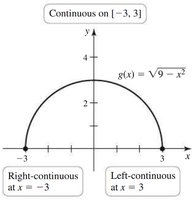
is continuous on [-3, 3], right-continuous at -3, left-continuous at 3.
is continuous for all x, since the root is odd.
Continuity of Inverse and Transcendental Functions
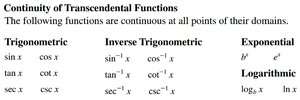
If f is continuous on an interval and has an inverse, then its inverse is also continuous on the corresponding interval. Common transcendental functions (trigonometric, inverse trigonometric, exponential, logarithmic) are continuous at all points in their domains.
Trigonometric | Inverse Trigonometric | Exponential | Logarithmic |
|---|---|---|---|
sin x cos x tan x cot x sec x csc x | sin-1 x cos-1 x tan-1 x cot-1 x sec-1 x csc-1 x | bx ex | logb x ln x |
Intermediate Value Theorem (IVT)
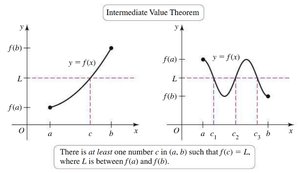
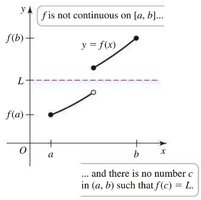
The IVT states that if f is continuous on [a, b] and L is a number strictly between f(a) and f(b), then there exists at least one number c in (a, b) such that f(c) = L. This theorem is fundamental for proving the existence of solutions to equations within intervals.
Example
Suppose f(x) is continuous on [a, b], f(a) < L < f(b). Then there is at least one c in (a, b) with f(c) = L.
Additional info: The notes cover Section 2.6 Continuity, which is directly relevant to Calculus Chapter 2 - Limits, and provides foundational material for later chapters on derivatives and integration. The examples and theorems are standard for college calculus courses.
