 Back
BackCurves in the Plane, Conic Sections, and Coordinate Systems
Study Guide - Smart Notes
 Tailored notes based on your materials, expanded with key definitions, examples, and context.
Curves in the Plane
Graphs of Functions
The graph of a function y = f(x) represents the set of all points (x, f(x)) in the plane, where x belongs to the domain of the function. This is a fundamental concept in calculus, as it allows us to visualize the behavior of functions and analyze their properties.
Definition: The graph of y = f(x) is the set of points (x, f(x)).
Example: For f(x) = x2, the graph is a parabola opening upwards.
Conic Sections
Definition and Types
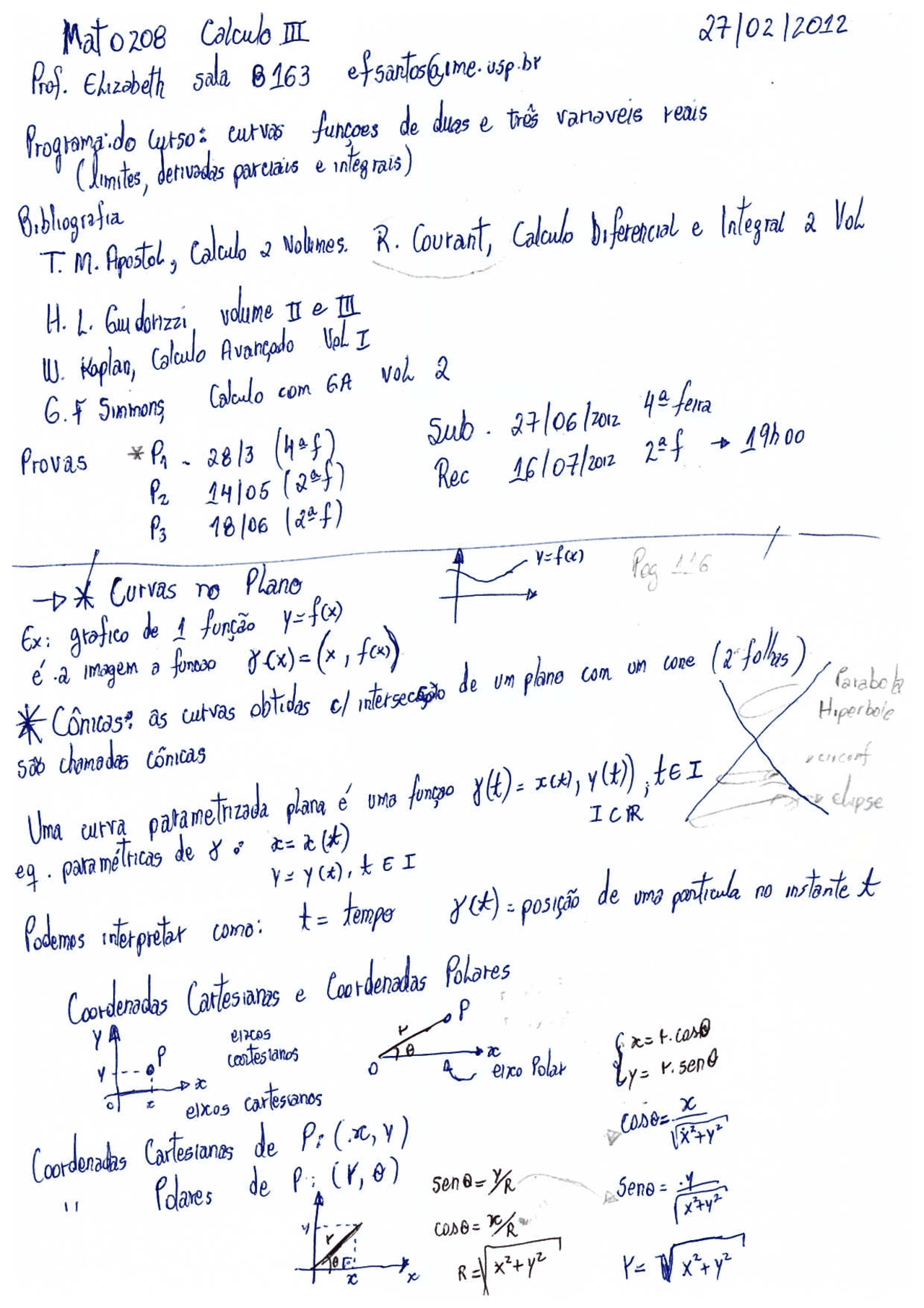
Conic sections are the curves obtained by intersecting a plane with a double-napped cone. The type of curve depends on the angle and position of the intersection:
Parabola: Intersection parallel to the side of the cone.
Ellipse: Intersection at an angle, but not parallel to the base or side.
Circle: Special case of an ellipse where the plane is perpendicular to the axis of the cone.
Hyperbola: Intersection cuts through both nappes of the cone.
These curves are fundamental in calculus and analytic geometry, with applications in physics, engineering, and astronomy.
Parametric Curves
Parametric Equations
A parametric curve in the plane is defined by a pair of functions x(t) and y(t), where t varies over an interval I. The set of points (x(t), y(t)) traces out the curve as t changes.
General form:
Interpretation: t can represent time, and (x(t), y(t)) the position of a particle at time t.
Example: The unit circle can be parametrized as , , .
Coordinate Systems
Cartesian and Polar Coordinates
Points in the plane can be represented using different coordinate systems:
Cartesian coordinates: Each point is given by (x, y), where x and y are distances along perpendicular axes.
Polar coordinates: Each point is given by (r, θ), where r is the distance from the origin and θ is the angle from the positive x-axis.
Conversion between Cartesian and Polar Coordinates
From polar to Cartesian:
From Cartesian to polar:
Example:
Given a point (3, 4) in Cartesian coordinates:
Summary Table: Coordinate Conversion
Cartesian (x, y) | Polar (r, θ) |
|---|---|
x = r cos θ | r = √(x² + y²) |
y = r sin θ | θ = arctan(y/x) |
Applications: Polar coordinates are especially useful for describing curves with circular or rotational symmetry, such as circles, spirals, and some conic sections.
Additional info: These topics are foundational for calculus involving functions of several variables, vector calculus, and advanced integration techniques.
