 Back
BackCurves in the Plane, Conics, and Coordinate Systems – Calculus III Study Notes
Study Guide - Smart Notes
 Tailored notes based on your materials, expanded with key definitions, examples, and context.
Curves in the Plane
Graphs of Functions
In calculus, a curve in the plane can often be represented as the graph of a function y = f(x). The graph is the set of all points (x, f(x)) for each x in the domain of f.
Definition: The graph of a function y = f(x) is the set of points (x, f(x)) in the plane.
Example: The parabola y = x^2 is the set of all points (x, x^2).
Conics
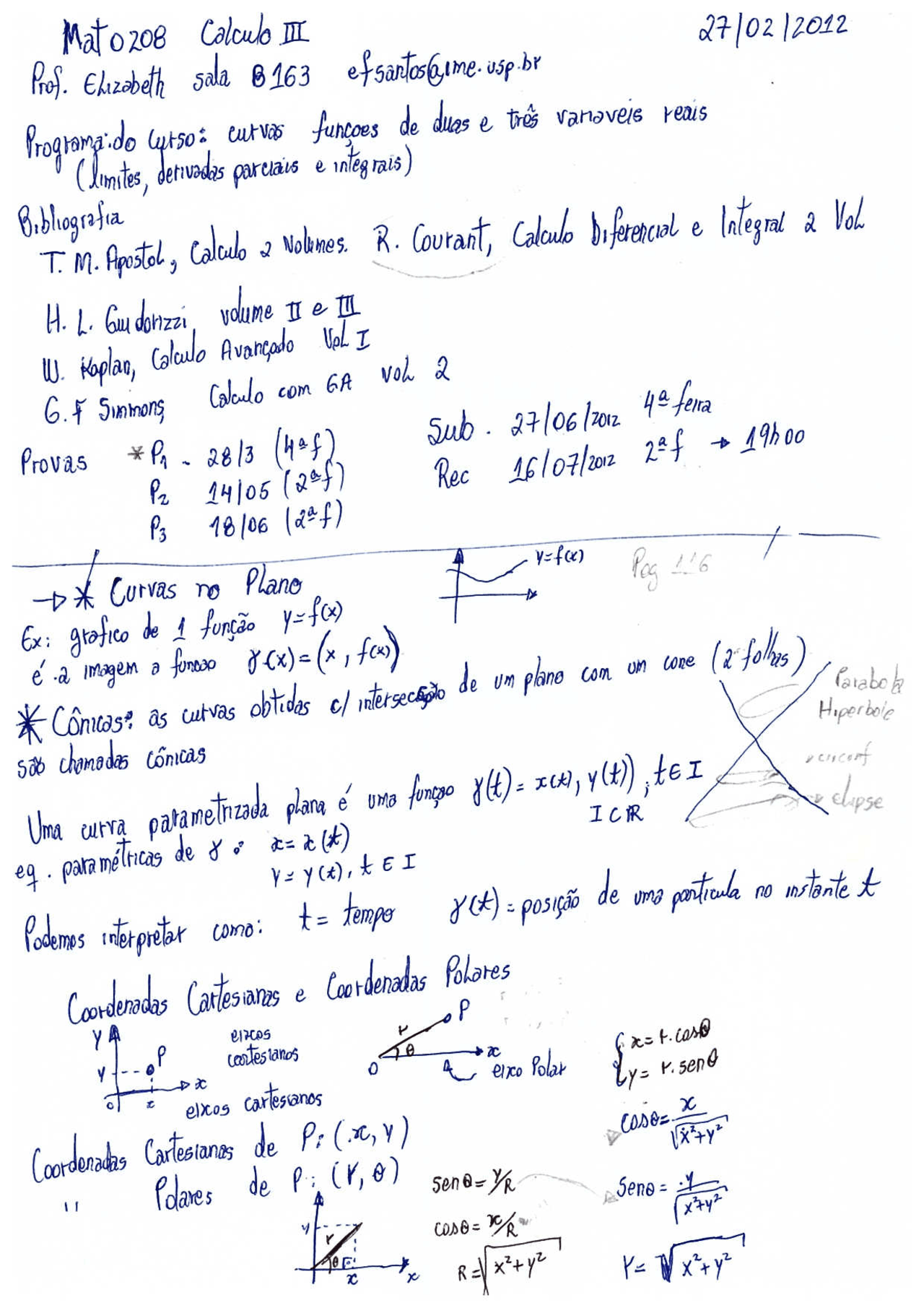
Conic sections are curves obtained by the intersection of a plane with a double-napped cone. These curves include the parabola, ellipse, circle, and hyperbola.
Definition: A conic is any curve formed by the intersection of a plane and a cone.
Types of Conics:
Circle: Plane perpendicular to the cone's axis.
Ellipse: Plane at an angle, not parallel to the side of the cone.
Parabola: Plane parallel to the side of the cone.
Hyperbola: Plane intersects both nappes of the cone.
Parametric Curves
Parametric Equations
A parametric curve in the plane is defined by a pair of functions x = x(t) and y = y(t), where t varies over an interval I of real numbers. The parameter t often represents time.
General Form:
Interpretation: t can represent time, and \gamma(t) = (x(t), y(t)) gives the position of a particle at time t.
Example: The unit circle can be parametrized as
Coordinate Systems
Cartesian and Polar Coordinates
Points in the plane can be described using either Cartesian coordinates (x, y) or polar coordinates (r, \theta).
Cartesian Coordinates: (x, y) specify the horizontal and vertical distances from the origin.
Polar Coordinates: (r, \theta) specify the distance r from the origin and the angle \theta from the positive x-axis.
Conversion Between Cartesian and Polar Coordinates
From Polar to Cartesian:
From Cartesian to Polar:
Summary Table: Cartesian vs. Polar Coordinates
Cartesian (x, y) | Polar (r, \theta) |
|---|---|
|
|
Additional info:
These topics are foundational for Calculus III, especially for understanding curves, surfaces, and coordinate transformations.
Conic sections are important in geometry, physics, and engineering applications.
Parametric equations and polar coordinates are essential for describing more general curves and for integration in multiple variables.
