 Back
BackCurves, Parametric Equations, and Coordinate Systems in Calculus III
Study Guide - Smart Notes
 Tailored notes based on your materials, expanded with key definitions, examples, and context.
Curvas no Plano (Curves in the Plane)
Gráfico de uma Função (Graph of a Function)
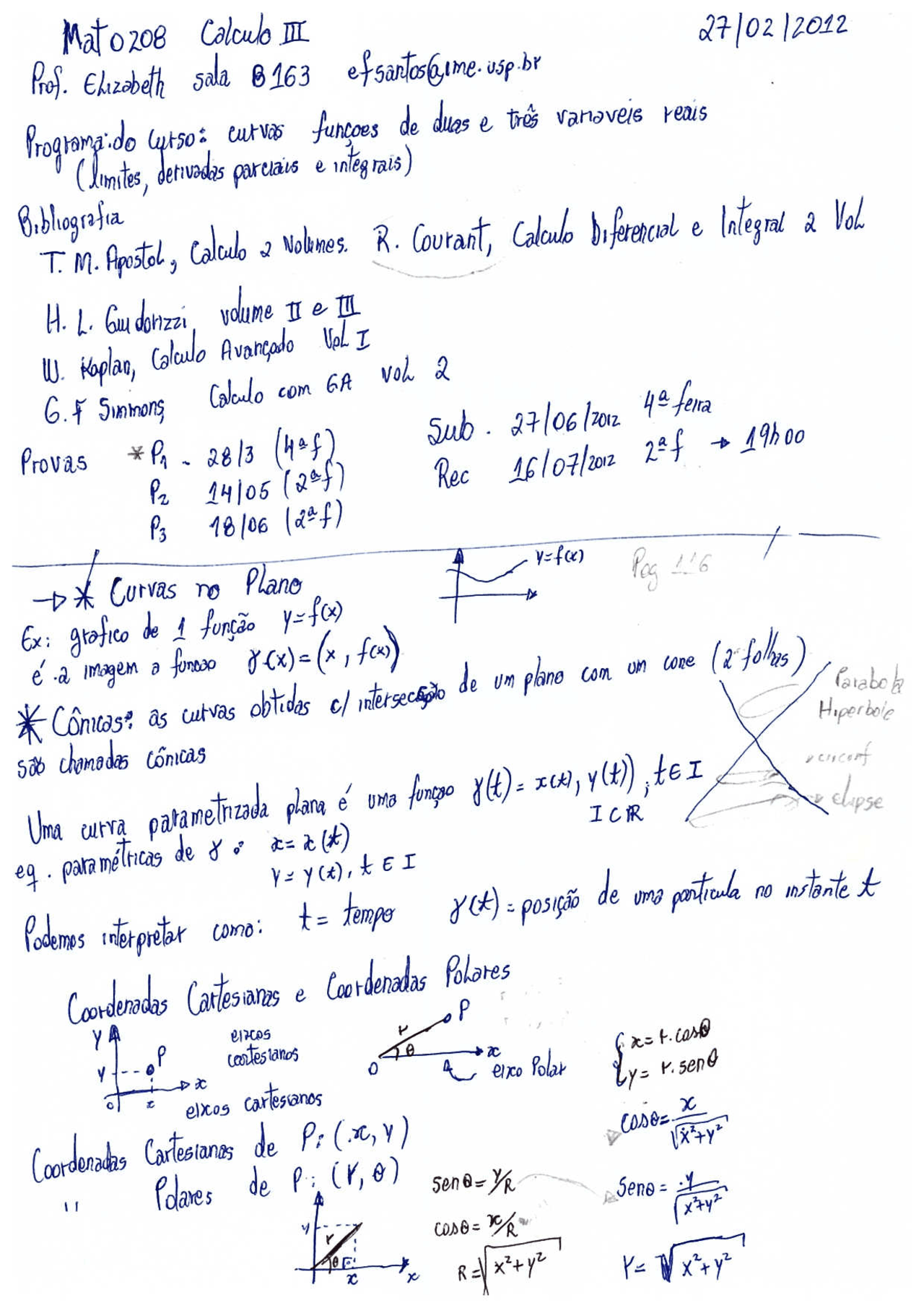
In Calculus, the graph of a function y = f(x) represents the set of all points (x, f(x)) in the plane. This is a fundamental concept for visualizing mathematical relationships and understanding the behavior of functions.
Definition: The graph of a function y = f(x) is the set of points (x, f(x)) for all x in the domain of f.
Example: For f(x) = x2, the graph is a parabola opening upwards.
Cônicas (Conic Sections)
Conic sections are curves obtained by intersecting a plane with a cone. These include the parabola, hyperbola, circle, and ellipse. Each type of conic section has unique geometric and algebraic properties.
Types of Conics:
Parabola
Hyperbola
Circle
Ellipse
Application: Conic sections appear in physics, engineering, and astronomy (e.g., planetary orbits).
Curvas Parametrizadas (Parametric Curves)
Equações Paramétricas (Parametric Equations)
A parametric curve in the plane is defined by a pair of functions x(t) and y(t), where t varies over an interval I. This allows for the representation of more general curves than those described by y = f(x) alone.
Definition: A parametric curve is given by:
Interpretation: The parameter t can often be interpreted as time, and the vector gives the position of a particle at time t.
Example: The unit circle can be parametrized as .
Sistemas de Coordenadas (Coordinate Systems)
Coordenadas Cartesianas (Cartesian Coordinates)
Cartesian coordinates describe the position of a point P in the plane using two perpendicular axes (x, y). This is the most common coordinate system in mathematics.
Definition: The coordinates of a point P are (x, y), where x is the horizontal distance and y is the vertical distance from the origin.
Coordenadas Polares (Polar Coordinates)
Polar coordinates describe the position of a point P using the distance from the origin (r) and the angle (θ) from the positive x-axis.
Definition: The coordinates of a point P are (r, θ), where:
Conversion between systems:
From Cartesian to Polar: or
From Polar to Cartesian:
Example: The point (1, 1) in Cartesian coordinates corresponds to , in polar coordinates.
Summary Table: Cartesian vs. Polar Coordinates
System | Coordinates | Conversion to Other System |
|---|---|---|
Cartesian | (x, y) | , |
Polar | (r, θ) | , |
Additional info: These concepts are foundational for studying multivariable calculus, including limits, derivatives, and integrals in higher dimensions.
