 Back
Derivatives of Trigonometric Functions: Calculus Study Notes
Study Guide - Smart Notes
 Tailored notes based on your materials, expanded with key definitions, examples, and context.
Derivatives of Trigonometric Functions
Introduction
This section explores the derivatives of basic trigonometric functions, focusing on sine and cosine. Understanding these derivatives is essential for solving problems involving rates of change and motion in calculus.
Derivative of the Sine Function
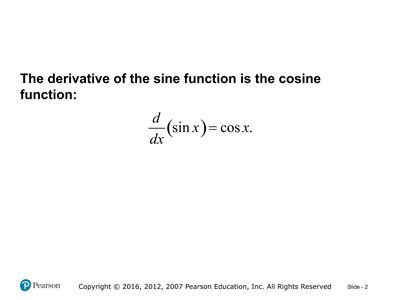
The derivative of the sine function describes how the value of sin x changes with respect to x. This is a fundamental result in calculus and is used extensively in applications involving periodic motion.
Key Point 1: The derivative of sin x is cos x.
Formula:
Example: If f(x) = \sin x, then f'(x) = \cos x.
Derivative of the Cosine Function
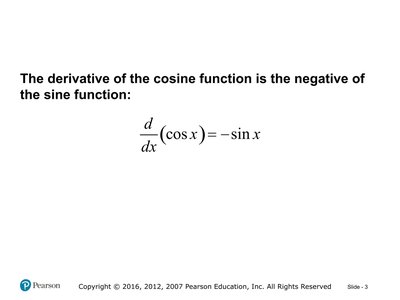
The derivative of the cosine function is closely related to the sine function, but with a negative sign. This relationship is important for understanding the behavior of trigonometric functions and their applications in physics and engineering.
Key Point 1: The derivative of cos x is -sin x.
Formula:
Example: If g(x) = \cos x, then g'(x) = -\sin x.
Graphical Interpretation of Derivatives
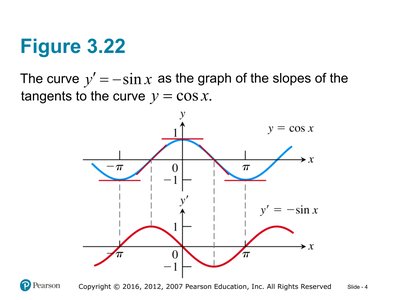
Graphing the derivatives of trigonometric functions helps visualize how the slope of the tangent line changes along the curve. The derivative of y = cos x is y' = -sin x, which can be seen as the graph of the slopes of tangents to the cosine curve.
Key Point 1: The graph of y' = -sin x represents the slope of the tangent to y = cos x at each point.
Key Point 2: The periodic nature of sine and cosine is reflected in their derivatives.
Example: At x = 0, y = cos x has a slope of 0 since -sin(0) = 0.
Applications: Position and Velocity in Periodic Motion
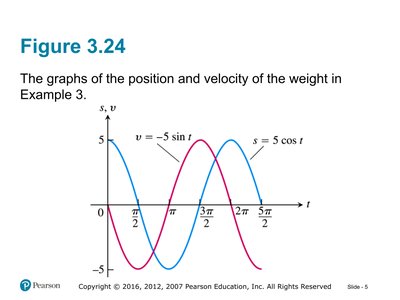
Trigonometric derivatives are used to model periodic motion, such as the position and velocity of a weight in oscillatory systems. The position function is often a cosine function, while the velocity is its derivative, a sine function with a negative coefficient.
Key Point 1: If s = 5 \cos t represents position, then v = -5 \sin t represents velocity.
Key Point 2: The graphs of position and velocity are phase-shifted by \frac{\pi}{2} radians.
Example: In a simple harmonic oscillator, the velocity is maximum when the position is zero.
Additional info: The derivatives of other trigonometric functions (such as tangent, cotangent, secant, and cosecant) are also important in calculus, but only sine and cosine are covered in these slides.
