 Back
BackDerivatives of Trigonometric Functions: Calculus Study Notes
Study Guide - Smart Notes
 Tailored notes based on your materials, expanded with key definitions, examples, and context.
Section 3.5: Derivatives of Trigonometric Functions
Introduction
Trigonometric functions are fundamental in calculus, and their derivatives are essential for solving many problems involving rates of change and motion. This section covers the derivatives of the six basic trigonometric functions, provides examples, and explores higher-order derivatives and their patterns.
Basic Derivatives of Trigonometric Functions
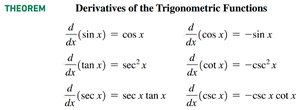
The derivatives of the six primary trigonometric functions are summarized below. These results are foundational for calculus and are frequently used in differentiation problems.
Sine:
Cosine:
Tangent:
Cotangent:
Secant:
Cosecant:
Numerical Limits and Derivatives
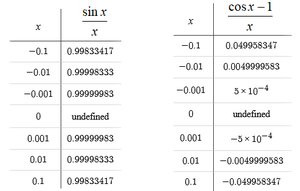
Numerical tables can help illustrate the behavior of trigonometric functions near zero, which is important for understanding limits and derivatives. For example, the limit is a key result used in calculus.
Derivatives of Sine and Cosine: Theorems and Examples
The derivatives of sine and cosine functions are often used in calculus. The following theorem summarizes these derivatives:
Theorem:
Theorem:

Examples: Differentiation Using Rules
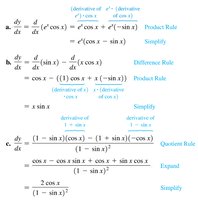
Applying the product, difference, and quotient rules allows us to differentiate more complex trigonometric expressions. The following examples demonstrate these techniques:
Product Rule:
Difference Rule:
Quotient Rule:
Derivatives of Other Trigonometric Functions
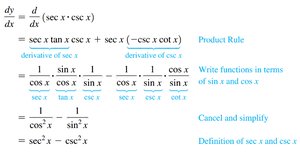
For functions such as secant and cosecant, the product rule is often used to find their derivatives. The following example shows the differentiation of :
Product Rule:
Expressing in terms of sine and cosine simplifies the result.
Limit Examples Involving Trigonometric Functions
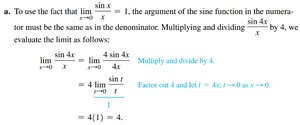
Limits involving trigonometric functions are often used to derive their derivatives. For example, the limit can be evaluated by multiplying and dividing by 4, and using the known limit .
Example:
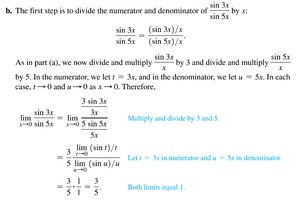
Example:
Higher-Order Derivatives of Trigonometric Functions
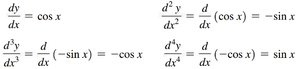
Higher-order derivatives of trigonometric functions exhibit periodic patterns. For example, the derivatives of and cycle every four derivatives:
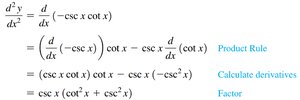
Second Derivative of Cosecant and Cotangent Functions
Calculating higher-order derivatives for functions like involves the product rule and simplification:
Summary Table: Derivatives of Trigonometric Functions
The following table summarizes the derivatives of the six basic trigonometric functions:
Function | Derivative |
|---|---|
Example: Find the derivative of . Using the table, .
Additional info: The periodicity of higher-order derivatives is a useful property for solving differential equations and analyzing wave phenomena in physics and engineering.
