 Back
Differentiation Techniques and Applications: Chain Rule, Power Rule, and Tangent Lines
Study Guide - Smart Notes
 Tailored notes based on your materials, expanded with key definitions, examples, and context.
Techniques of Differentiation
The Chain Rule
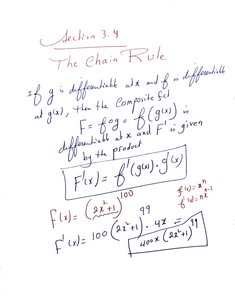
The Chain Rule is a fundamental technique in calculus used to differentiate composite functions. If g is differentiable and f is differentiable at g(x), then the composite function F(x) = f(g(x)) is differentiable, and its derivative is given by:
Formula:
Application: Used when functions are nested, such as .
Example: For , .
The Power Rule Combined with the Chain Rule
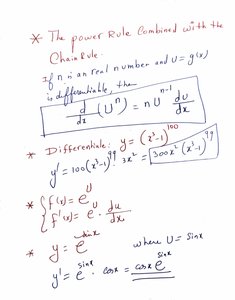
The Power Rule can be extended using the Chain Rule for functions of the form , where is a differentiable function and is a real number.
Formula:
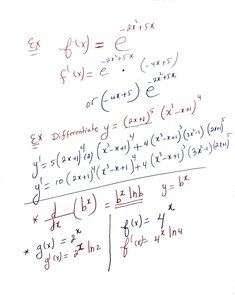
Example: For , .
Exponential Functions: If , then .
Example: , .
Applications of Derivatives
Finding Tangent Lines to Curves
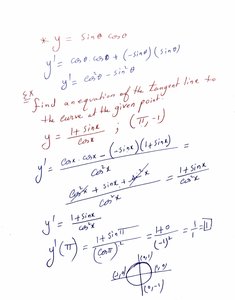
To find the equation of the tangent line to a curve at a given point, first compute the derivative to find the slope at that point, then use the point-slope form of a line.
Example: For at , the derivative is .
At , and the tangent line equation is .
Implicit Differentiation and Tangent Lines
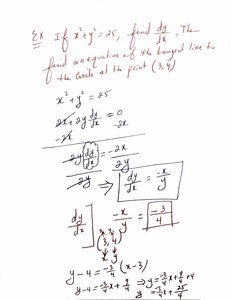
Implicit differentiation is used when a function is not given explicitly in terms of one variable. To find the tangent line to a curve defined implicitly, differentiate both sides with respect to , solve for , and use the point-slope form.
Example: For , differentiate to get .
Solve for : .
At the point , the slope is , and the tangent line is .
Derivatives of Exponential Functions
Differentiating Exponential Functions
Exponential functions of the form are differentiated using the Chain Rule. For general bases, the derivative of is .
Formula:
Example: ,
Example: ,
Summary Table: Key Differentiation Rules
Rule | Formula | Example |
|---|---|---|
Chain Rule | ||
Power Rule (with Chain Rule) | ||
Exponential Rule | ||
General Exponential | ||
Implicit Differentiation |
