 Back
Differentiation Techniques and Applications in Calculus
Study Guide - Smart Notes
 Tailored notes based on your materials, expanded with key definitions, examples, and context.
§1.5 - Differentiation Techniques: The Power and Sum-Difference Rules
Leibniz Notation
Leibniz notation is a standard way to denote derivatives in calculus. If y = f(x), the derivative of y with respect to x is written as . The derivative evaluated at a specific value can be written as or .
Derivative Operator: placed next to an expression denotes its derivative.
Examples:
The Power Rule
The Power Rule is a fundamental technique for differentiating functions of the form .
Theorem: For any real number n, if , then .
Examples:
The Derivative of a Constant Function
The derivative of a constant function is always zero, as the slope of its graph is flat.
Theorem: for any constant c.
The Derivative of a Constant Times a Function
When differentiating a constant times a function, the constant can be factored out.
Theorem:
Examples:
The Derivative of a Sum or a Difference
The derivative of a sum or difference of functions is the sum or difference of their derivatives.
Theorem:
Sum:
Difference:
Example:
Slopes of Tangent Lines
To find points where the tangent line has a specific slope, set the derivative equal to the desired value and solve for x.
Example: For , find where the tangent is horizontal (set ) or has slope 9 (set ).
Applications: Population Growth and Ticket Prices
Derivatives are used to model rates of change in real-world scenarios, such as population growth and pricing.
Example: Population growth rate: , .
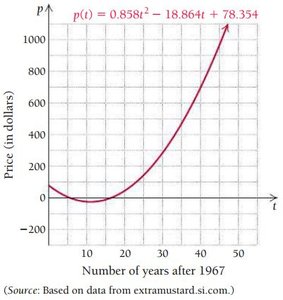
Example: Super Bowl ticket prices: .
§1.6 - Differentiation Techniques: The Product and Quotient Rules
The Product Rule
The Product Rule is used to differentiate products of two functions.
Theorem: If , then .
Example:
The Quotient Rule
The Quotient Rule is used to differentiate quotients of two functions.
Theorem: If , then
Example:
Application: Average Cost, Revenue, and Profit
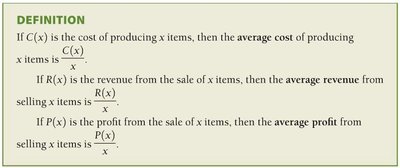
In business, average cost, revenue, and profit are important for analyzing performance. These are defined as follows:
Quantity | Formula |
|---|---|
Average Cost | |
Average Revenue | |
Average Profit |
§1.7 - Differentiation Techniques: The Chain Rule
The Extended Power Rule
The Extended Power Rule generalizes the Power Rule to functions raised to a power.
Theorem: If , then
Example:
Composition of Functions and the Chain Rule
The Chain Rule is used to differentiate compositions of functions.
Definition: The composition is .
Theorem:
Example: If and , then
§1.8 - Higher Order Derivatives
Higher Order Derivatives
Higher order derivatives are derivatives of derivatives, representing rates of change of rates of change.
Notation: is the second derivative, is the third, and is the nth derivative.
Leibniz Notation: , , etc.
Example: For ,
Velocity and Acceleration
When a function describes position over time, its first derivative is velocity and its second derivative is acceleration.
Velocity:
Acceleration:
Example: For , ,
§2.2 - Derivatives of Exponential (Base-e) Functions
Derivatives of Exponential Functions
The exponential function with base e, , is unique in that its derivative is itself.
Theorem:
Chain Rule for Exponential Functions:
Example:
§2.3 - Derivatives of Natural Logarithmic Functions
Derivatives of Natural Logarithmic Functions
The natural logarithm function, , has a simple derivative.
Theorem:
Chain Rule for Logarithms:
Example:
Applications
Logarithmic functions are used in models of learning, advertising, and other social sciences.
Example: Learning model:
Example: Advertising response:
