 Back
BackExponential and Logarithmic Functions: Definitions, Properties, and Applications
Study Guide - Smart Notes
 Tailored notes based on your materials, expanded with key definitions, examples, and context.
Exponential Functions
Definition and Exponential Behavior
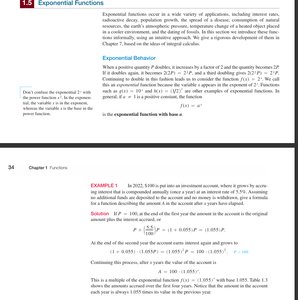
Exponential functions are widely used in mathematics, science, and engineering to model growth and decay processes. An exponential function with base a is defined as a function of the form , where and . These functions are characterized by the property that the rate of change of the function is proportional to its current value.
Key Property: If a quantity increases by a fixed percentage over equal time intervals, it can be modeled by an exponential function.
Doubling and Halving: Exponential growth and decay can be described in terms of doubling time (for growth) or half-life (for decay).
General Form:
Applications: Investment Growth Example
Exponential functions are commonly used to model compound interest in finance. The amount in an account after years, with principal and annual interest rate , is given by:
Example: If $100 annual interest, the amount after years is .
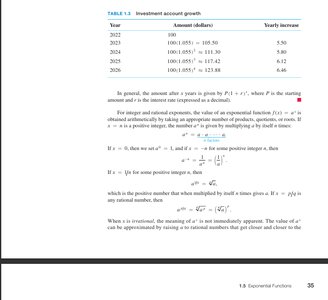
Table: Investment Account Growth
The following table illustrates the growth of an investment account over several years:
Year | Amount (dollars) | Yearly increase |
|---|---|---|
2022 | 100 | — |
2023 | 100(1.05) = 105.00 | 5.00 |
2024 | 100(1.05)^2 = 110.25 | 5.25 |
2025 | 100(1.05)^3 = 115.76 | 5.51 |
2026 | 100(1.05)^4 = 121.55 | 5.79 |
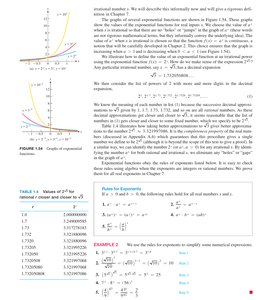
Properties of Exponents
Exponential expressions follow specific algebraic rules:
Product Rule:
Quotient Rule:
Power Rule:
Zero Exponent:
Negative Exponent:
The Natural Exponential Function
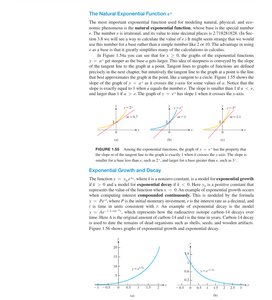
The most important exponential function is the natural exponential function, where the base is the special number . The function is used extensively in calculus and mathematical modeling.
Continuous Growth/Decay: Many natural processes are best modeled using due to its unique calculus properties.
Exponential Growth and Decay
Exponential functions model both growth and decay:
Exponential Growth: , where
Exponential Decay: , where
Half-life: The time required for a quantity to decrease to half its initial value.
Inverse Functions and Logarithms
One-to-One and Inverse Functions
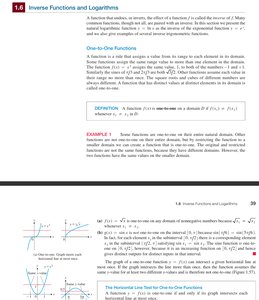
A function is one-to-one if each output is produced by exactly one input. The inverse function reverses the effect of , so that and .
Horizontal Line Test: A function is one-to-one if every horizontal line intersects its graph at most once.
Logarithmic Functions
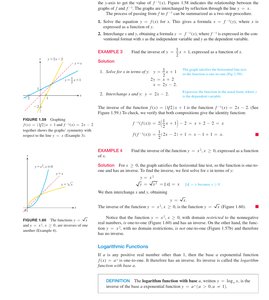
The logarithmic function with base is the inverse of the exponential function . It is defined as:
Natural Logarithm: The logarithm with base is called the natural logarithm and is written as .
Common Logarithm: The logarithm with base $10$ is called the common logarithm and is written as .
Properties of Logarithms
Logarithms satisfy several important properties:
Product Rule:
Quotient Rule:
Power Rule:
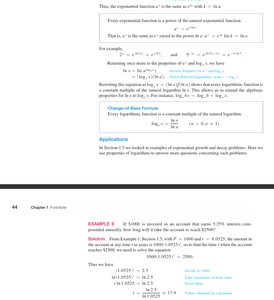
Change-of-Base Formula:
Applications of Logarithms
Logarithms are used to solve equations involving exponential growth and decay, such as finding the time required for an investment to reach a certain value or the half-life of a radioactive substance.
Example: If $5000 interest compounded annually, the time to reach $5200 for using logarithms.
Half-life Formula: , where is the decay constant.
Inverse Trigonometric Functions (Mentioned)
Inverse trigonometric functions are introduced as the inverses of the basic trigonometric functions, but their detailed study is reserved for later chapters.
Additional info: The notes above include all main concepts, definitions, properties, and applications of exponential and logarithmic functions as presented in the provided materials. Tables and graphs are included where they directly support the explanation of the mathematical concepts.
