 Back
BackGuided Practice: Evaluating Limits Using Graphs
Study Guide - Smart Notes
 Tailored notes based on your materials, expanded with key definitions, examples, and context.
Q2. Use the graphs of f and g to evaluate the following limits:
limx→2−(f(x) − g(x))
limx→2+(f(x) − g(x))
limx→2(f(x) − g(x))
limx→2+ \( \frac{f(x)}{g(x)} \)
f(2) + g(2) + limx→−1g(x)
limx→4(x2g(x))
f(0) + limx→4f(x)
limx→4 3(f(x) + g(t))
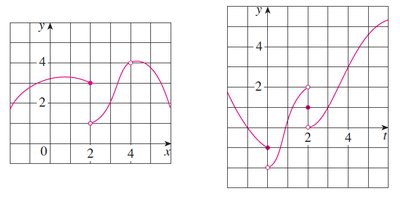
Background
Topic: Limits and Graphical Analysis
These questions test your ability to evaluate limits and function values using the graphs of two functions, f(x) and g(x). You will need to interpret left-hand and right-hand limits, as well as function values at specific points, by carefully reading the graphs provided.
Key Terms and Concepts:
Left-hand limit (limx→a− f(x)): The value that f(x) approaches as x approaches a from the left.
Right-hand limit (limx→a+ f(x)): The value that f(x) approaches as x approaches a from the right.
Limit at a point (limx→a f(x)): Exists if and only if both the left-hand and right-hand limits exist and are equal.
Function value (f(a)): The actual value of the function at x = a, which may or may not be the same as the limit.
Difference of functions: (f(x) - g(x)) means you subtract the y-values of g(x) from f(x) at the same x.
Product and quotient of functions: Multiply or divide the y-values as indicated.
Step-by-Step Guidance
For each limit, first identify the relevant x-value (e.g., x = 2, x = -1, x = 4, etc.).
For left-hand limits (x→a−), trace the graph as x approaches a from values less than a. For right-hand limits (x→a+), trace from values greater than a.
Read the y-values of f(x) and g(x) from the graphs at the specified points or as x approaches those points. Pay attention to open and closed circles, which indicate whether the function is defined at that point.
For expressions like f(x) - g(x), subtract the y-values you found for f(x) and g(x) at the relevant limit.
For expressions involving products or quotients, multiply or divide the y-values as appropriate, being careful with undefined values (e.g., division by zero).
Try solving on your own before revealing the answer!
