 Back
BackGuided Study: Calculus III – Tangent Planes, Level Surfaces, and Partial Derivatives
Study Guide - Smart Notes
 Tailored notes based on your materials, expanded with key definitions, examples, and context.
Q1. For , find the domain and describe the level surfaces.
Background
Topic: Multivariable Functions – Domains and Level Surfaces
This question tests your understanding of how to determine the domain of a function of several variables and how to interpret and describe its level surfaces.
Key Terms and Formulas:
Domain: The set of all points for which the function is defined (i.e., the expression under the square root is non-negative).
Level Surface: The set of points where is constant, i.e., for some constant .
Step-by-Step Guidance
Set the expression under the square root greater than or equal to zero: .
Rearrange the inequality to describe the domain in terms of .
For level surfaces, set and solve for in terms of .
Interpret the resulting equation geometrically (what kind of surface does it represent?).
Try solving on your own before revealing the answer!
Q2. For , find the level curve going through and the equation of the tangent plane at that point.
Background
Topic: Level Curves and Tangent Planes for Functions of Two Variables
This question asks you to find a specific level curve and the tangent plane to the surface at a given point.
Key Terms and Formulas:
Level Curve: The set of points where for some constant .
Tangent Plane: For at , the tangent plane is .
Step-by-Step Guidance
Evaluate to find the value of the level curve through .
Write the equation for the level curve, using the value found in step 1.
Compute the partial derivatives and at .
Set up the equation for the tangent plane using the formula above.
Try solving on your own before revealing the answer!
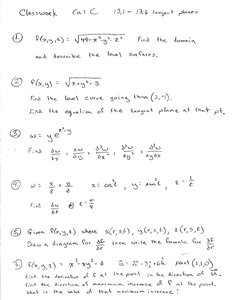
Q3. For , find , , and .
Background
Topic: Partial Derivatives
This question tests your ability to compute partial derivatives of a function with respect to each variable, treating the others as constants.
Key Terms and Formulas:
Partial Derivative: means differentiate with respect to , treating and as constants.
Product and Chain Rule for differentiation.
Step-by-Step Guidance
For , treat as a constant and differentiate .
For , use the chain rule to differentiate with respect to .
For , use the chain rule to differentiate with respect to .
Try solving on your own before revealing the answer!
Q4. If , , , find .
Background
Topic: Chain Rule for Multivariable Functions
This question tests your ability to use the chain rule to compute the derivative of a function where the variables themselves depend on another variable.
Key Terms and Formulas:
Chain Rule:
Step-by-Step Guidance
Compute and .
Compute and using the given expressions for and .
Plug all these derivatives into the chain rule formula above.
Simplify the resulting expression as much as possible before substituting values for .
Try solving on your own before revealing the answer!
Q5. Given where , , , , draw the diagram for the set of points where and the tangent plane at .
Background
Topic: Level Surfaces and Tangent Planes in Three Dimensions
This question asks you to visualize a level surface and the tangent plane at a specific point, using given partial derivatives.
Key Terms and Formulas:
Level Surface: The set of points where .
Tangent Plane: At , the tangent plane is .
Step-by-Step Guidance
Write the equation for the tangent plane at using the given partial derivatives.
Interpret the geometric meaning: the tangent plane is perpendicular to the gradient vector at the point.
Sketch or visualize the level surface and the tangent plane at the point .
Try solving on your own before revealing the answer!
Q6. Suppose is differentiable at , and the directional derivative at this point in the direction of vector is $3\nabla f(2, -1, 1) \cdot \mathbf{u}$?
Background
Topic: Directional Derivatives and the Gradient
This question tests your understanding of the relationship between the directional derivative and the gradient vector.
Key Terms and Formulas:
Directional Derivative: , where is a unit vector.
Gradient Vector: .
Step-by-Step Guidance
Recall that the directional derivative in the direction of is the dot product of the gradient and .
Set up the equation using the given information.
Interpret what this tells you about the relationship between the gradient and the direction vector at the point.
Try solving on your own before revealing the answer!
