 Back
Implicit Differentiation and Applications in Calculus
Study Guide - Smart Notes
 Tailored notes based on your materials, expanded with key definitions, examples, and context.
Implicit Differentiation
Introduction to Implicit Functions
In calculus, not all curves can be represented as explicit functions of the form y = f(x). Some curves are defined implicitly by equations involving both x and y. To analyze such curves, we use implicit differentiation, a technique that allows us to find derivatives even when y is not isolated.
Implicit Function: An equation involving both x and y that defines y as a function of x only implicitly, not explicitly.
Example: The equation defines a curve that is not the graph of a single function y = f(x), but can be analyzed in segments.
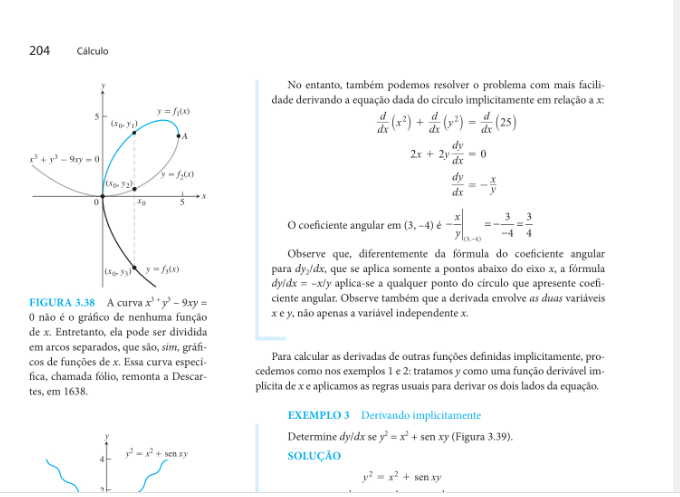
Additional info: The curve shown is known as a folium of Descartes, first studied in 1638.
Implicit Differentiation Process
To differentiate an equation involving both x and y, we treat y as a differentiable function of x (i.e., y = y(x)) and apply the derivative to both sides, using the chain rule where necessary.
Step 1: Differentiate both sides of the equation with respect to x.
Step 2: Apply the chain rule to terms involving y (e.g., ).
Step 3: Solve for .
Example: Differentiating the Circle Equation
Consider the circle equation .
Differentiating both sides with respect to x:
This formula for the slope of the tangent applies at any point on the circle, not just below the x-axis.
Example: At the point (3, -4) on the circle, the slope is:
General Approach for Implicit Differentiation
For any equation involving x and y, follow these steps:
Differentiating both sides with respect to x.
Apply the chain rule to terms involving y.
Collect all terms involving on one side.
Solve for .
Example: Implicit Differentiation with Trigonometric Functions
Problem: Find if .
Differentiating both sides with respect to x:
Apply the product rule to :
Substitute back:
Expand and collect terms:
Summary: Implicit differentiation is a powerful tool for finding derivatives of equations where y is not isolated. It is essential for analyzing curves defined implicitly, such as circles, ellipses, and more complex relations.
