 Back
BackImproper Integrals: Infinite Intervals and Discontinuous Integrands
Study Guide - Smart Notes
 Tailored notes based on your materials, expanded with key definitions, examples, and context.
Improper Integrals
Introduction to Improper Integrals
Improper integrals extend the concept of definite integrals to cases where the interval of integration is infinite or the integrand becomes unbounded within the interval. These integrals are essential for analyzing areas and quantities that would otherwise be undefined using standard integration techniques.
Improper integrals of Type I involve infinite limits of integration.
Improper integrals of Type II involve integrands with infinite discontinuities within the interval of integration.
Type I: Integrals Over Infinite Intervals
Improper integrals with infinite limits are defined using limits:
If f(x) is continuous on [a, ∞), then:
If f(x) is continuous on (−∞, b], then:
If f(x) is continuous on (−∞, ∞), then: where c is any real number.
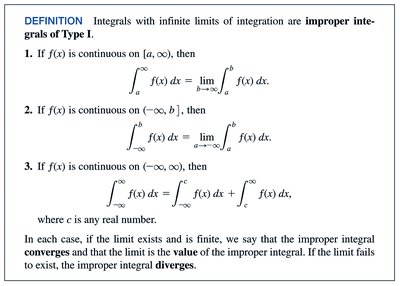
If the limit exists and is finite, the improper integral converges; otherwise, it diverges.
Examples: Area Under Curves with Infinite Intervals
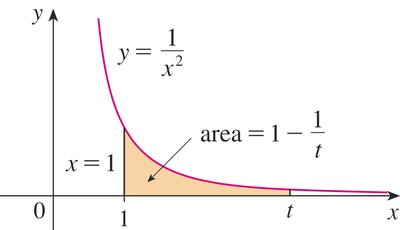
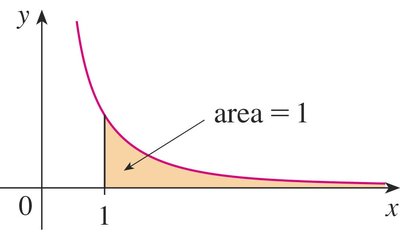
Consider the region under for :
The area from to is:
As , .
For finite intervals, the area under from to , $3 are , , and respectively.
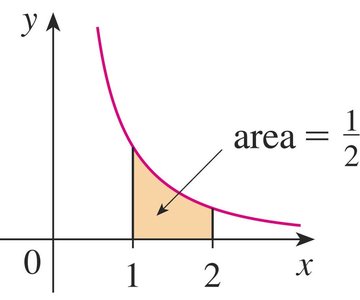
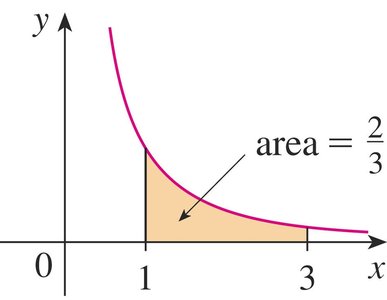
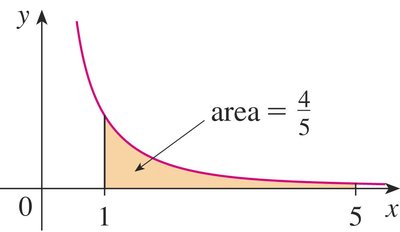
As the upper limit increases, the area approaches 1.
Convergence and Divergence of Improper Integrals
The integral converges to 1.
The integral diverges (the area is infinite).
For :
Converges if
Diverges if
Type II: Integrals with Infinite Discontinuities
Improper integrals where the integrand becomes infinite at a point within the interval are defined as follows:
If f(x) is continuous on (a, b] and discontinuous at a:
If f(x) is continuous on [a, b) and discontinuous at b:
If f(x) is discontinuous at c where :
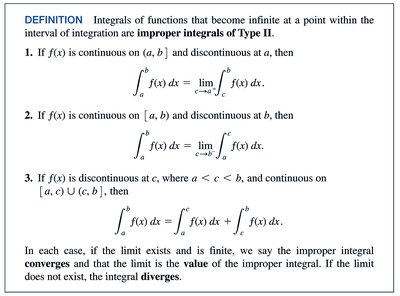
If the limit exists and is finite, the improper integral converges; otherwise, it diverges.
Geometric Interpretation of Improper Integrals
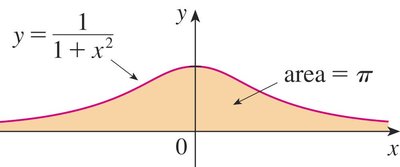
Improper integrals can represent the area under a curve over an infinite interval or where the curve has a vertical asymptote.
For example, represents the total area under .
Comparison Tests for Improper Integrals
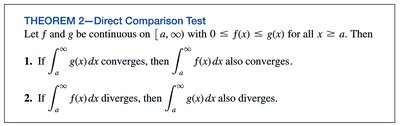
Direct Comparison Test
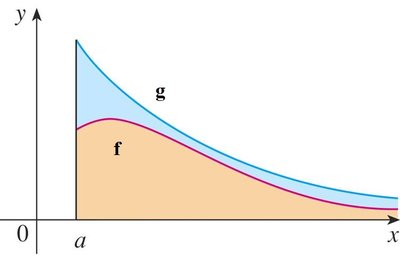
The Direct Comparison Test is used to determine the convergence or divergence of improper integrals by comparing them to known integrals.
If for all :
If converges, then also converges.
If diverges, then also diverges.
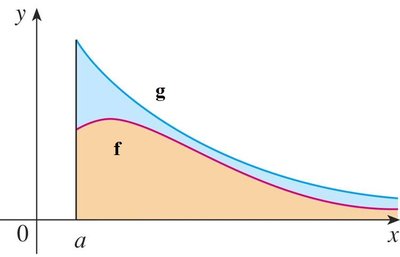
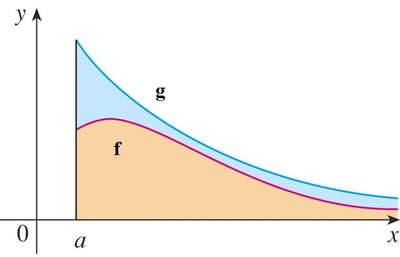
Note: The converse is not necessarily true; if converges, may or may not converge.
Limit Comparison Test
If and are positive and continuous on , and with , then both and either both converge or both diverge. 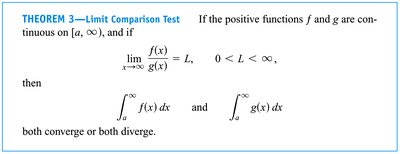
Summary Table: Convergence of
Value of p | Convergence |
|---|---|
Converges | |
Diverges | |
Diverges |
Key Points and Applications
Improper integrals are evaluated using limits to handle infinite intervals or discontinuities.
Convergence or divergence depends on the behavior of the integrand as approaches infinity or the point of discontinuity.
Comparison tests are powerful tools for determining convergence when direct evaluation is difficult.
Improper integrals have important applications in probability, physics, and engineering, such as calculating total probability, mass, or charge over unbounded domains.
