 Back
Infinite Sequences and Series: Convergence, Divergence, and Tests
Study Guide - Smart Notes
 Tailored notes based on your materials, expanded with key definitions, examples, and context.
Infinite Sequences and Series
Sequences: Definitions and Examples
A sequence is a function whose domain is the set of natural numbers, often written as {a1, a2, a3, ..., an, ...}. Each term is indexed by n, and sequences can be represented by explicit formulas or by listing terms.
Example 1: The sequence 1, -1/4, 1/9, -1/16, 1/25, ... consists of reciprocals of squares of positive integers with alternating signs.

Example 2: The sequence -3/2, -1/6, 1/12, 3/20, 5/30, ... consists of integers differing by 2 divided by products of consecutive integers.

Convergence and Divergence of Sequences
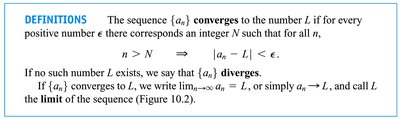
A sequence {an} converges to a number L if for every positive number ε, there exists an integer N such that for all n > N, |an - L| < ε. If no such L exists, the sequence diverges.
If {an} converges to L, we write .
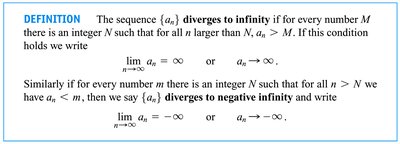
If {an} diverges to infinity, .
If {an} diverges to negative infinity, .
Limit Rules for Sequences
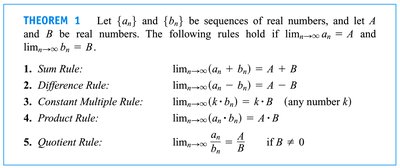
Several rules apply to the limits of sequences:
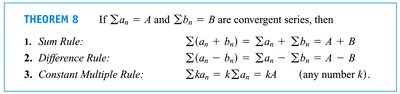
Sum Rule:
Difference Rule:
Constant Multiple Rule:
Product Rule:
Quotient Rule: (if )
Sandwich Theorem for Sequences
If for all n beyond some index N, and if , then also.

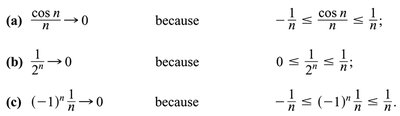
Examples of Sequence Limits
because
because
because
Important Sequence Limits
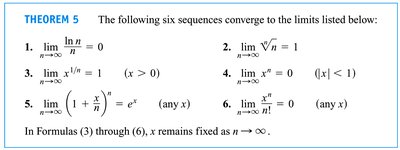
(x > 0)
(|x| < 1)
(any x)
(any x)
Bounded and Monotonic Sequences
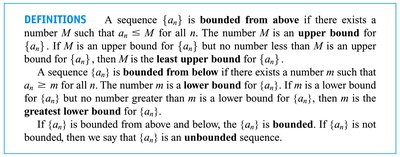
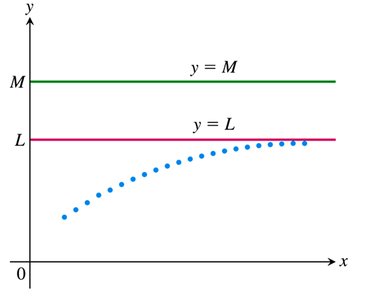
A sequence {an} is bounded from above if there exists M such that an ≤ M for all n. It is bounded from below if there exists m such that an ≥ m for all n. If both, it is bounded; otherwise, it is unbounded.
A sequence is nondecreasing if an ≤ an+1 for all n, nonincreasing if an ≥ an+1 for all n, and monotonic if it is either.

The Monotonic Sequence Theorem: If a sequence is both bounded and monotonic, then it converges.

Infinite Series: Definitions and Partial Sums
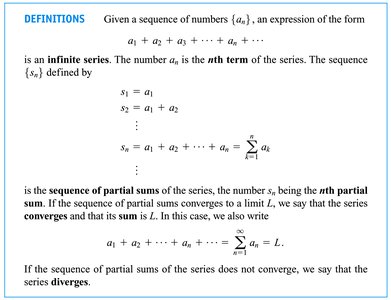
An infinite series is the sum of the terms of a sequence: . The nth partial sum is . If the sequence of partial sums converges to L, the series converges and its sum is L.
Geometric Series
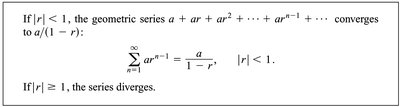
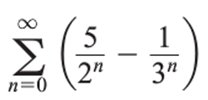
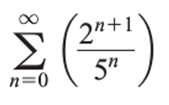
A geometric series has the form . It converges if and diverges otherwise. The sum is .
Example: is a geometric series with , , and sum .
Examples of Series

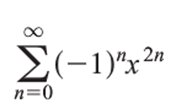
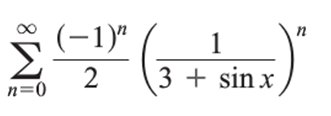
The nth-Term Test for Divergence
If fails to exist or is different from zero, then diverges.
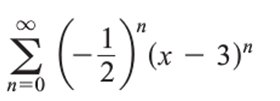
Tests for Convergence of Series
Integral Test: If and f is continuous, positive, and decreasing, then and both converge or diverge together.

p-Series: converges if , diverges if .

Comparison Test: If for all n > N, and converges, then converges. If diverges, then $\sum a_n$ diverges.
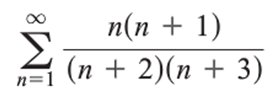
Limit Comparison Test: If (c > 0), then and both converge or both diverge.
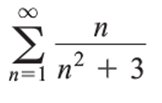
Ratio Test: If , then the series converges if , diverges if , and is inconclusive if .
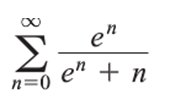
Root Test: If , then the series converges if , diverges if , and is inconclusive if .
Alternating Series and Absolute Convergence
An alternating series has terms that alternate in sign. The Alternating Series Test (Leibniz's Test) states that the series converges if:
All are positive
is nonincreasing eventually
as

The Alternating Series Estimation Theorem states that the error in approximating the sum by the nth partial sum is less than the absolute value of the first unused term.
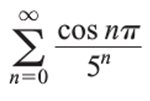
A series converges absolutely if converges.
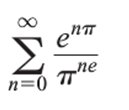
Examples of Alternating and Absolute Convergence
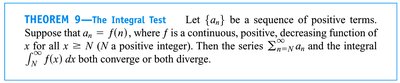
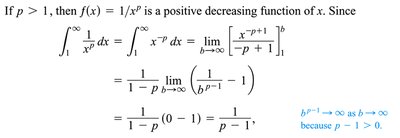
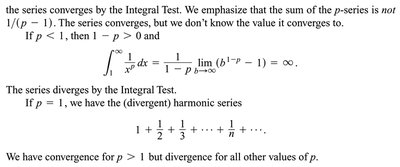
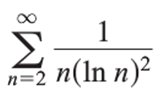
Summary of Series Convergence Tests
Use the Integral Test for easily integrable terms.
Use the Root Test for nth power terms.
Use the Ratio Test for factorials or products.
Use the Comparison Test for terms similar to p-series or geometric series.
Additional info: These notes cover the foundational concepts and major tests for infinite sequences and series, including convergence, divergence, and absolute convergence, with relevant examples and theorems. The included images visually reinforce definitions, theorems, and examples directly related to the content.
