 Back
BackIntegral and Comparison Tests for Series Convergence
Study Guide - Smart Notes
 Tailored notes based on your materials, expanded with key definitions, examples, and context.
Section 10.3: The Integral Test
Introduction to the Integral Test
The Integral Test is a method used to determine the convergence or divergence of infinite series whose terms are positive and decrease monotonically. It is particularly useful when the series terms resemble a function that is easy to integrate.
Key Idea: Compare the sum of a series to the value of an improper integral.
Typical Series: (p-series)
Theorem: The Integral Test
If , where is a continuous, positive, decreasing function for (for some integer ), then the series and the improper integral both converge or both diverge.
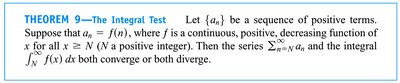
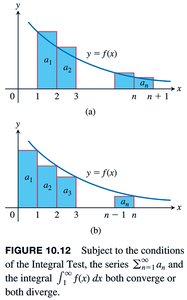
Convergence: If the integral converges, so does the series.
Divergence: If the integral diverges, so does the series.
Application to p-Series
The p-series converges if and diverges if .
For , the series converges.
For , the harmonic series diverges.
Examples and Visualizations
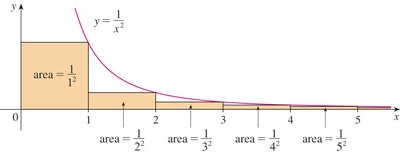
Consider the series :
The sum of the areas of rectangles with height and width 1 is less than the area under for .
The improper integral is convergent, so the series converges.
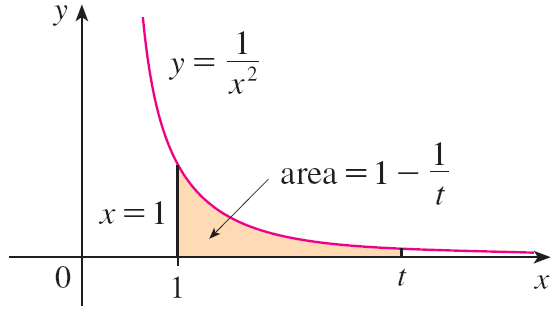
For the harmonic series , the corresponding integral diverges, so the series diverges.
Estimating Sums and Remainders
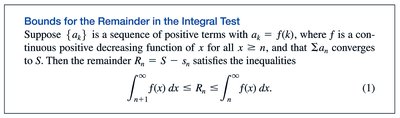
The Integral Test also provides a way to estimate the error (remainder) when approximating the sum of a convergent series by its first terms.
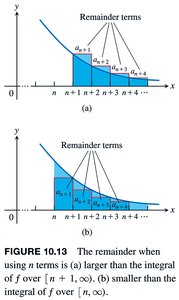
The remainder satisfies:
Section 10.4: Comparison Tests
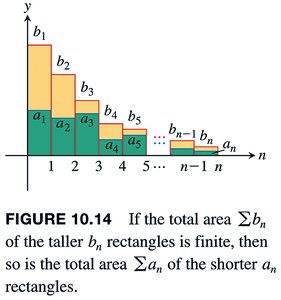
Direct Comparison Test
The Direct Comparison Test is used to determine the convergence or divergence of a series by comparing it to another series with known behavior.
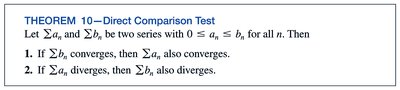
If for all and converges, then also converges.
If for all and diverges, then also diverges.
Limit Comparison Test
The Limit Comparison Test is useful when the terms of two series are similar for large but not necessarily ordered.
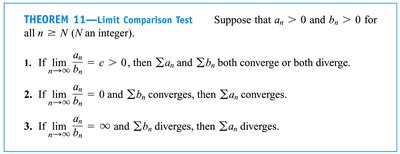
If where , then and both converge or both diverge.
If the limit is 0 and converges, then converges.
If the limit is and diverges, then diverges.
Estimating Sums Using Comparison
When using the Comparison Test, the remainder of the series being tested can be estimated by the remainder of the comparison series, especially if the comparison series is a p-series or geometric series.
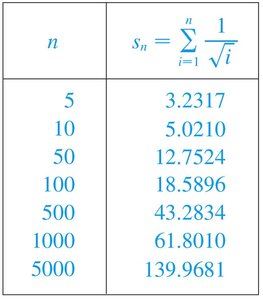
Summary Table: Partial Sums of a Divergent Series
The following table shows the partial sums for the series , illustrating divergence as increases:
n | |
|---|---|
5 | 3.2317 |
10 | 5.0210 |
50 | 12.7524 |
100 | 18.5896 |
500 | 43.2834 |
1000 | 61.8010 |
5000 | 139.9681 |
Key Formulas and Theorems
Integral Test: converges if and only if converges.
Direct Comparison Test: Compare to termwise.
Limit Comparison Test: (with ) implies both series behave the same.
Remainder Estimate (Integral Test):
Examples
Example 1: converges by the Integral Test.
Example 2: diverges (harmonic series).
Example 3: diverges (p-series with ).
Example 4: diverges by the Integral Test.
Additional info: The notes above include all major results, visualizations, and remainder estimates for the Integral Test and both Comparison Tests, as well as a summary table for divergent series. All images included are directly relevant to the explanations provided.
