 Back
BackIntegration of Rational Functions by Partial Fractions and Volumes Using Cross-Sections
Study Guide - Smart Notes
 Tailored notes based on your materials, expanded with key definitions, examples, and context.
Integration of Rational Functions by Partial Fractions
Introduction to Partial Fractions
Integration by partial fractions is a technique used to integrate rational functions, which are quotients of polynomials. This method decomposes a complex rational function into a sum of simpler fractions that are easier to integrate.
Rational Function: A function of the form , where and are polynomials.
Proper Rational Function: The degree of is less than the degree of .
Improper Rational Function: The degree of is greater than or equal to the degree of . In this case, perform polynomial long division first.
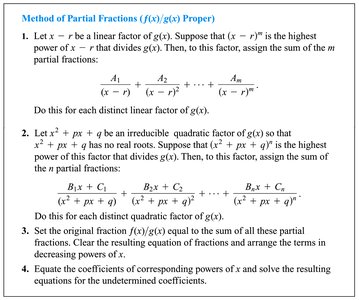
Method of Partial Fractions (Proper Case)
The decomposition depends on the factorization of the denominator :
For each distinct linear factor of , assign a sum of the form:
For each irreducible quadratic factor (where ), assign:
Set the original function equal to the sum of all partial fractions and arrange terms by decreasing powers of .
Equate coefficients of corresponding powers of and solve for the unknowns.
Example: Distinct Linear Factors
Given , factor the denominator and decompose:
Factor:
Decomposition:
Solve for by equating coefficients.
Example: Irreducible Quadratic Factors
Given , the decomposition includes terms like , , .
Summary Table: Partial Fraction Decomposition Forms
Denominator Factor | Partial Fraction Form |
|---|---|
Distinct Linear | |
Repeated Linear | |
Irreducible Quadratic | |
Repeated Irreducible Quadratic |
Volumes Using Cross-Sections
Introduction to Solids of Known Cross-Section
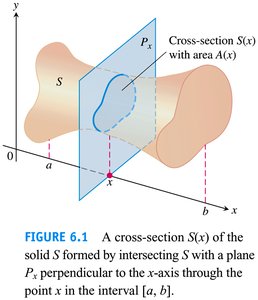
The volume of a solid can be found by integrating the area of cross-sections perpendicular to an axis. This method is foundational in applications of definite integrals.
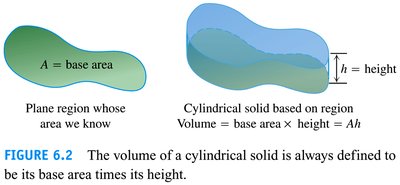
Volume of a Cylindrical Solid
For a solid with constant cross-sectional area and height , the volume is .
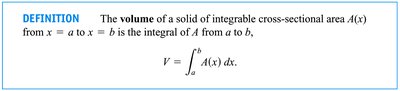
General Volume Formula
If the cross-sectional area varies with , the volume from to is:
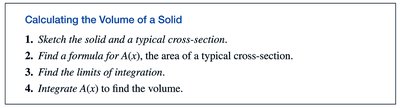
Steps for Calculating the Volume of a Solid
Sketch the solid and a typical cross-section.
Find a formula for , the area of a typical cross-section.
Find the limits of integration.
Integrate to find the volume.
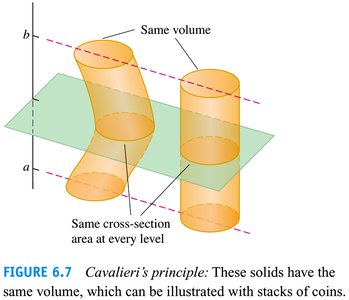
Cavalieri's Principle
If two solids have equal heights and equal cross-sectional areas at every level, then they have equal volumes.
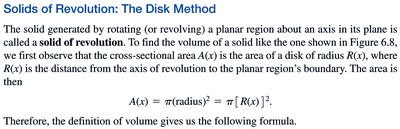
Solids of Revolution: The Disk Method
Volume by Disks for Rotation About the x-Axis
When a region is revolved about the x-axis, the resulting solid's volume can be found using the disk method:
Where is the distance from the axis of rotation to the outer edge of the region.

Example: Volume of a Sphere
The volume of a sphere of radius can be derived by integrating the area of circular cross-sections:
Cross-sectional area at :
Volume:
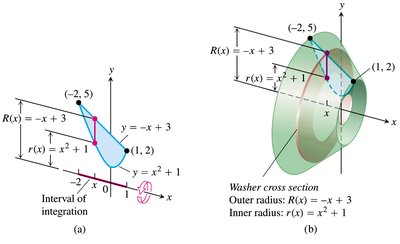
Solids of Revolution: The Washer Method
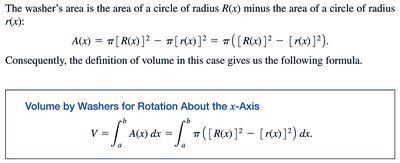
Volume by Washers for Rotation About the x-Axis
If the solid has a hole (i.e., the region does not border the axis of revolution), use the washer method:
Outer radius:
Inner radius:
Area of washer:
Volume:
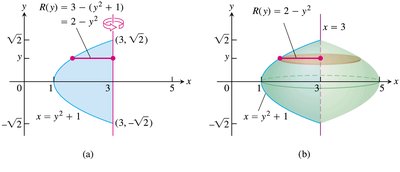
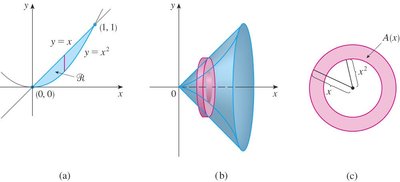
Example: Region Between Two Curves
To find the volume generated by rotating the region between and about the x-axis:
Outer radius:
Inner radius:
Volume:
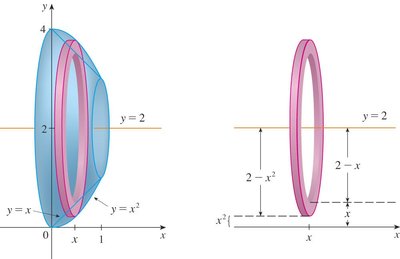
Example: Rotation About a Line Other Than the Axis
When rotating about , adjust the radii accordingly:
Outer radius:
Inner radius:
Volume:
Summary Table: Methods for Finding Volumes of Solids of Revolution
Method | Formula | When to Use |
|---|---|---|
Disk | Solid has no hole; region borders axis of revolution | |
Washer | Solid has a hole; region does not border axis | |
Cross-Section | General solids with known cross-sectional area |
Additional info: The notes above include both the algebraic and geometric foundations for integrating rational functions by partial fractions and for calculating volumes of solids using cross-sections, disks, and washers. These are core topics in Calculus II and are essential for applications in physics, engineering, and advanced mathematics.
