 Back
Back1.6
Study Guide - Smart Notes
 Tailored notes based on your materials, expanded with key definitions, examples, and context.
Inverse Functions and Logarithms
Functions: Definitions, Domain, and Range
A function \( f(x) \) is a rule that assigns to each element \( x \) in a set \( D \) (the domain) exactly one element \( f(x) \) in a set \( R \) (the range).
Polynomials: Domain is \(( -\infty, \infty )\).
Radicals: Domain is restricted so the expression under the root is non-negative.
Rational Functions: Domain excludes values that make the denominator zero.
One-to-One and Not One-to-One Functions
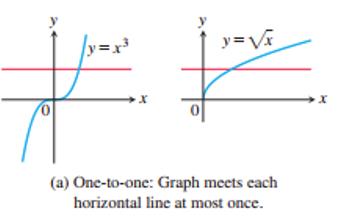
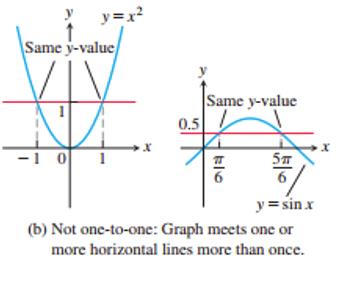
A function is one-to-one if every horizontal line intersects its graph at most once. Otherwise, it is not one-to-one.
One-to-one functions have inverses that are also functions.
Not one-to-one functions do not have inverses that are functions unless their domains are restricted.
Inverse Functions: Definition and Properties
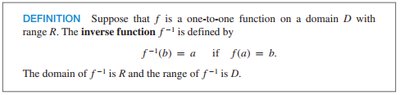
If \( f \) is a one-to-one function on domain \( D \) with range \( R \), the inverse function \( f^{-1} \) is defined by:
\( f^{-1}(b) = a \) if \( f(a) = b \).
The domain of \( f^{-1} \) is \( R \), and the range of \( f^{-1} \) is \( D \).
Finding the Inverse of a Function Algebraically
The process of finding the inverse of a function \( f(x) \) involves:
Replace \( f(x) \) with \( y \).
Interchange \( x \) and \( y \).
Solve the equation for \( y \).
Replace \( y \) with \( f^{-1}(x) \).
Example: Find the inverse of \( f(x) = 5x - 7 \):
Let \( y = 5x - 7 \).
Interchange: \( x = 5y - 7 \).
Solve for \( y \): \( y = \frac{x + 7}{5} \).
So, \( f^{-1}(x) = \frac{x + 7}{5} \).
Graphs of Inverse Functions
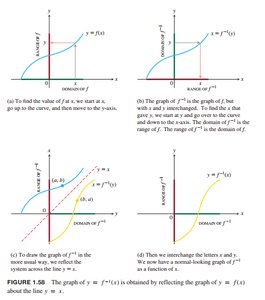
The graph of \( y = f^{-1}(x) \) is obtained by reflecting the graph of \( y = f(x) \) about the line \( y = x \). The domain and range are interchanged between a function and its inverse.
Exponential and Logarithmic Functions
The natural exponential function is \( f(x) = a^x \) where \( a > 0 \). Its inverse is the logarithmic function, denoted \( f(x) = \log_a x \), where \( a > 0, a \neq 1 \).
Domain of exponential: \( ( -\infty, \infty ) \)
Range of exponential: \( (0, \infty) \)
Domain of logarithm: \( (0, \infty) \)
Range of logarithm: \( ( -\infty, \infty ) \)
The natural logarithmic function is \( f(x) = \ln x \), the inverse of \( f(x) = e^x \).
Properties of Logarithms
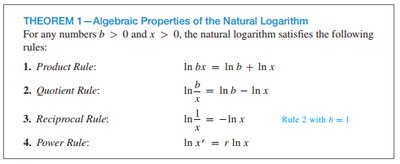
Logarithms have several important algebraic properties that allow us to expand or condense expressions:
Rule | Formula |
|---|---|
Product Rule | \( \ln(bx) = \ln b + \ln x \) |
Quotient Rule | \( \ln\left(\frac{b}{x}\right) = \ln b - \ln x \) |
Reciprocal Rule | \( \ln\left(\frac{1}{x}\right) = -\ln x \) |
Power Rule | \( \ln(x^r) = r \ln x \) |
Inverse Trigonometric Functions
The six trigonometric functions are not one-to-one over their entire domains due to periodicity. By restricting their domains, we can define their inverses:
\( \sin^{-1} x = y \) means \( \sin y = x \), also written as \( y = \arcsin x \).
Similar definitions apply for \( \arccos x \) and \( \arctan x \).
Example:
\( \cos^{-1}(-1) = \pi \)
\( \arctan(-1) = -\frac{\pi}{4} \)
\( \arcsin(\sin \pi) = 0 \)
Summary Table: Domains and Ranges of Key Functions
Function | Domain | Range |
|---|---|---|
Polynomial | \( ( -\infty, \infty ) \) | \( ( -\infty, \infty ) \) |
Radical (e.g., \( \sqrt{x} \)) | \( [0, \infty) \) | \( [0, \infty) \) |
Rational (e.g., \( \frac{x+1}{x-5} \)) | \( x \neq 5 \) | Depends on function |
Exponential (\( a^x \)) | \( ( -\infty, \infty ) \) | \( (0, \infty) \) |
Logarithmic (\( \log_a x \)) | \( (0, \infty) \) | \( ( -\infty, \infty ) \) |
