 Back
BackInverse Functions and Logarithms: Study Guide
Study Guide - Smart Notes
 Tailored notes based on your materials, expanded with key definitions, examples, and context.
Inverse Functions and Logarithms
Inverse Functions
Inverse functions are a fundamental concept in calculus, allowing us to reverse the effect of a function. Understanding when a function has an inverse and how to find it is essential for solving equations and analyzing mathematical relationships.
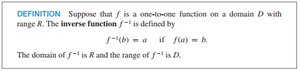
Definition: A function f is one-to-one if each value in its range corresponds to exactly one value in its domain. The inverse function f-1 is defined by: The domain of f-1 is the range of f, and the range of f-1 is the domain of f.
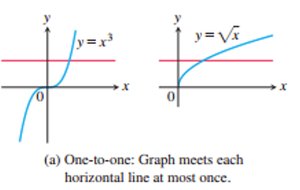
One-to-One Functions: A function is one-to-one if its graph meets each horizontal line at most once. This property is necessary for a function to have an inverse.
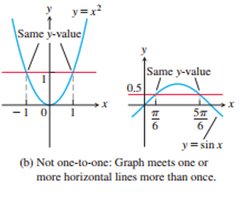
Not One-to-One Functions: If a function's graph meets a horizontal line more than once, it does not have an inverse over its entire domain.
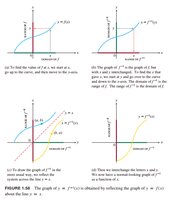
Graphical Representation: The graph of an inverse function is obtained by reflecting the graph of the original function across the line y = x.
Example: The function f(x) = x^3 is one-to-one and has an inverse, while f(x) = x^2 is not one-to-one unless its domain is restricted.
Exponential and Logarithmic Functions
Exponential and logarithmic functions are closely related as inverses of each other. They are widely used in calculus for modeling growth, decay, and solving equations involving exponents.
Exponential Function: The function f(x) = a^x (where a > 0 and a \neq 1) is called an exponential function.
Logarithmic Function: The logarithmic function f(x) = \log_a(x) is the inverse of the exponential function a^x.
Natural Exponential Function: The function f(x) = e^x is called the natural exponential function, where e is Euler's number (approximately 2.718).
Natural Logarithm: The function f(x) = \ln(x) is the natural logarithm, the inverse of e^x.
Example: If y = e^x, then x = \ln(y).
Properties of Logarithms
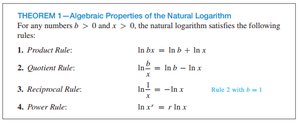
Logarithms have several important algebraic properties that allow us to expand, condense, and simplify expressions. These properties are essential for solving logarithmic equations and manipulating exponential expressions.
Product Rule:
Quotient Rule:
Reciprocal Rule:
Power Rule:
Example: Expand using the product and power rules:
Inverse Trigonometric Functions
Inverse trigonometric functions allow us to find angles when given the value of a trigonometric function. These functions are important in calculus for solving equations and evaluating integrals.
Definition: The inverse trigonometric functions include arcsin(x), arccos(x), and arctan(x), which are the inverses of sin(x), cos(x), and tan(x) respectively.
Domain and Range: Each inverse trigonometric function has a restricted domain and range to ensure it is one-to-one.
Example: If y = \sin(x), then x = \arcsin(y) for -1 \leq y \leq 1 and -\frac{\pi}{2} \leq x \leq \frac{\pi}{2}.
Domain and Range Review
Understanding the domain and range of functions is crucial for determining where a function is defined and what values it can take. This is especially important when considering inverse functions, as the domain and range are swapped.
Domain: The set of all possible input values (x-values) for a function.
Range: The set of all possible output values (y-values) for a function.
Example: For f(x) = \sqrt{x}, the domain is x \geq 0 and the range is y \geq 0.
