 Back
BackL'Hospital's Rule and Indeterminate Forms
Study Guide - Smart Notes
 Tailored notes based on your materials, expanded with key definitions, examples, and context.
L'Hospital's Rule
Introduction to L'Hospital's Rule
L'Hospital's Rule is a powerful tool in calculus for evaluating limits that result in indeterminate forms, such as 0/0 or ∞/∞. This rule allows us to differentiate the numerator and denominator separately to find the limit.
Indeterminate Forms: Expressions like 0/0 or ∞/∞ that do not have a clear value and require further analysis.
Applicability: L'Hospital's Rule can only be used when the original limit yields an indeterminate form.
Statement of L'Hospital's Rule
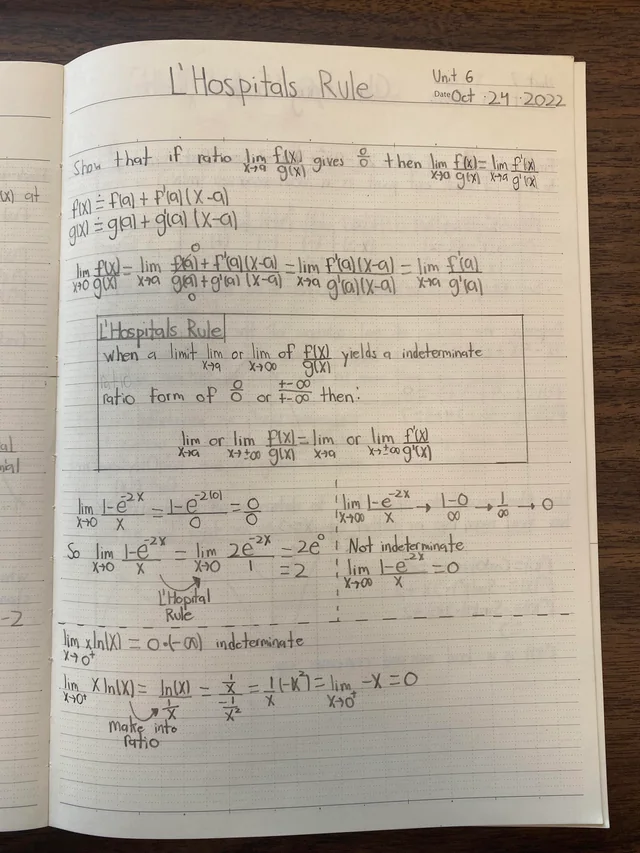
If limx→a f(x)/g(x) yields an indeterminate form 0/0 or ∞/∞, then:
f(x) and g(x) must be differentiable near x = a.
g'(x) \neq 0 near x = a (except possibly at x = a).
The limit on the right side must exist or be infinite.
Derivation and Explanation
Suppose f(x) and g(x) are differentiable at x = a and both approach 0 as x → a. Using the definition of the derivative, we can write:
Since f(a) = 0 and g(a) = 0, this simplifies to:
This justifies the use of derivatives in evaluating the original limit.
Examples of L'Hospital's Rule
Example 1:
Direct substitution gives 0/0 (indeterminate form).
Apply L'Hospital's Rule:
Example 2:
Direct substitution gives (not indeterminate).
No need for L'Hospital's Rule.
Example 3:
Direct substitution gives (indeterminate form).
Rewrite as (ratio form).
Apply L'Hospital's Rule:
Summary Table: Indeterminate Forms and L'Hospital's Rule
Form | Indeterminate? | Can Use L'Hospital's Rule? |
|---|---|---|
0/0 | Yes | Yes |
∞/∞ | Yes | Yes |
0 × ∞ | Yes (convert to 0/0 or ∞/∞) | Yes (after conversion) |
1/∞ | No | No |
Key Points to Remember
Always check if the limit is indeterminate before applying L'Hospital's Rule.
Rewrite limits into a ratio form if necessary (e.g., to ).
Differentiate numerator and denominator separately.
Repeat the process if the result is still indeterminate.
