 Back
BackLimits and Continuity: Analyzing Limits from Graphs
Study Guide - Smart Notes
 Tailored notes based on your materials, expanded with key definitions, examples, and context.
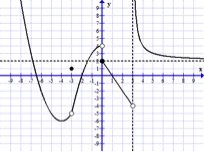
Q1. Use the graph of function f to find the following limits:
limx→−3− f(x)
limx→−3+ f(x)
limx→−3 f(x)
limx→0− f(x)
limx→0+ f(x)
limx→0 f(x)
limx→3− f(x)
limx→3+ f(x)
limx→3 f(x)
limx→−4− f(x)
limx→−4+ f(x)
limx→−4 f(x)
Background
Topic: Limits and Continuity
This question tests your ability to interpret limits from a graph, including one-sided limits and determining whether a limit exists at a given point. You will need to analyze the behavior of the function as x approaches specific values from the left and right.
Key Terms and Formulas:
Limit: The value that a function approaches as the input approaches a certain point.
One-sided limits: (from the left), (from the right)
Existence of a limit: The limit exists if and only if both one-sided limits exist and are equal.
Discontinuity: If the left and right limits are not equal, the function is discontinuous at that point.
Step-by-Step Guidance
Examine the graph at each specified x-value (e.g., , , , ). Identify the behavior of the function as x approaches these points from the left and right.
For each one-sided limit, trace the curve as x approaches the point from the left () and from the right (). Note the y-value the function approaches.
Compare the left and right limits at each point. If they are equal, the two-sided limit exists and equals that value. If not, the two-sided limit does not exist (d.n.e.).
Pay attention to open and closed circles on the graph, which indicate whether the function is defined at that point or if there is a jump/discontinuity.
Try solving on your own before revealing the answer!
Final Answer:
The limits at each point can be read directly from the graph by following the steps above. For example, at , both one-sided limits approach the same value, so the two-sided limit exists. At , the left and right limits are different, so the two-sided limit does not exist. Continue this process for each x-value listed.
Remember: The existence of a limit depends on the agreement of the left and right limits, not just the function value at the point.
