 Back
BackLimits from a Graph – Step-by-Step Guidance
Study Guide - Smart Notes
 Tailored notes based on your materials, expanded with key definitions, examples, and context.
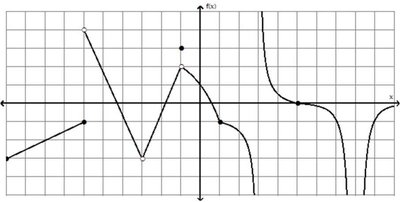
Q1. Use the graph of to find the following limits and function values:
Background
Topic: Limits from Graphs
This question tests your ability to evaluate one-sided and two-sided limits, as well as function values, by interpreting the graph of a function. You will need to distinguish between left-hand limits, right-hand limits, and the actual value of the function at a point.
Key Terms and Concepts:
Left-hand limit: is the value approaches as approaches from the left.
Right-hand limit: is the value approaches as approaches from the right.
Two-sided limit: exists if and only if both one-sided limits exist and are equal.
Function value: is the actual value of the function at (may be different from the limit).
Step-by-Step Guidance
For each limit, locate the -value of interest on the $x$-axis of the graph (e.g., , , , ).
To find a left-hand limit (), trace the graph as approaches from values less than $a$ (from the left). Observe the -value the graph approaches.
To find a right-hand limit (), trace the graph as approaches from values greater than $a$ (from the right). Observe the -value the graph approaches.
For the two-sided limit (), check if the left-hand and right-hand limits are equal. If they are, that is the limit. If not, the two-sided limit does not exist.
To find the function value , look for a solid dot at on the graph. If there is a solid dot, its -value is $f(a)$. If there is an open circle, $f(a)$ is not that value.
Try solving on your own before revealing the answer!
