 Back
Back2.2
Study Guide - Smart Notes
 Tailored notes based on your materials, expanded with key definitions, examples, and context.
Section 2.2: The Limit of a Function and Limit Laws
Introduction to Limits
The concept of a limit is fundamental in calculus and describes the behavior of a function as its input approaches a particular value. Understanding limits allows us to analyze functions at points where they may not be explicitly defined and forms the basis for derivatives and integrals.
Informal Definition of a Limit
Limit Statement: If f(x) becomes arbitrarily close to a number L as x approaches c (but x ≠ c), we write:
This is read as “the limit of f(x) as x approaches c is L.”
The value of the function at c (i.e., f(c)) does not affect the limit as x approaches c.
Example: Evaluating a Limit
Consider . As x approaches 1, the function simplifies to for x ≠ 1.
Thus, .
Even if f(1) is undefined, the limit as x approaches 1 exists and equals 2.
Limits and Function Values
The limit depends only on the behavior of the function near c, not necessarily at c itself.
It is possible for a function to have a limit at a point where it is not defined, or where its value is different from the limit.
Evaluating Limits Numerically
Example:
To estimate the value of this limit, we can use a table of values for x approaching 0 from both sides:
x | \( \frac{\sin x}{x} \) |
|---|---|
±1.0 | 0.84147098 |
±0.5 | 0.95885108 |
±0.4 | 0.97354586 |
±0.3 | 0.98506736 |
±0.2 | 0.99334665 |
±0.1 | 0.99833417 |
±0.05 | 0.99958339 |
±0.01 | 0.99998333 |
±0.005 | 0.99999583 |
±0.001 | 0.99999983 |
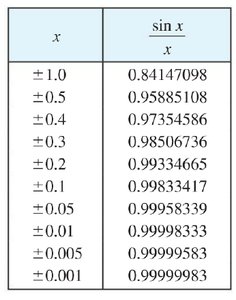
As x approaches 0, approaches 1.
When Limits Do Not Exist
Some functions do not have limits at certain points. For example, does not exist because the function oscillates infinitely as x approaches 0.
Limit Laws
Theorem 1: Limit Laws
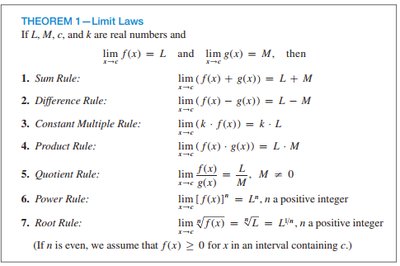
The following rules allow us to compute limits of functions using the limits of their parts, provided the individual limits exist:
Sum Rule:
Difference Rule:
Constant Multiple Rule:
Product Rule:
Quotient Rule: , provided
Power Rule: , for positive integer n
Root Rule: , for positive integer n (if n is even, require near c)
Limits of Polynomials and Rational Functions
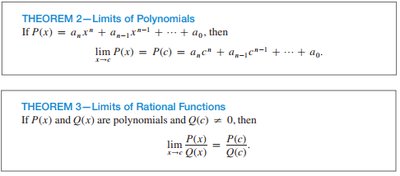
Theorem 2: Limits of Polynomials
If is a polynomial, then .
Theorem 3: Limits of Rational Functions
If and are polynomials and , then .
If , try to simplify the expression before evaluating the limit.
Examples of Evaluating Limits
a.
b.
c.
d. The denominator factors as , so for , . Thus, the limit as is .
e. Substitute : Numerator: Denominator: Since both numerator and denominator are zero, factor and simplify before evaluating the limit.
f. Combine and simplify before evaluating the limit.
g. Simplify numerator and denominator, then substitute .
The Sandwich (Squeeze) Theorem
If near (except possibly at ), and , then .
This theorem is useful when a function is "trapped" between two others that share the same limit.
Example: for all . Since and , by the Sandwich Theorem, .
