 Back
BackMean Value Theorem and Curve Analysis – Step-by-Step Calculus Guidance
Study Guide - Smart Notes
 Tailored notes based on your materials, expanded with key definitions, examples, and context.
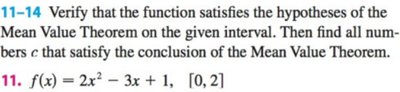
Q1. Verify that the function satisfies the hypotheses of the Mean Value Theorem on . Then find all numbers that satisfy the conclusion of the Mean Value Theorem.
Background
Topic: Mean Value Theorem (MVT) for Derivatives
This question tests your understanding of the Mean Value Theorem, which states that if a function is continuous on a closed interval and differentiable on the open interval , then there exists at least one number in $(a, b)$ such that .
Key Terms and Formulas
Continuous: No breaks, jumps, or holes in the graph on .
Differentiable: The derivative exists at every point in .
Mean Value Theorem (MVT):
for some in
Step-by-Step Guidance
Check if is continuous on and differentiable on . Since $f(x)$ is a polynomial, it is continuous and differentiable everywhere.
Calculate and :
Find the average rate of change over :
Find :
Set equal to the average rate of change and solve for :
Try solving on your own before revealing the answer!
Q2. Find the number that satisfies the conclusion of the Mean Value Theorem on the given interval. Graph the function, the secant line through the endpoints, and the tangent line at . Are the secant line and the tangent line parallel?
Background
Topic: Mean Value Theorem (MVT) and Graphical Interpretation
This question asks you to apply the MVT, find the specific value , and interpret the result graphically by comparing the slopes of the secant and tangent lines.
Key Terms and Formulas
Secant Line: The line connecting the endpoints and .
Tangent Line: The line with slope at the point .
Parallel Lines: Two lines are parallel if they have the same slope.
Step-by-Step Guidance
Recall from the previous question how to find using the MVT.
Write the equation for the secant line's slope: .
Write the equation for the tangent line's slope at : .
Graph the function , the secant line, and the tangent line at (you can use graphing technology or sketch by hand).
Compare the slopes to determine if the secant and tangent lines are parallel.
Try solving on your own before revealing the answer!

