 Back
BackOptimization and Graph Analysis in Calculus
Study Guide - Smart Notes
 Tailored notes based on your materials, expanded with key definitions, examples, and context.
Q3. A homeowner wants to build a rectangular planting bed with an area equal to 200 ft² and a width x between 1 and 25 ft. The bed will be behind the house, so no fence is along the back wall of the house.
Part (a): Build a function f(x) that gives the total length of the fence.
Background
Topic: Optimization and Function Construction
This question is about expressing a real-world constraint (fencing a rectangular area with one side against a wall) as a function, which is a common application of calculus in optimization problems.
Key Terms and Formulas:
Let x = width of the bed (perpendicular to the house).
Let y = length of the bed (parallel to the house, but not against the wall).
Area constraint:
Total fence needed: Only three sides (two widths and one length) require fencing.

Step-by-Step Guidance
Express the area constraint as and solve for in terms of .
Write the total length of fence needed as (since the back side against the house does not need fencing).
Substitute your expression for from step 1 into the formula for to get in terms of only.
Remember to state the domain for (given as ).
Try solving on your own before revealing the answer!
Q3b. Find the minimum length of the fence.
Background
Topic: Optimization Using Calculus
This part asks you to minimize the function you found in part (a), which is a classic calculus optimization problem. You will use derivatives to find critical points and determine the minimum value within the given domain.
Key Terms and Formulas:
Critical points: Values of where or where is undefined.
Endpoints: Check and as possible candidates for the minimum.
Step-by-Step Guidance
Take the derivative of your function from part (a).
Set and solve for to find critical points.
Check the value of at the critical point(s) and at the endpoints and .
Compare these values to determine which gives the minimum fence length.
Try solving on your own before revealing the answer!
Q6. Let .
Part (a): Compute , determine the intervals for which is increasing or decreasing, and list (if any) extreme value(s) of .
Background
Topic: First Derivative Test and Critical Points
This question tests your ability to find the derivative of a polynomial, use it to determine where the function is increasing or decreasing, and identify local maxima and minima (extreme values).
Key Terms and Formulas:
First derivative: gives the slope of the tangent line to .
Critical points: Where or is undefined.
Increasing: Where ; Decreasing: Where .
Step-by-Step Guidance
Compute using the power rule.
Set and solve for to find critical points.
Use a sign chart or test values in each interval determined by the critical points to see where is positive (increasing) or negative (decreasing).
Identify any local maxima or minima by checking the sign changes of at the critical points.
Try solving on your own before revealing the answer!
Part (b): Compute , determine the intervals for which is concave up or down, and list (if any) inflection points.
Background
Topic: Second Derivative Test and Concavity
This part asks you to analyze the concavity of the function and find inflection points using the second derivative.
Key Terms and Formulas:
Second derivative: tells you about the concavity of .
Concave up: Where ; Concave down: Where .
Inflection point: Where changes sign.
Step-by-Step Guidance
Compute by differentiating .
Set and solve for to find possible inflection points.
Test intervals around these points to determine where is positive (concave up) or negative (concave down).
List the -values where the concavity changes as inflection points.
Try solving on your own before revealing the answer!
Part (c): Choose the letter with the graph of .
Background
Topic: Graph Matching
This part asks you to match the function to its graph based on the analysis from parts (a) and (b).
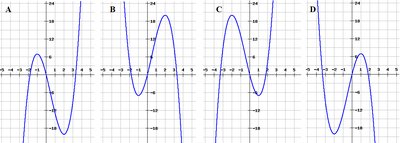
Step-by-Step Guidance
Recall the key features of : degree (cubic), end behavior, and the number and location of turning points and inflection points.
Compare these features to the graphs provided (A, B, C, D).
Look for the graph that matches the increasing/decreasing intervals, concavity, and intercepts you found earlier.
Try solving on your own before revealing the answer!
