 Back
BackPlanes and Lines in Three-Dimensional Space
Study Guide - Smart Notes
 Tailored notes based on your materials, expanded with key definitions, examples, and context.
Planes in Three-Dimensional Space
Definition and Equation of a Plane
A plane in three-dimensional space is a flat, two-dimensional surface that extends infinitely in all directions. To uniquely determine a plane, we require:
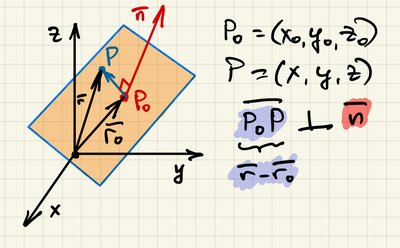
A point in the plane, P0 = (x0, y0, z0)
A normal vector to the plane, \( \vec{n} = A \hat{i} + B \hat{j} + C \hat{k} \)
If a point P = (x, y, z) lies on the plane, then the vector from P0 to P (denoted \( \overrightarrow{P_0P} = (x-x_0, y-y_0, z-z_0) \)) must be perpendicular to the normal vector \( \vec{n} \). This leads to the condition:
\( \overrightarrow{P_0P} \cdot \vec{n} = 0 \)
Or, equivalently, \( (\vec{r} - \vec{r}_0) \cdot \vec{n} = 0 \)
The general equation for a plane is:
\[ A(x - x_0) + B(y - y_0) + C(z - z_0) = 0 \]
Alternatively, this can be written as:
\[ Ax + By + Cz = D \]
where \( D = Ax_0 + By_0 + Cz_0 \).
Examples of Plane Equations
Example 1: Find the equation of the plane containing the point (1, 0, 5) and having a normal vector \( \vec{n} = 3\hat{i} + \hat{j} - \hat{k} \).
Solution:
\( A = 3, B = 1, C = -1 \)
Equation: \( 0 = 3(x-1) + 1(y-0) + (-1)(z-5) \)
Simplifies to: \( 3x + y - z = -2 \)
Example 2: Find the equation of the plane containing the points P1 = (1, 1, 0), P2 = (2, 0, 2), and P3 = (0, 3, 3).
Solution:
Find vectors in the plane: \( \overrightarrow{P_1P_2} = (1, -1, 2) \), \( \overrightarrow{P_1P_3} = (-1, 2, 3) \)
Normal vector: \( \vec{n} = \overrightarrow{P_1P_2} \times \overrightarrow{P_1P_3} = (-7, -5, 1) \)
Equation: \( -7(x-1) -5(y-1) + 1(z-0) = 0 \)
Simplifies to: \( -7x -5y + z = -12 \)
Lines in Three-Dimensional Space
Definition and Equations of a Line
A line in three-dimensional space is determined by:
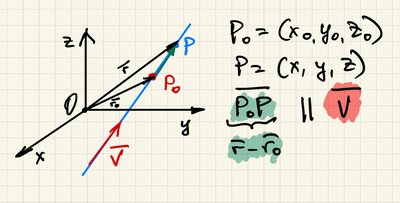
A point on the line, P0 = (x0, y0, z0)
A direction vector, \( \vec{v} = a\hat{i} + b\hat{j} + c\hat{k} \)
If a point P = (x, y, z) lies on the line, then the vector \( \overrightarrow{P_0P} = (x-x_0, y-y_0, z-z_0) \) must be parallel to \( \vec{v} \). Thus,
\( \overrightarrow{P_0P} = t \vec{v} \) for some scalar parameter t
Or, \( \vec{r} = \vec{r}_0 + t\vec{v} \)
In component form, the equations are:
\[ \begin{cases} x = x_0 + at \\ y = y_0 + bt \\ z = z_0 + ct \end{cases} \]
Alternatively, eliminating t (assuming a, b, c ≠ 0):
\[ \frac{x - x_0}{a} = \frac{y - y_0}{b} = \frac{z - z_0}{c} \]
If a = 0, but b and c are not zero:
\[ \frac{y - y_0}{b} = \frac{z - z_0}{c}, \quad x = x_0 \]
Example: Intersection of Two Planes
Example 3: Find the standard form equation for the line of intersection of the planes x + y − z = 0 and y + 2z = 6.
Solution:
Normals: \( \vec{n}_1 = (1, 1, -1) \), \( \vec{n}_2 = (0, 1, 2) \)
Direction vector: \( \vec{v} = \vec{n}_1 \times \vec{n}_2 = (3, -2, 1) \)
Find a point on the line by solving the system:
x0 + y0 − z0 = 0
y0 + 2z0 = 6
One solution: (3, 0, 3)
Standard form equation:
\( \frac{x-3}{3} = \frac{y}{-2} = \frac{z-3}{1} \)
Alternative solution: (0, 2, 2) yields \( \frac{x}{3} = \frac{y-2}{-2} = \frac{z-2}{1} \)
Additional info: The intersection of two non-parallel planes is always a line, and the direction vector of this line is given by the cross product of the planes' normal vectors.
