 Back
Planes and Quadratic Surfaces in Three-Dimensional Space
Study Guide - Smart Notes
 Tailored notes based on your materials, expanded with key definitions, examples, and context.
Planes in Three-Dimensional Space
Coordinate Planes and Parallel Planes
In three-dimensional space, the coordinate planes are fundamental reference surfaces: the xy-plane, yz-plane, and xz-plane. Planes parallel to these coordinate planes can be described by equations of the form x = a, y = b, or z = c, where a, b, and c are constants.
xy-plane: Defined by z = 0
yz-plane: Defined by x = 0
xz-plane: Defined by y = 0
Parallel planes: For example, x = 2 is a plane parallel to the yz-plane.

General Equation of a Plane
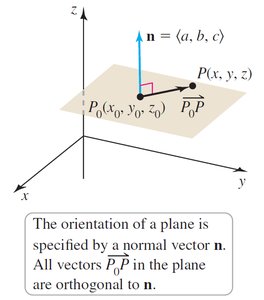
A general plane in space can be described by its normal vector and a point through which it passes. The normal vector n = (a, b, c) is perpendicular to the plane, and the plane passes through the point P0(x0, y0, z0). The equation for the plane is:
Point-normal form:
General form:
All vectors lying in the plane are orthogonal to the normal vector.
Parallel and Orthogonal Planes
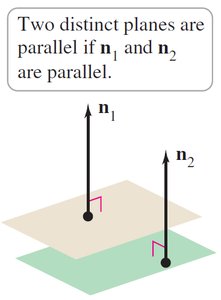
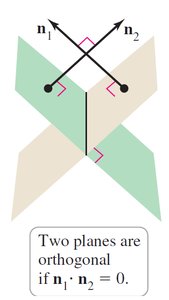
Two planes are parallel if their normal vectors are parallel, and they are orthogonal if their normal vectors are perpendicular (dot product is zero).
Parallel planes:
Orthogonal planes:
Surfaces in Three-Dimensional Space
Definition and Types of Surfaces
The graph of a three-dimensional equation is called a surface. Surfaces can be planes or more complex shapes such as quadratic surfaces. Quadratic surfaces are the three-dimensional analogs of conic sections and are described by second-degree equations.
Plane: Linear equation in x, y, z
Quadratic surface: Second-degree equation in x, y, z
Quadratic Surfaces (Quadric Surfaces)
Quadratic surfaces are defined by equations of the form:
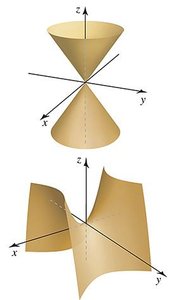
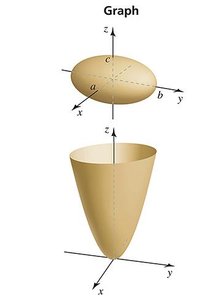
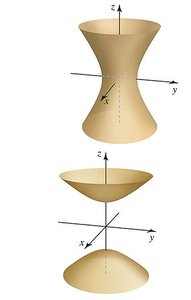
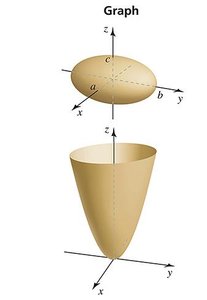
Common types include ellipsoids, hyperboloids, paraboloids, and cones.
Traces of Surfaces
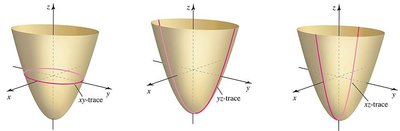
A trace of a surface is the set of points where the surface intersects a plane parallel to one of the coordinate planes. Traces help visualize and sketch surfaces by examining their cross-sections.
xy-trace: Intersection with the plane z = constant
yz-trace: Intersection with the plane x = constant
xz-trace: Intersection with the plane y = constant
Graphing Surfaces
To graph a surface in three dimensions:
Identify the number of variables in the equation.
Find the x, y, and z intercepts.
Draw the traces in the coordinate planes.
Sketch the surface using the traces and intercepts as guides.
Examples include graphing ellipsoids, hyperboloids, and paraboloids using their traces and intercepts.
Examples of Quadratic Surfaces
Ellipsoid:
Hyperboloid of one sheet:
Hyperboloid of two sheets:
Elliptic paraboloid:
Hyperbolic paraboloid:
Elliptic cone:
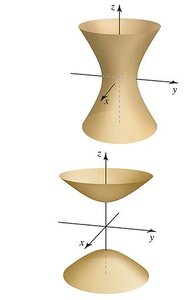
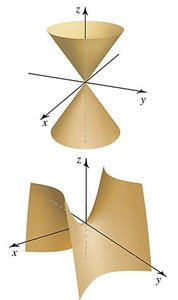
Summary Table: Common Quadratic Surfaces
Surface Type | General Equation | Key Features |
|---|---|---|
Ellipsoid | Closed surface, all cross-sections are ellipses | |
Hyperboloid (one sheet) | Open surface, cross-sections are hyperbolas and ellipses | |
Hyperboloid (two sheets) | Open surface, two separate sheets | |
Elliptic Paraboloid | Parabolic cross-sections, bowl-shaped | |
Hyperbolic Paraboloid | Saddle-shaped surface | |
Elliptic Cone | Conical surface, cross-sections are ellipses |
