 Back
BackPower Series: Definitions, Convergence, and Applications
Study Guide - Smart Notes
 Tailored notes based on your materials, expanded with key definitions, examples, and context.
Section 9.7 Power Series
Definition of Power Series
A power series is an infinite series of the form:
About x = 0 (Maclaurin series):
About x = a (Taylor series):
Here, a is the center of the series, and the cn are constant coefficients. Power series are used to represent functions as infinite polynomials, which can be useful for approximation and analysis.
Polynomial Approximations of Power Series
Partial sums of a power series (polynomial approximations) can be used to approximate the function represented by the series. As more terms are included, the approximation improves within the interval of convergence.
y0 = 1 (constant term)
y1 = 1 + x (linear approximation)
y2 = 1 + x + x^2 (quadratic approximation)
... and so on, up to higher-degree polynomials.
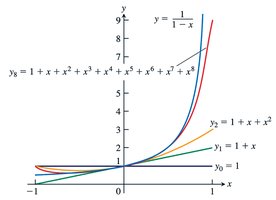
Example: The function can be represented by the power series for .
Convergence of Power Series
A power series may converge (sum to a finite value) for some values of x and diverge for others. The set of x values for which the series converges is called the interval of convergence.
Absolute Convergence: The series converges absolutely if converges.
Radius of Convergence (R): There exists a number R such that the series converges absolutely for and diverges for .
At the endpoints , convergence must be checked separately.
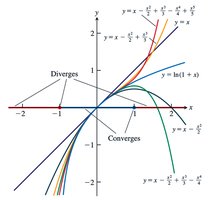
Theorem 18: Convergence Theorem for Power Series
If the power series converges at , then it converges absolutely for all with . If it diverges at , then it diverges for all $x$ with .
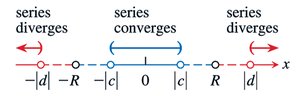
Corollary to Theorem 18: Radius and Interval of Convergence
The convergence of a power series is described by one of three cases:
There is a positive number R such that the series diverges for but converges absolutely for .
The series may or may not converge at the endpoints .
The series converges absolutely for every (i.e., ).
The series converges only at ().
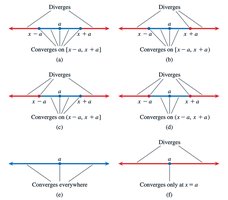
How to Test a Power Series for Convergence
To determine where a power series converges:
Use the Ratio Test (or Root Test) to find the largest open interval where the series converges absolutely.
If the radius of convergence R is finite, test for convergence or divergence at each endpoint using the Comparison Test, Integral Test, or Alternating Series Test.
If , the series diverges because the nth term does not approach zero.
Theorem 19: Series Multiplication for Power Series
If two power series and converge absolutely for , then their product also converges absolutely to the product of the sums for $|x-a| < R$.
Theorem 20: Continuity and Power Series
If converges absolutely for and is a continuous function, then converges absolutely on the set of points where $|x-a| < R$.
Theorem 21: Term-by-Term Differentiation Theorem
If has radius of convergence , then it defines a function on with derivatives of all orders inside the interval. The derivatives can be found by differentiating the series term by term:
... and so on.
Each derived series converges at every point of the interval .
Theorem 22: Term-by-Term Integration Theorem
If converges for , then the series obtained by integrating term by term also converges for $|x-a| < R$:
Summary Table: Possibilities for Interval of Convergence
Case | Interval of Convergence | Description |
|---|---|---|
(a) | None | Diverges everywhere except at center |
(b) | [x-a, x+a] | Converges on closed interval |
(c) | (x-a, x+a] | Converges on half-open interval |
(d) | [x-a, x+a) | Converges on half-open interval |
(e) | All real numbers | Converges everywhere |
(f) | x = a | Converges only at center |
