 Back
BackPrecise Definitions of Limits (Epsilon-Delta Definition)
Study Guide - Smart Notes
 Tailored notes based on your materials, expanded with key definitions, examples, and context.
Precise Definitions of Limits
Introduction to the Epsilon-Delta Definition
The concept of a limit is foundational in calculus, providing a rigorous way to describe how a function behaves as its input approaches a particular value. The epsilon-delta definition formalizes the idea of a limit, ensuring mathematical precision and clarity.
Objective: Understand and apply the precise (epsilon-delta) definition of a limit.
Key Idea: For a function f(x), the statement means that as x gets arbitrarily close to a (but not equal to a), f(x) gets arbitrarily close to L.
Formal Definition of a Limit
The precise definition of a limit uses two variables: epsilon () and delta (). These represent how close f(x) must be to L and how close x must be to a, respectively.
For every , there exists a such that if , then .
This definition ensures that f(x) can be made as close as desired to L by taking x sufficiently close to a (but not equal to a).
Mathematical Statement:
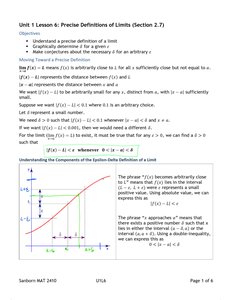
Understanding the Components of the Epsilon-Delta Definition
Epsilon (): Represents how close f(x) must be to the limit L.
Delta (): Represents how close x must be to a (excluding a itself).
The phrase "for every " means the definition must work for all possible degrees of closeness.
The phrase "there exists a " means we can always find a suitable interval around a for each .
Applying the Epsilon-Delta Definition
Step-by-Step Process
To prove a limit using the epsilon-delta definition, follow these steps:
Let be given.
Find a (possibly in terms of ) such that if , then .
Show that this works for the given .
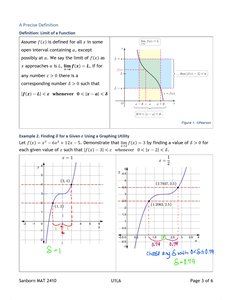
Example: Finding Delta for a Given Epsilon
Suppose . For a specific function, we may be asked to find a value of for a given .
Example: Let , , . For , find such that whenever .
Solution: Solve for near 2 to find a suitable .
Symmetric Intervals and the Role of Delta
The inequality means that lies within a symmetric interval around , but not at $a$ itself. This interval is .
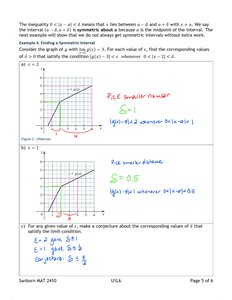
Practice Problems and Further Examples
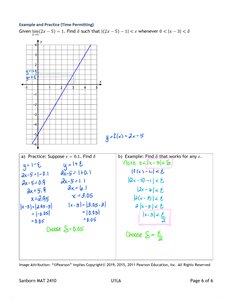
Given , find such that whenever .
For , , , solve for and verify the relationship between and $\delta$.
Generalize the process for any linear function .
Summary Table: Epsilon-Delta Relationships
Function | Limit Statement | Given | Calculated |
|---|---|---|---|
0.5 | 0.11 (approx.) | ||
0.1 | 0.05 | ||
0.05 | 0.025 |
Additional info: The table above summarizes the relationship between and for common functions, illustrating how $\delta$ is chosen based on the function's behavior near the point of interest.
Conclusion
The epsilon-delta definition provides a rigorous foundation for understanding limits in calculus. Mastery of this concept is essential for further study in calculus, including continuity, derivatives, and integrals.
