 Back
Quadric Surfaces and Traces: Study Guide for Calculus Students
Study Guide - Smart Notes
 Tailored notes based on your materials, expanded with key definitions, examples, and context.
Quadric Surfaces and Their Traces
Vector and Parametric Equations of Lines in ℝ3
In three-dimensional space, lines can be described using vector and parametric equations. These forms are foundational for understanding intersections and relationships between geometric objects.
Vector Equation: The line passing through point P0(x0, y0, z0) in the direction of vector v = ⟨a, b, c⟩ is given by: where .
Parametric Equations: Equivalent form: for .
Equations of Planes in ℝ3
A plane in three-dimensional space is defined by a point and a normal vector. The equation is derived from the dot product.
Plane Definition: The set of points P for which the vector P0P is orthogonal to the normal vector n.
General Plane Equation: where are real numbers and not all of are zero.
Intersection of Lines and Planes
To determine if a line and a plane intersect, substitute the parametric equations of the line into the plane equation and solve for . If the resulting equation is impossible (e.g., ), the line and plane do not intersect and may be parallel.
Quadric Surfaces
Definition and General Equation
Quadric surfaces are three-dimensional analogues of conic sections, described by a general quadratic equation in three variables:
General Quadric Equation: where are constants and not all of are zero.
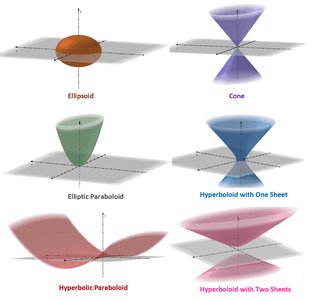
Quadric surfaces include ellipsoids, cones, paraboloids, and hyperboloids.
Conic Sections and Their Equations
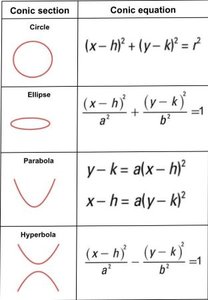
Conic sections are the two-dimensional curves obtained by slicing a cone. Their equations are fundamental for understanding traces of quadric surfaces.
Conic section | Conic equation |
|---|---|
Circle | |
Ellipse | |
Parabola |
|
Hyperbola |
Traces of Quadric Surfaces
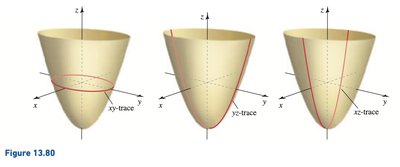
Traces are the curves formed by intersecting a quadric surface with a plane parallel to one of the coordinate planes. These traces are often conic sections and help visualize the surface.
Example: Sphere
xy-trace (set ): (circle)
yz-trace (set ): (circle)
xz-trace (set ): (circle)
All traces are circles of radius 1 centered at the origin.
Example: Hyperboloid of One Sheet
xz-trace (set ): (hyperbola)
xy-trace (set ): (circle)
yz-trace (set ): (hyperbola)
The surface is a hyperboloid of one sheet.
Identifying and Drawing Quadric Surfaces Using Traces
By analyzing traces in different coordinate planes, one can identify the type of quadric surface. This method is useful for visualizing and sketching surfaces, especially when memorization of standard forms is incomplete.
Example: Cone
Traces parallel to the xy-plane (set ): For : (two intersecting lines). For : hyperbola.
Traces parallel to the yz-plane (set ): (ellipse).
Traces parallel to the xz-plane (set ): (hyperbola if , pair of lines if ).
The surface is a cone.
Cylinders and Paraboloids
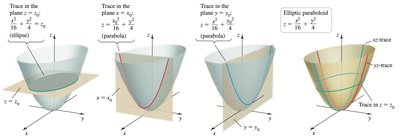
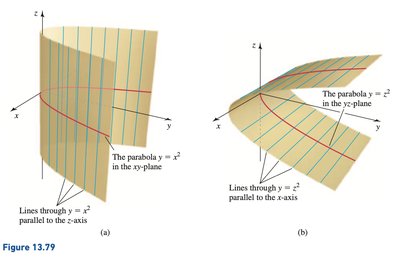
Cylinders and paraboloids are special cases of quadric surfaces. Cylinders are generated by lines parallel to a given axis passing through a curve, while paraboloids are surfaces with parabolic traces.
Cylinder: A surface formed by lines parallel to an axis passing through a given curve.
Elliptic Paraboloid: A surface with elliptical and parabolic traces, described by .
Additional info: Understanding traces is essential for visualizing quadric surfaces and is foundational for later topics in multivariable calculus, such as integration over surfaces.
