 Back
BackRules of Differentiation: Power, Constant Multiple, Sum, and Higher-Order Derivatives
Study Guide - Smart Notes
 Tailored notes based on your materials, expanded with key definitions, examples, and context.
Rules of Differentiation
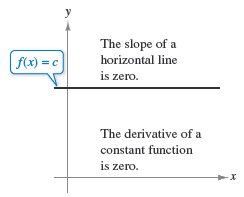
Derivative of a Constant Function
The derivative of a constant function is a fundamental concept in calculus. If f(x) = c, where c is a constant, the slope of the graph is always zero, indicating a horizontal line.
Key Point: The derivative of a constant function is zero.
Formula:
Example: If f(x) = 5, then .
Power Rule
The power rule is used to differentiate functions of the form x^n, where n is a nonnegative integer. This rule provides a shortcut to finding derivatives without using the limit definition.
Key Point: The derivative of x^n is n x^{n-1}.
Formula:
Example:

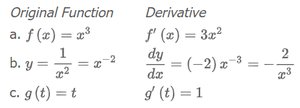
Examples of the Power Rule
f(x) = x^3:
y = \frac{1}{x^2} = x^{-2}:
g(t) = t:
Application: Slope of the Graph
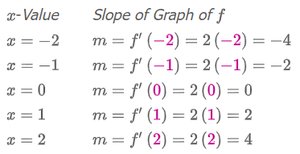
The derivative gives the slope of the tangent line to the graph at any point. For f(x) = 2x, the slope at various points is:
x-Value | Slope of Graph of f |
|---|---|
x = -2 | m = f'(-2) = 2(-2) = -4 |
x = -1 | m = f'(-1) = 2(-1) = -2 |
x = 0 | m = f'(0) = 2(0) = 0 |
x = 1 | m = f'(1) = 2(1) = 2 |
x = 2 | m = f'(2) = 2(2) = 4 |
Constant Multiple Rule
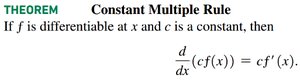
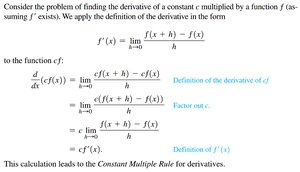
The constant multiple rule states that the derivative of a constant times a function is the constant times the derivative of the function. This rule applies whether the constant is in the numerator or denominator.
Key Point: You can factor out a constant before differentiating.
Formula:
Example:
Constant in the Denominator
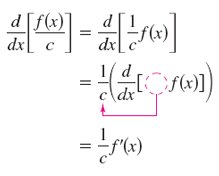
Key Point: If the constant is in the denominator, the rule still applies.
Formula:
Examples: Constant Multiple Rule
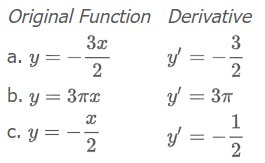
Original Function | Derivative |
|---|---|
y = -\frac{3x}{2} | y' = -\frac{3}{2} |
y = 3\pi x | y' = 3\pi |
y = -\frac{x}{2} | y' = -\frac{1}{2} |
Combining Power and Constant Multiple Rules
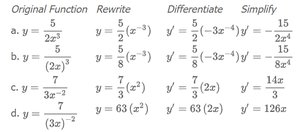
Original Function | Rewrite | Differentiate | Simplify |
|---|---|---|---|
y = \frac{5}{2x^3} | y = \frac{5}{2} x^{-3} | y' = \frac{5}{2}(-3x^{-4}) | y' = \frac{-15}{2x^4} |
y = \frac{5}{8}(2x)^{-3} | y = \frac{5}{8}(2x)^{-3} | y' = \frac{5}{8}(-3(2x)^{-4}) | y' = \frac{-15}{8x^4} |
y = \frac{7}{3x^{-2}} | y = 7(3x^2) | y' = 7(2x) | y' = 14x/3 |
y = \frac{7}{(3x)^{-2}} | y = 63(x^2) | y' = 63(2x) | y' = 126x |
Differentiating Radicals
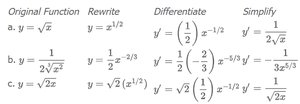
Radical expressions can be rewritten as power functions to apply the power rule. For example, .
Original Function | Rewrite | Differentiate | Simplify |
|---|---|---|---|
y = \sqrt{x} | y = x^{1/2} | y' = \frac{1}{2} x^{-1/2} | y' = \frac{1}{2\sqrt{x}} |
y = \frac{1}{2\sqrt{x^3}} | y = \frac{1}{2} x^{-2/3} | y' = \frac{1}{2}(-\frac{2}{3} x^{-5/3}) | y' = -\frac{1}{3x^{5/3}} |
y = \sqrt{2x} | y = \sqrt{2}(x^{1/2}) | y' = \sqrt{2}(\frac{1}{2} x^{-1/2}) | y' = \frac{1}{\sqrt{2x}} |
Sum and Difference Rules
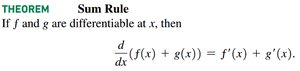
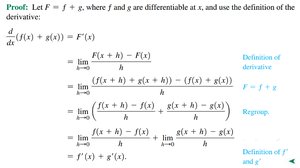
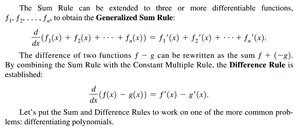
The sum rule states that the derivative of a sum is the sum of the derivatives. The difference rule is a direct extension, stating that the derivative of a difference is the difference of the derivatives.
Sum Rule Formula:
Difference Rule Formula:
Generalized Sum Rule:
Derivative of the Exponential Function
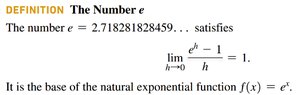
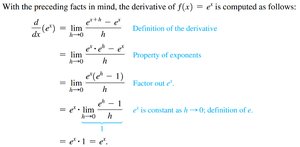
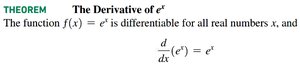
The number e is a mathematical constant approximately equal to 2.71828. It is the base of the natural exponential function. The derivative of e^x is unique because it is equal to itself.
Definition:
Derivative Formula:
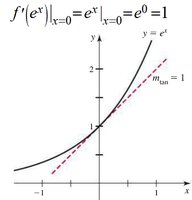
Example: The slope of the tangent line to y = e^x at x = 0 is 1.
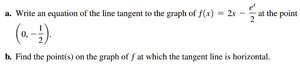
Applications: Tangent Lines and Horizontal Tangents
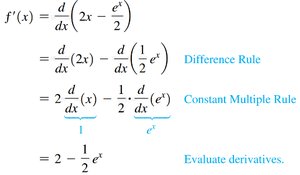
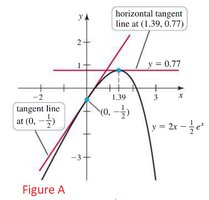
Derivatives are used to find equations of tangent lines and points where the tangent is horizontal (slope zero).
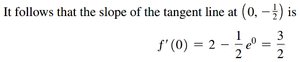
Example: For f(x) = 2x - \frac{e^x}{2}, the slope at (0, -1/2) is .
Tangent Line Equation:
Horizontal Tangent: Occurs where .

Higher-Order Derivatives
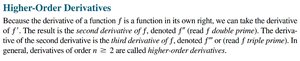
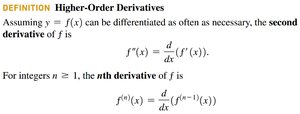
Higher-order derivatives are derivatives taken multiple times. The second derivative is the derivative of the first derivative, and so on. These are useful for analyzing the curvature and concavity of functions.
Key Point: The nth derivative of an nth-degree polynomial is a constant; derivatives of order k > n are zero.
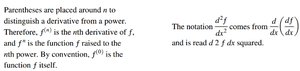
Notation: (second derivative), (third derivative), (nth derivative)
Formula:
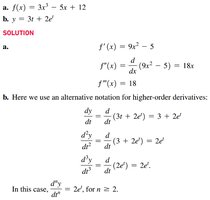
Example: For , ,

Additional info: The notes cover the main differentiation rules (power, constant multiple, sum, difference), applications to tangent lines, and higher-order derivatives, with examples and proofs. All images included directly reinforce the mathematical concepts and examples discussed.
