 Back
Section 3.3: Differentiation Rules – Comprehensive Study Notes
Study Guide - Smart Notes
 Tailored notes based on your materials, expanded with key definitions, examples, and context.
Section 3.3 Differentiation Rules
Definition of the Derivative
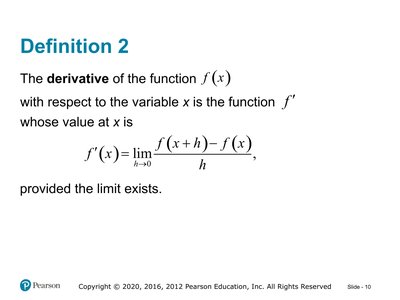
The derivative of a function f(x) with respect to the variable x is a fundamental concept in calculus, representing the instantaneous rate of change of the function at a given point. The derivative is defined as:
Definition: The derivative of f(x) at x is given by the limit:
Existence: The limit must exist for the derivative to be defined at x.
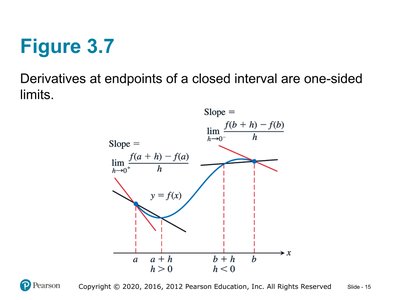
One-Sided Derivatives at Endpoints
At the endpoints of a closed interval, derivatives are defined using one-sided limits. This is necessary because the function may not be defined on both sides of the endpoint.
Left Endpoint: The derivative at a uses the right-hand limit.
Right Endpoint: The derivative at b uses the left-hand limit.
Non-Differentiable Points
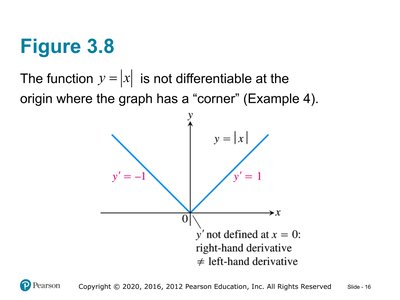
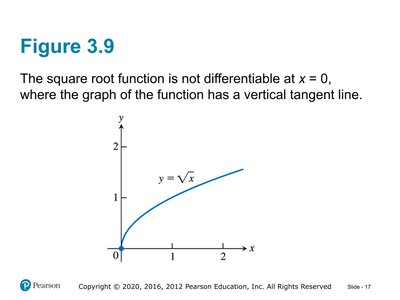
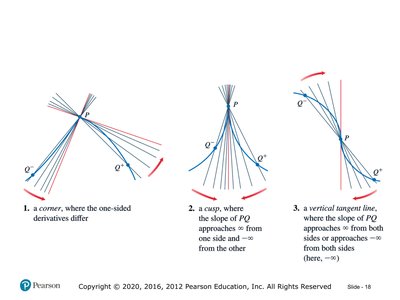
Some functions are not differentiable at certain points due to discontinuities, corners, cusps, or vertical tangent lines.
Corner: The function y = |x| is not differentiable at x = 0 because the left and right derivatives are not equal.
Cusp: The slope approaches infinity from opposite directions.
Vertical Tangent: The slope approaches infinity from both sides.
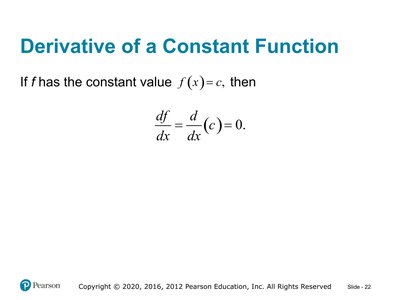
Derivative of a Constant Function
A constant function has a derivative of zero everywhere, since its value does not change.
Formula: If f(x) = c, then:
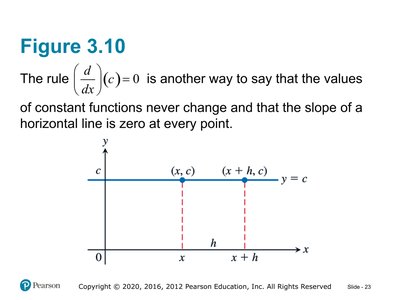
Graphical Interpretation
The slope of a horizontal line (constant function) is zero at every point.
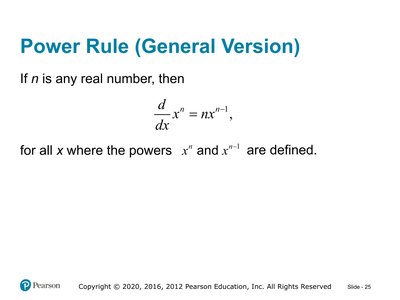
Power Rule for Derivatives
The power rule is a fundamental rule for differentiating functions of the form xn, where n is any real number.
Formula:
Valid for all x where x^n and x^{n-1} are defined.
Derivative Constant Multiple Rule
If u is a differentiable function and c is a constant, the derivative of the product is the constant times the derivative of the function.
Formula:
Derivative Sum Rule
The sum rule states that the derivative of the sum of two differentiable functions is the sum of their derivatives.
Formula:
Derivative Product Rule
The product rule is used to differentiate the product of two functions.
Formula:
Derivative Quotient Rule
The quotient rule is used to differentiate the quotient of two functions, provided the denominator is not zero.
Formula:
Summary Table: Differentiation Rules
Rule | Formula |
|---|---|
Constant Rule | |
Power Rule | |
Constant Multiple Rule | |
Sum Rule | |
Product Rule | |
Quotient Rule |
Examples and Applications
Example 1: Differentiate f(x) = x^3 using the power rule:
Example 2: Differentiate f(x) = 5x^2 using the constant multiple rule:
Example 3: Differentiate f(x) = x^2 + 3x using the sum rule:
Example 4: Differentiate f(x) = x^2 \cdot x^3 using the product rule:
Example 5: Differentiate f(x) = \frac{x^2}{x^3} using the quotient rule:
Additional info: Academic context and examples were added to ensure completeness and clarity for exam preparation.
