 Back
Section 3.4: The Derivative as a Rate of Change – Motion, Velocity, and Acceleration
Study Guide - Smart Notes
 Tailored notes based on your materials, expanded with key definitions, examples, and context.
Section 3.4: The Derivative as a Rate of Change
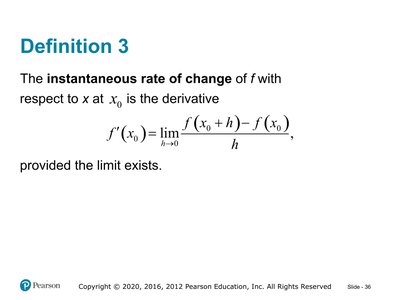
Instantaneous Rate of Change
The instantaneous rate of change of a function f with respect to x at a point x_0 is defined as the derivative of f at x_0. This concept is fundamental in calculus, as it describes how a quantity changes at a specific instant.
Definition: The derivative of f at x_0 is given by:
Key Point: The limit must exist for the derivative to be defined.
Position and Displacement in Motion
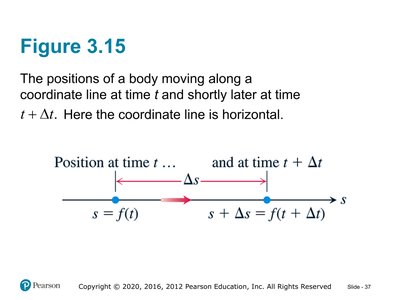
When analyzing the motion of a body along a coordinate line, its position at time t is described by s = f(t). The displacement over a time interval is the change in position.
Position at time t:
Position at time t + \Delta t:
Displacement:
Velocity (Instantaneous Velocity)
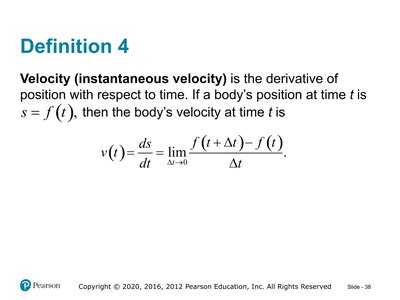
Velocity is the rate of change of position with respect to time. The instantaneous velocity at time t is the derivative of the position function s = f(t) with respect to t.
Definition:
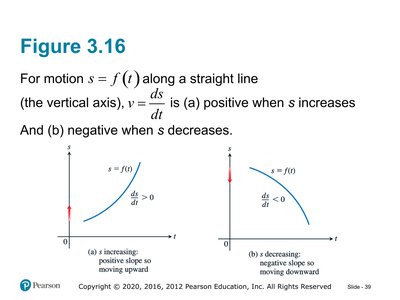
Interpretation: Velocity is positive when the position increases, negative when it decreases.
Graphical Interpretation of Velocity
The sign of the derivative indicates the direction of motion. If , the object moves upward (position increases). If , the object moves downward (position decreases).
Positive velocity: Moving upward, slope is positive.
Negative velocity: Moving downward, slope is negative.
Acceleration and Jerk
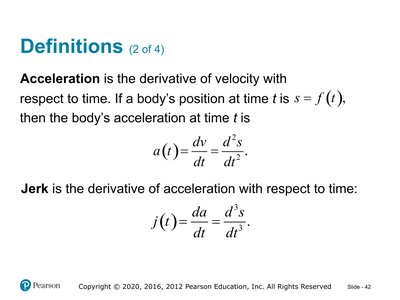
Acceleration is the rate of change of velocity with respect to time, and is the second derivative of position. Jerk is the rate of change of acceleration, or the third derivative of position.
Acceleration:
Jerk:
Velocity Graphs and Motion Analysis
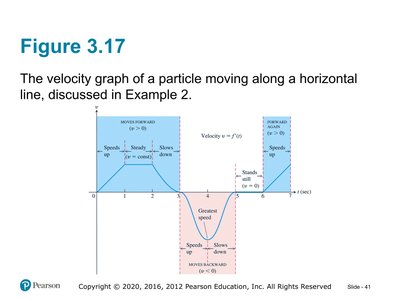
Velocity graphs provide insight into the motion of a particle. The sign and slope of the velocity function indicate whether the particle is speeding up, slowing down, moving forward, or backward.
Speeding up: When velocity and acceleration have the same sign.
Slowing down: When velocity and acceleration have opposite signs.
Greatest speed: Occurs at points where the absolute value of velocity is maximized.
Standing still: Velocity is zero.
Applications: Motion Problems
Typical calculus problems involving motion include finding displacement, average velocity, speed, acceleration, and determining when a body changes direction. These require understanding and applying derivatives to position functions.
Displacement:
Average velocity:
Speed at endpoints:
Acceleration at endpoints:
Change in direction: Occurs when velocity changes sign.
Example: If a rock is thrown upward with a velocity of 24 m/s, its position function can be analyzed to find velocity, acceleration, time to reach the highest point, and maximum height.
Additional info: These concepts are foundational for understanding motion in physics and engineering, and are directly related to Chapter 4: Applications of Derivatives in Calculus.
